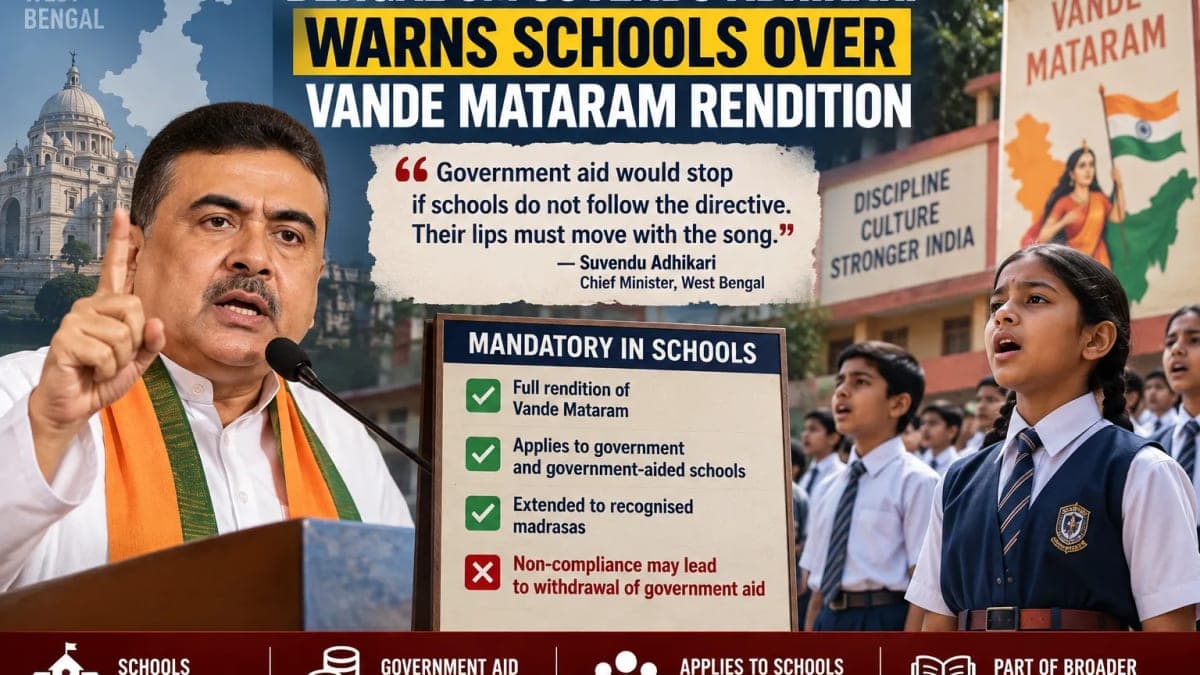
Suvendu Adhikari Warns Bengal Schools of Aid Cut Over Full Vande Mataram Rendition
West Bengal Chief Minister Suvendu Adhikari has issued a strong warning to schools over compliance with his government's requirement for the full rendition of Vande Mataram, saying institutions receiving government assistance could lose that support if they refuse to follow the directive.
Adhikari made the remarks on Thursday, September 3, while addressing an annual programme of the Vivekananda Vidya Bharati Vikas Parishad, an RSS-affiliated organisation, at the Ramakrishna Mission Institute of Culture in Golpark, Kolkata.
The Chief Minister said that merely standing during the rendition would not amount to compliance and stressed that students were expected to participate in singing the song.
His comments bring renewed attention to a policy introduced by the new West Bengal government earlier this year and to the wider debate surrounding the implementation of Vande Mataram in educational institutions.
‘Government Aid Would Stop,’ Says Adhikari
Speaking at the event, Adhikari said there had been resistance in some quarters to singing the complete version of Vande Mataram.
“A few people had objected to singing the complete rendition of Vande Mataram. I told them that government aid would stop,” Adhikari said, according to PTI.
He said the response initially amounted to only partial compliance.
“They stood up, but did not move lips,” he said.
The Chief Minister then made his expectation explicit, saying: “Their lips must move with the song.”
The warning indicates that the government is prepared to link compliance with its Vande Mataram policy to the financial assistance and other support received by schools.
Bengal Government Made Vande Mataram Mandatory in May
The latest warning follows a policy change introduced soon after the Suvendu Adhikari-led government assumed office.
In May 2026, the West Bengal School Education Department issued an order making the singing of Vande Mataram during morning assembly mandatory in schools under the department.
The order required the song to be performed during assembly prayers before regular classes begin.
Adhikari had initially announced that the requirement would apply to government and government-aided schools, while private institutions were asked to adopt the practice as well.
The policy subsequently became one of the new government's most visible education-related decisions.
Order Was Later Extended to Madrasas
The policy was subsequently expanded beyond conventional schools.
Later in May, the West Bengal government made the rendition of Vande Mataram mandatory in recognised aided and unaided madrasas under the state's Minority Affairs and Madrasah Education Department.
Reports at the time said the government required the six stanzas of Vande Mataram to be sung before classes.
That decision generated opposition from the All India Muslim Personal Law Board (AIMPLB), which called for the notification to be withdrawn or for Muslim students to be exempted.
The AIMPLB's position represents the organisation's objection to the policy; it does not by itself determine the legal validity of the state government's directive.
Adhikari Links Policy to Education Reforms
The Chief Minister placed the Vande Mataram requirement within his government's broader approach to education.
During Thursday's speech, Adhikari alleged that West Bengal's education system had been “brought to the brink of destruction” under previous governments.
That characterisation is a political claim made by the Chief Minister rather than an independently established assessment of the state's education system.
Adhikari said the BJP government was pursuing reforms intended to restore Indian culture, traditions and nationalist values in education.
His remarks indicate that the Vande Mataram policy is being presented by the government not as an isolated administrative requirement but as part of a wider ideological and educational programme.
1,000 Vidya Bharati Schools Planned Across Bengal
At the same event, Adhikari announced another significant education initiative.
The Chief Minister said the state aims to establish at least 1,000 schools associated with Vidya Bharati, the RSS-linked education network, across West Bengal within a year.
The proposed expansion would cover districts, municipalities and panchayats across the state.
According to reporting on the announcement, Vidya Bharati currently has 313 schools in West Bengal.
Adhikari said the proposed schools would promote what he described as “nationalistic learning.”
If implemented on the announced scale and timetable, the initiative would represent a substantial expansion of the Vidya Bharati network in the state.
Government Also Signals Changes to Education Administration
Adhikari also outlined plans for structural changes in the administration of education.
He proposed bringing West Bengal's four existing education departments under a unified administrative structure.
The proposed restructuring would mean that madrasa education would no longer have a separate administrative arrangement.
These plans, alongside the Vande Mataram directive and proposed expansion of Vidya Bharati schools, point toward a broader attempt by the government to reshape both the administrative structure and cultural orientation of education in West Bengal.
Why the ‘Lips Must Move’ Remark Matters
The latest statement is significant because it moves the controversy beyond whether schools formally include Vande Mataram in their morning assemblies.
Adhikari's remarks indicate an expectation of active participation, rather than simply standing while the song is performed.
His warning about government aid also raises a separate question about enforcement: how the state would assess compliance and what administrative procedure would precede any withdrawal of financial assistance.
The reports reviewed for this article quote the Chief Minister's warning but do not provide details of a specific school whose funding has already been withdrawn under the policy.
That distinction is important. Adhikari has threatened withdrawal of aid for non-compliance; that does not mean funding cuts have already been imposed on schools.
Vande Mataram Remains a Powerful National Symbol
Written by Bankim Chandra Chattopadhyay, Vande Mataram has a particularly deep connection with Bengal.
It appeared in his Bengali novel Anandamath and later became closely associated with India's freedom movement.
The Constituent Assembly adopted Jana Gana Mana as India's National Anthem on January 24, 1950, while Vande Mataram has the status of the country's National Song.
Its historical importance makes the song an enduring national symbol. At the same time, requirements surrounding its rendition have periodically generated political, religious and constitutional debate.
What Happens Next
Adhikari's September 3 warning signals that his government intends to enforce the Vande Mataram policy rather than treat it as a symbolic recommendation.
The immediate issue will be how the School Education Department translates the Chief Minister's warning into administrative practice, particularly in government-aided institutions.
For now, the confirmed development is clear: the Chief Minister has warned that schools refusing to comply with the full Vande Mataram rendition requirement could lose government aid and other support.
Whether the warning leads to actual funding withdrawals—and what process would be followed in individual cases—will depend on subsequent government action.