Son Makes Perilous Journey Through Flooded Village
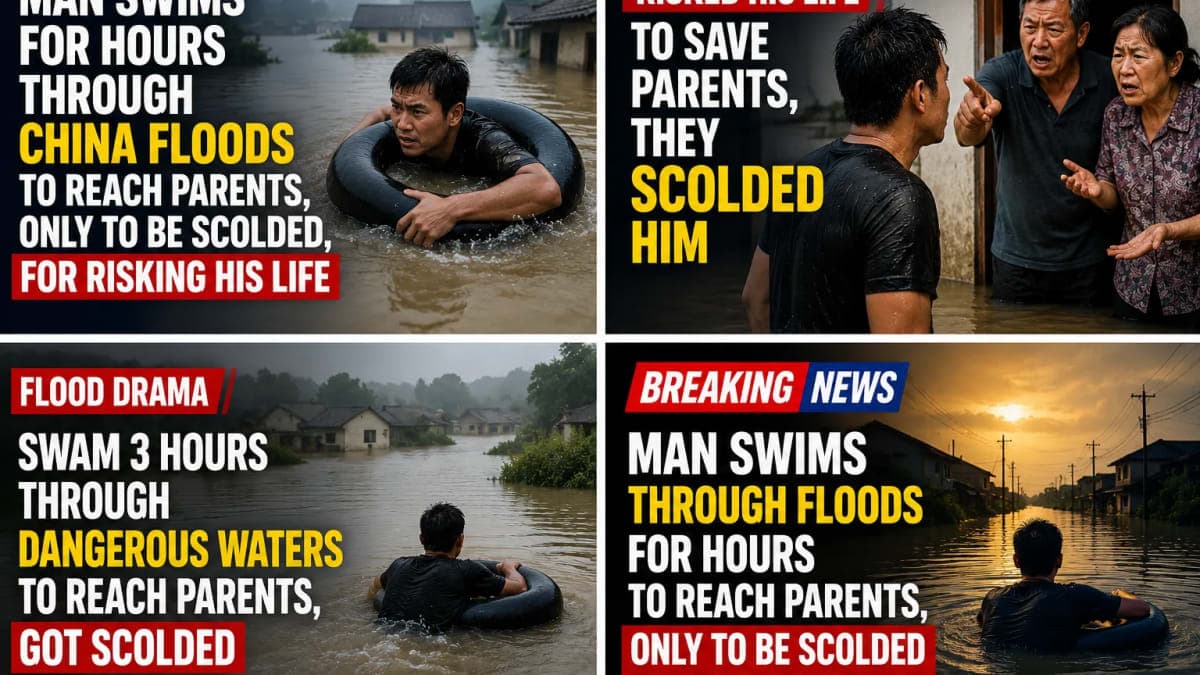
A man identified by his surname, Xie, undertook a dangerous journey through severe floodwaters in southern China after communication with his parents suddenly stopped.
The incident occurred on July 6 in Qinzhou, a city in the Guangxi Zhuang Autonomous Region. The area had been hit by intense rainfall, flooding and reported dam failures, leaving communities isolated and disrupting electricity and mobile-phone services.
Xie, 30, lived in town with his two siblings, while his parents remained in a village approximately 10 kilometres away. His concern intensified after his mother told him that his 63-year-old father had gone to protect harvested rice stored at the family’s flooded property and had not returned.
As water levels rose and phone signals failed, Xie was unable to confirm whether his father had reached safety. Fearing that he might have been swept away, he decided to travel to the village himself.
Truck Tyres Used as Improvised Flotation Devices
With roads and normal transport routes made unusable by flooding, Xie and a friend purchased two truck tyres and used them to stay afloat during the journey.
The pair reportedly spent close to three hours moving through the floodwater. The final kilometre was particularly difficult and took approximately one hour to cross.
Such improvised flotation may have helped them remain above water, but the journey still involved serious risks. Floodwater can conceal debris, strong currents, damaged structures, electrical hazards and sudden changes in depth.
Father Found Trapped in Flooded House
When Xie reached the family property, he found his father on an upper floor of the flooded house. The older man had reportedly entered the building in an effort to protect sacks of harvested rice as the water rose around the property.
Xie then helped guide his father along a narrow route behind the house toward another family home situated on higher ground. That second property had not been inundated.
The successful reunion brought relief, but it did not produce the reaction Xie may have expected.
His father reportedly smiled when he saw him before scolding him for risking his life over stored rice. When Xie’s mother saw him arrive completely soaked, she became emotional and also reprimanded him for making such a dangerous journey.
Their response appeared to reflect fear rather than ingratitude. Although Xie had travelled to protect them, his parents were alarmed that their son might have died while attempting to reach the village.
He Swam Back After Confirming Their Safety
After ensuring that both parents were safe, Xie returned to the city later the same day.
The return journey reportedly involved another two hours of swimming through the flooded area, taking his total time in the water to roughly five hours.
His actions attracted attention not only because of the physical endurance involved but also because they captured the desperation families can experience when disasters disrupt communication and cut off entire communities.
Background: Severe Flooding in Guangxi
The incident unfolded amid widespread flooding in Guangxi. Reports said the disaster had killed 39 people and affected nearly 400,000 residents.
Qinzhou reportedly received more than 800 millimetres of rainfall between July 3 and July 6, creating dangerous conditions across the region.
Power failures and damaged communication networks increased the uncertainty for families separated by floodwater. In Xie’s case, the inability to contact his parents became the immediate reason for his decision to make the journey.
The flooding also threatened homes, food supplies and agricultural livelihoods. The rice Xie’s father tried to protect was not merely household property; harvested crops can represent months of labour and an important source of food or income for rural families.
Why the Event Matters
The story highlights how quickly communication failures can influence personal decisions during natural disasters.
When telephone networks collapse, relatives may have no reliable way to determine whether family members are safe. That uncertainty can push people toward dangerous rescue attempts, particularly when official assistance is delayed or access routes are blocked.
The incident also demonstrates the emotional complexity of family responsibility. Xie apparently viewed the journey as necessary because he feared for his parents. His parents, however, saw his decision as an unacceptable risk to his own life.
Both reactions came from concern for family, even though they led to opposite conclusions.
Courage or Unnecessary Risk?
Xie’s determination is likely to be seen by many as an extraordinary act of devotion. He travelled for hours through hazardous conditions, located his father and helped him reach higher ground.
However, disaster-response experts generally discourage untrained individuals from entering floodwater. Even experienced swimmers may be overwhelmed by currents, submerged obstacles or contaminated water.
The use of truck tyres offered some buoyancy, but it did not remove the broader dangers. Xie and his friend could also have become additional victims requiring rescue.
The episode therefore raises an important distinction between courage and safe emergency response. An action can be brave and successful while still being extremely dangerous.
Balanced Analysis
The incident should not be reduced to a simple story of a heroic son and ungrateful parents.
Xie’s decision was shaped by a genuine fear that his father had disappeared during a major flood. With communication systems unavailable and the village cut off, waiting may have felt impossible.
At the same time, his parents’ criticism was understandable. They had survived the immediate danger, while their son had exposed himself to several hours of potentially deadly conditions.
Their scolding appears to have been an expression of relief, fear and parental concern. The family’s reactions show that acts of love during emergencies do not always look calm or celebratory.
The story also points to a wider public-policy challenge. Reliable warnings, emergency communication systems, evacuation support and organised rescue services can reduce the likelihood that residents or relatives will feel forced to conduct their own hazardous missions.
Lessons From the Incident
The episode offers several practical lessons for flood-prone communities.
Families should establish evacuation plans and identify higher ground before severe weather arrives. Important documents, medicines, communication equipment and emergency supplies should be prepared in advance.
People should avoid entering moving floodwater wherever possible. Even shallow water can become dangerous when currents are strong or the ground beneath it is unstable.
Communities also benefit from backup communication arrangements, including designated meeting locations and relatives outside the affected area who can coordinate information.
A Family Reunion Shaped by Fear and Relief
Xie’s journey ended safely, and his parents were found alive. That outcome turned a potentially tragic situation into a remarkable account of endurance and family devotion.
Yet the strongest message may have come from the parents who scolded him.
Their reaction suggested that no stored crop, building or possession was worth the possibility of losing their son. In a disaster that had already caused widespread destruction and loss of life, their anger was ultimately another expression of how much his safety mattered.