Teacher Aspirants Take Recruitment Protest to Mohan Yadav and Shivraj Chouhan in Bhopal
Introduction
After spending days protesting at Bhopal’s Neelam Park, teacher recruitment aspirants took their demands directly to two of Madhya Pradesh’s most influential political leaders on September 4.
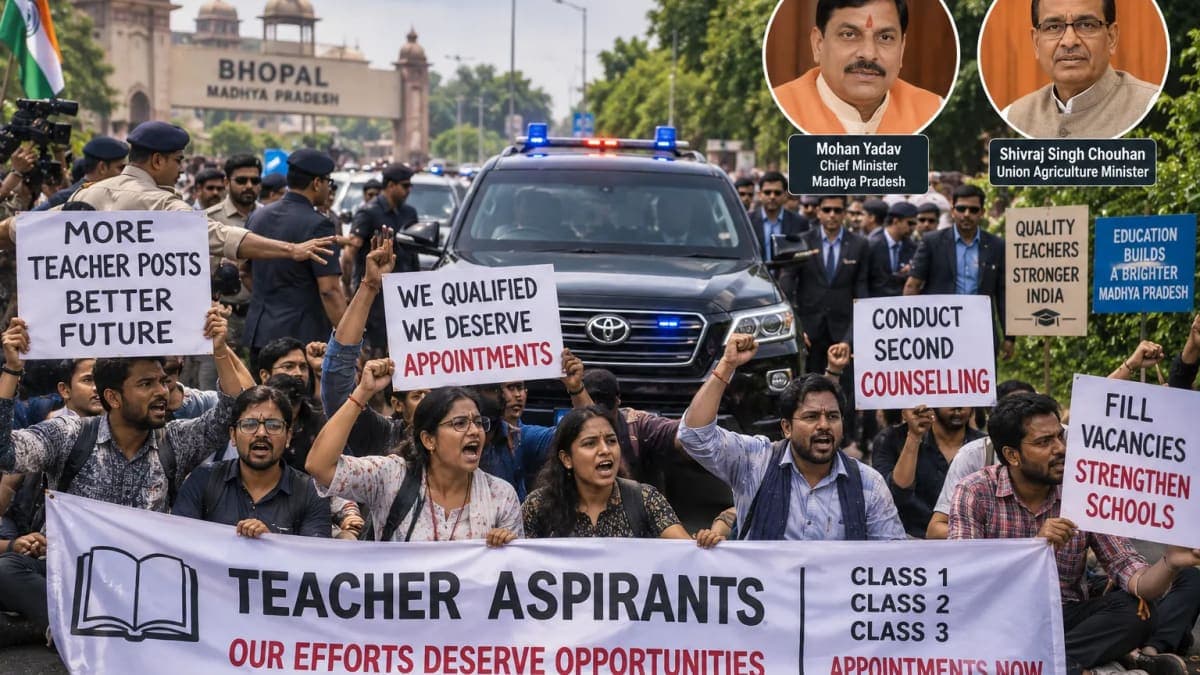
Candidates stopped the convoys of Chief Minister Mohan Yadav and Union Agriculture Minister Shivraj Singh Chouhan at separate locations in the state capital and handed over memoranda seeking more government teaching posts and further counselling.
The encounters were brief, but they brought a months-long recruitment dispute into sharper political focus. Candidates who have cleared selection examinations argue that the number of jobs being offered does not reflect the scale of vacancies in government schools. The state, meanwhile, has indicated that the number of positions available for immediate regular recruitment is considerably smaller than the headline vacancy figures suggest.
At the centre of the disagreement is a practical question: how many recorded vacancies will actually be converted into appointments?
Aspirants Approach Yadav and Chouhan
Class-1 teacher aspirants intercepted Chouhan’s convoy near Neelam Park and submitted a memorandum outlining their demands.
The candidates also appealed to him because the recruitment process at issue began while he was chief minister of Madhya Pradesh.
Separately, Class-2 and Class-3 candidates stopped Yadav’s convoy near Barkhedi and presented their demands to the chief minister.
The demonstrations brought together candidates from different teacher recruitment exercises, each with its own dispute over vacancies and appointments. What connects them is their demand for the government to expand recruitment rather than defer large numbers of candidates to a future selection cycle.
Class-1 Candidates Push for Second Counselling
For Class-1 aspirants, the dispute goes back to the 2023 High School Teacher Selection Examination.
Protesters say 8,720 posts were advertised under that recruitment exercise but only 2,901 appointments were made during the first counselling round. They maintain that counselling has yet to take place for the remaining 5,819 positions.
The candidates are demanding a second counselling round along with 10,000 additional Class-1 posts.
Those figures form part of the protesters’ case and should be distinguished from a current government statement confirming the precise number of posts still available.
The timing matters to candidates as much as the numbers. Recruitment exercises can be separated by long intervals, and aspirants approaching the upper age limit fear that waiting for another examination could effectively end their opportunity to secure a government teaching position.
By September 4, Class-1 candidates had been on hunger strike for 12 days.
Class-2 and Class-3 Groups Seek Bigger Recruitment Drive
Candidates from the other teaching categories have put forward their own demands.
Class-2 aspirants want at least 10,000 additional posts. They have also sought a minimum of 3,000 vacancies in each subject and another counselling round once the number of positions is increased.
Class-3 candidates are pressing for the primary teacher intake to be expanded to 25,000 posts.
The Class-2 and Class-3 groups had been demonstrating at Neelam Park for around 15 days by September 4, although their campaign over recruitment numbers had already been running for several months.
Rather than asking the government simply to announce another examination, candidates want existing recruitment exercises expanded so people who have already gone through the selection process can compete for additional vacancies.
Hunger Strike Adds Pressure
The protest has also involved a sustained hunger strike.
One participant, Kirti Jha, became unwell during the agitation and was taken to hospital again on September 4, according to local reports.
The episode added urgency to a demonstration that had otherwise been centred on recruitment rules, counselling schedules and vacancy calculations.
Despite Jha’s hospitalisation, candidates continued their protest.
Government and Aspirants Use Different Vacancy Measures
The most important context for the dispute lies in the difference between the number of vacancies recorded in government systems and the number of regular positions the state plans to fill.
School Education Minister Uday Pratap Singh said Madhya Pradesh plans to recruit against 18,000 teaching posts over two years, despite government records showing 72,950 vacancies.
He said the difference cannot be understood simply by comparing those two numbers. Around 70,000 to 72,000 guest teachers are already working in the system, while reservation-related factors also affect recruitment, including SC/ST backlog posts and the 13% OBC quota that remains on hold.
That explanation points to an important distinction in public-sector hiring: a recorded vacancy does not necessarily translate immediately into a position approved for regular recruitment.
The protesters, however, argue that the gap has become too large.
Candidates Cite Much Higher Vacancy Numbers
In their memorandum, aspirants have cited figures substantially above the vacancy total discussed by the education minister.
They claim that, as of December 27, 2024, the School Education Department had approximately 99,197 secondary-teacher vacancies and 131,152 primary-teacher vacancies.
Their memorandum also cites roughly 43,734 secondary and 54,625 primary vacancies in the Tribal Affairs Department.
These are figures presented by the protesting candidates and should not be read as independently verified current vacancy totals.
Their significance lies in the argument being made with them. Aspirants say that even allowing for guest teachers, reservation requirements and administrative constraints, the number of regular posts being opened for recruitment remains too small.
Protesters Want 15,000 Posts Added to Existing Process
Candidates have proposed a more immediate solution.
They want 15,000 teaching posts approved during the current budget session to be incorporated into the ongoing Class-2 and Class-3 recruitment processes.
From their perspective, that would serve two purposes: increase the number of available jobs and avoid another lengthy examination cycle for vacancies that could potentially be filled through candidates who have already completed the existing selection process.
Whether those posts can legally and administratively be folded into the current recruitment is a matter for the state government. Public-sector appointments must account for sanctioned strength, departmental requirements, reservation rules and other recruitment procedures.
That is where a seemingly straightforward argument over vacant classrooms becomes considerably more complicated.
Recruitment Numbers Now Carry Political Weight
The protests are no longer confined to examination procedures.
By stopping the convoys of Yadav and Chouhan, aspirants have pushed the disagreement directly into the political arena. They are asking the government not merely to acknowledge vacancies but to explain how those vacancies translate into regular jobs.
The state has its own calculation. Guest teachers already working in schools, reservation-related complications and the difference between recorded vacancies and sanctioned recruitment all affect how many permanent positions can be filled at a given time.
Candidates see the same situation differently. They have cleared recruitment examinations and point to substantial staffing gaps, yet many remain outside the government school system.
Resolving the protest will therefore require more than agreement on a headline vacancy number. The key issue is how many posts can be sanctioned for appointment, which recruitment process will be used to fill them and whether candidates who have already qualified will receive another opportunity through additional counselling.
For the aspirants gathered in Bhopal, those decisions carry more weight than promises of recruitment at some later date.