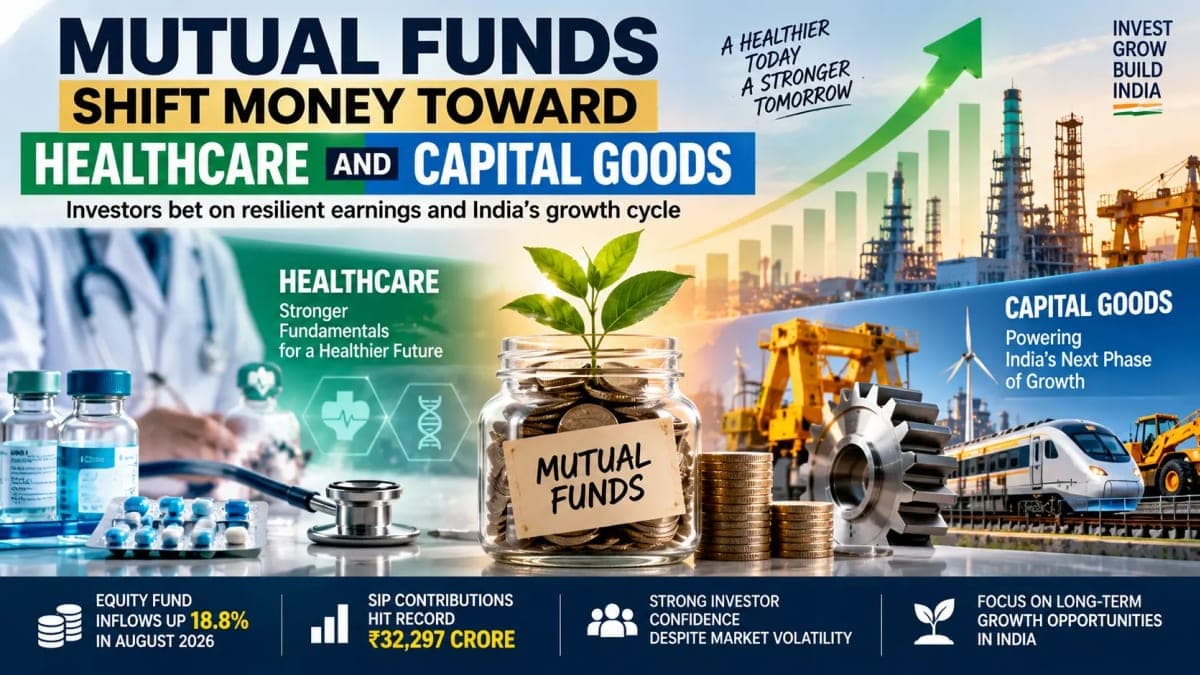
Healthcare and Capital Goods Gain Attention in Mutual Fund Portfolios as India’s Investment Cycle Evolves
Introduction
Indian mutual funds are navigating a changing equity-market landscape, with healthcare and capital goods emerging as notable areas of portfolio exposure alongside traditional heavyweight sectors such as financial services.
The positioning comes at a time when domestic investors continue to pour money into mutual funds despite volatility in the broader stock market.
In August 2026, equity mutual-fund inflows rose 18.8% from July to ₹29,329 crore, according to Association of Mutual Funds in India data reported by Reuters. Systematic investment plan contributions increased to a record ₹32,297 crore.
Within this environment, portfolio disclosures from individual funds show healthcare and capital goods occupying significant positions — potentially reflecting fund managers' search for a combination of earnings resilience and exposure to India's longer-term investment and manufacturing story.
Healthcare Builds a Strong Presence in Portfolios
Healthcare has emerged as a significant allocation in a number of mutual-fund portfolios.
Recent August 2026 portfolio data for individual schemes shows healthcare allocations of 11.29%, 16.55% and as high as 18.37% among examples available in current fund data.
That does not establish that the entire mutual-fund industry is uniformly increasing healthcare exposure, but it demonstrates the sector's meaningful presence within selected portfolios.
Healthcare can also offer characteristics that differ from highly cyclical parts of the market. Demand for medicines, healthcare services and related products is not entirely dependent on the economic cycle, although individual healthcare and pharmaceutical companies remain exposed to company-specific, regulatory, pricing and valuation risks.
For fund managers trying to balance growth opportunities with market uncertainty, that distinction can make healthcare an important part of portfolio construction.
Capital Goods Reflect India's Investment Story
Capital goods represent a different investment proposition.
Rather than primarily offering defensive characteristics, the sector is closely connected with industrial expansion, infrastructure development, manufacturing investment, power equipment and broader capital expenditure.
Portfolio data again shows meaningful exposure.
One August 2026 fund factsheet showed 10.37% allocated to capital goods, while another had 9.49%. A separate portfolio had healthcare as its largest sector allocation at 18.37%, with capital goods representing another 5.4%.
Infrastructure-focused strategies can naturally carry considerably larger allocations. For example, DSP India T.I.G.E.R. Fund's sector data showed capital goods at 19.90% at the end of August 2026, compared with 18.89% at the end of March.
The important caveat is that sector allocations vary substantially according to each scheme's mandate and investment strategy.
Why Capital Goods Remain an Important Market Theme
The investment case surrounding capital goods is connected to India's wider industrialisation and infrastructure cycle.
Businesses involved in industrial machinery, electrical equipment, engineering, automation and related areas can benefit when companies and governments increase expenditure on new capacity and infrastructure.
Recent investment commentary has also identified niche capital goods, along with aerospace, electronics, auto ancillaries and contract development and manufacturing, as areas potentially positioned to benefit from India's changing manufacturing landscape. At the same time, valuation discipline remains important because strong expectations can already be reflected in share prices.
That creates an important distinction for investors: a strong long-term economic theme does not automatically mean every company within the sector is attractively valued.
Record SIP Contributions Show Retail Investors Are Staying Invested
The sector positioning is taking place against an unusually strong backdrop for India's mutual-fund industry.
Gross monthly SIP contributions reached a record ₹32,297 crore in August, while total mutual-fund industry assets climbed above ₹87 lakh crore, also reaching a record level.
Equity funds have now recorded net inflows for 66 consecutive months, according to the August data reported by Reuters.
The persistence of those flows is significant because Indian equities have continued to experience periods of volatility.
Rather than abandoning equities altogether, domestic investors appear to be maintaining long-term participation through mutual funds.
Mid- and Small-Cap Funds Attract Strong Money
August's data also reveals where investors themselves are directing fresh money.
Inflows into mid-cap funds rose 13% to ₹6,989 crore, while small-cap fund inflows increased 2.6% to ₹7,973 crore.
Large-cap funds, in contrast, recorded ₹1,147 crore of outflows, marking their second consecutive month of net withdrawals.
That divergence is important when interpreting sector movements.
Investor inflows into a mutual-fund category and a fund manager's underlying sector allocation are two different things. Investors may put money into a diversified mid-cap or flexi-cap fund, for example, while the fund manager ultimately decides how much of that capital is exposed to healthcare, capital goods, financials or other industries.
Healthcare and Capital Goods Offer Different Portfolio Roles
One reason the two sectors are interesting together is that they can serve very different purposes within an equity portfolio.
Healthcare can provide exposure to pharmaceuticals, hospitals, diagnostics and other health-related businesses, while capital goods can offer greater sensitivity to industrial expansion and capital expenditure.
In simplified terms, healthcare may contribute an element of earnings resilience while capital goods can provide exposure to economic and infrastructure expansion.
But neither sector is automatically low risk.
Healthcare companies can face regulatory decisions, pricing pressure, product-development risks and international-market uncertainty. Capital-goods businesses can be affected by project delays, order execution, commodity costs, government spending and changes in the investment cycle.
Valuation is another crucial consideration for both.
What the Shift Means for Retail Mutual-Fund Investors
For retail investors, changes in sector exposure inside diversified mutual funds generally should not be interpreted as instructions to buy the same sectors directly.
Professional fund managers continuously adjust portfolios according to valuations, earnings expectations, risk and individual scheme mandates.
A diversified equity fund may therefore increase exposure to one industry while reducing another without changing its overall investment objective.
The more relevant question for investors is whether their chosen mutual fund remains consistent with its mandate, risk profile and their own investment horizon.
The Bigger Picture
The latest data presents two related developments.
First, Indian households continue to demonstrate substantial participation in mutual funds, illustrated by record SIP contributions and 66 consecutive months of equity-fund net inflows.
Second, individual portfolio disclosures demonstrate that healthcare and capital goods have become meaningful components of several equity strategies, even though the available evidence does not justify claiming that every mutual fund is rotating aggressively toward the two sectors.
That distinction matters.
The story is therefore less about investors abandoning one sector for another and more about how professional portfolios are positioning themselves across India's evolving economic cycle.
If manufacturing, infrastructure and private capital expenditure remain supportive, capital goods could continue to command fund-manager attention. Healthcare, meanwhile, offers a separate earnings and diversification story.
Together, the sectors illustrate how mutual funds are searching for opportunities beyond simply following India's largest benchmark stocks.


