Pranav Constructions Makes Strong Market Debut at 33% Premium; Shares Turn Volatile After Listing
Introduction
Pranav Constructions Ltd delivered a strong debut on the Indian stock market on Tuesday, September 15, 2026, rewarding IPO investors with a substantial listing premium before the shares encountered sharp selling pressure.
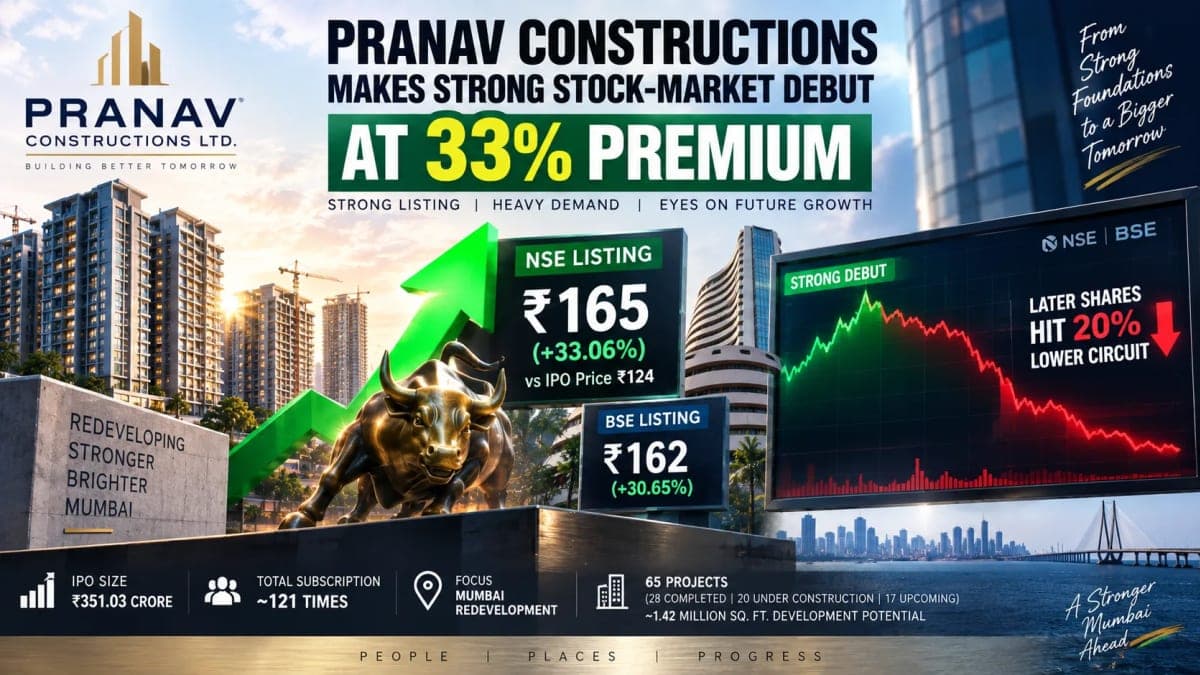
The stock opened at ₹165 on the NSE, representing a 33.06% premium over the IPO issue price of ₹124 per share. On the BSE, Pranav Constructions began trading at ₹162, a premium of approximately 30.65%.
The strong opening followed heavy investor demand for the company's initial public offering. However, the early enthusiasm did not hold throughout the session, with the stock subsequently falling sharply and hitting its 20% lower circuit.
The contrasting moves — a strong listing followed by significant selling — make Pranav Constructions' debut particularly notable for investors tracking India's active IPO market.
Pranav Constructions Lists at ₹165 on NSE
Pranav Constructions entered the secondary market with a significant premium to its IPO price.
The company had offered shares in a price band of ₹118 to ₹124, with the final issue price fixed at the upper end of ₹124.
On listing day:
NSE listing price: ₹165
NSE listing premium: 33.06%
BSE listing price: ₹162
BSE listing premium: approximately 30.65%
IPO issue price: ₹124
For an investor receiving shares at the IPO price, the ₹165 NSE opening translated into a paper listing gain of ₹41 per share.
The company's market capitalisation after listing was reported at approximately ₹1,493.38 crore.
₹351-Crore IPO Attracted Heavy Investor Demand
The strong opening did not emerge in isolation.
Pranav Constructions' IPO sought to raise approximately ₹351.03 crore and received substantial investor interest during the subscription period.
The public offering was subscribed around 121 times, according to reports tracking the final subscription data.
Demand was particularly strong among institutional and non-institutional investors.
Reported subscription figures included:
Qualified Institutional Buyers (QIBs): 258.71 times
Non-Institutional Investors (NIIs): 208.21 times
Retail Investors: 43.33 times
The scale of the subscription indicated that demand for available shares significantly exceeded the quantity offered.
That demand had also contributed to expectations of a strong listing before the shares officially began trading.
What Pranav Constructions Does
Pranav Constructions operates primarily in the real-estate redevelopment business, with a significant focus on Mumbai.
The company's operations are particularly concentrated in redevelopment projects within the Municipal Corporation of Greater Mumbai (MCGM) region and Mumbai's western suburbs.
As of March 31, 2026, the company reportedly had a portfolio of 65 redevelopment projects.
These comprised:
28 completed projects
20 projects under construction
17 upcoming projects
Together, the portfolio represented approximately 1.42 million square feet of developable area.
This exposure to Mumbai's redevelopment market gives Pranav Constructions access to a segment supported by the city's limited availability of undeveloped land and its large stock of ageing buildings.
At the same time, geographic concentration creates its own set of risks.
Strong Listing Was Followed by Sharp Selling
While the headline listing gain was impressive, investors looking only at the opening price would miss an important part of the day's story.
After its strong debut, Pranav Constructions shares came under significant selling pressure and eventually hit the 20% lower circuit.
That reversal illustrates the difference between an IPO's listing gain and its subsequent secondary-market performance.
A 33% listing premium measures the difference between the IPO issue price and the price at which shares initially begin trading. It does not mean that the stock will necessarily sustain that gain during the trading session.
For investors, the volatility following the listing is therefore just as relevant as the strong opening.
Why Did the IPO Attract So Much Attention?
Several aspects of Pranav Constructions' business may have contributed to investor interest.
The company operates in Mumbai's redevelopment market, where developers can potentially access projects without acquiring large parcels of undeveloped land in the conventional manner.
Its execution record and project pipeline were among the factors highlighted in market commentary surrounding the IPO.
The company has also been described as operating an asset-light model, an approach that can reduce some of the capital requirements associated with traditional real-estate development.
However, those potential advantages need to be considered alongside the company's business risks.
Risks Investors Should Not Ignore
A strong IPO subscription and listing premium do not eliminate the underlying risks associated with the company.
One key consideration is geographical concentration.
Pranav Constructions' business is heavily exposed to the Mumbai redevelopment market. While that provides specialised local expertise, it also means that regulatory, economic or real-estate changes affecting Mumbai could have a disproportionate impact on the company.
Redevelopment projects can additionally depend on regulatory approvals, cooperation among existing occupants, project execution timelines and broader property-market conditions.
Delays in any of these areas can potentially affect costs, cash flows and project completion schedules.
Investors should therefore separate the excitement surrounding the listing from an assessment of the company's longer-term fundamentals.
What the 33% Listing Premium Actually Means
The 33.06% NSE premium provides a straightforward indication of how strongly the market initially valued the shares relative to their IPO price.
At the ₹124 issue price, an investor allotted the minimum IPO lot of 120 shares would have invested:
₹14,880
At the ₹165 NSE listing price, those 120 shares were initially worth:
₹19,800
That represents an initial paper gain of:
₹4,920
The calculation reflects the opening price only and does not account for taxes, brokerage or subsequent movement in the stock.
More importantly, the later decline demonstrates why listing gains should not automatically be interpreted as evidence of sustained future returns.
What Comes Next for Pranav Constructions?
With the IPO process completed, investor attention is likely to shift from subscription numbers and grey-market expectations toward the company's actual operating performance.
Key areas to watch include its ability to execute projects on schedule, convert its upcoming pipeline into revenue, maintain profitability and manage risks associated with Mumbai's redevelopment market.
Investors may also monitor future financial results to determine whether the valuation established by the public market is supported by earnings growth.
The first day has already delivered two very different signals.
The ₹165 NSE listing demonstrated strong initial demand, while the subsequent decline showed that investors were also willing to book profits or reassess the stock once regular trading began.
The Bigger Picture
Pranav Constructions' debut comes during another busy period for India's IPO market, with investors evaluating multiple new listings and upcoming public issues.
Its 33.06% opening premium makes the debut noteworthy, particularly after the IPO received heavy subscription demand.
But the sharp reversal after listing provides an equally important lesson.
A successful IPO debut can create immediate wealth for successful applicants, but once a stock begins trading freely, its price is determined by changing demand, valuations, profit-taking and expectations about the underlying business.
For Pranav Constructions, the attention will now move away from the IPO itself and toward a more difficult question: whether the company's business performance can justify the expectations reflected in its strong market debut.


