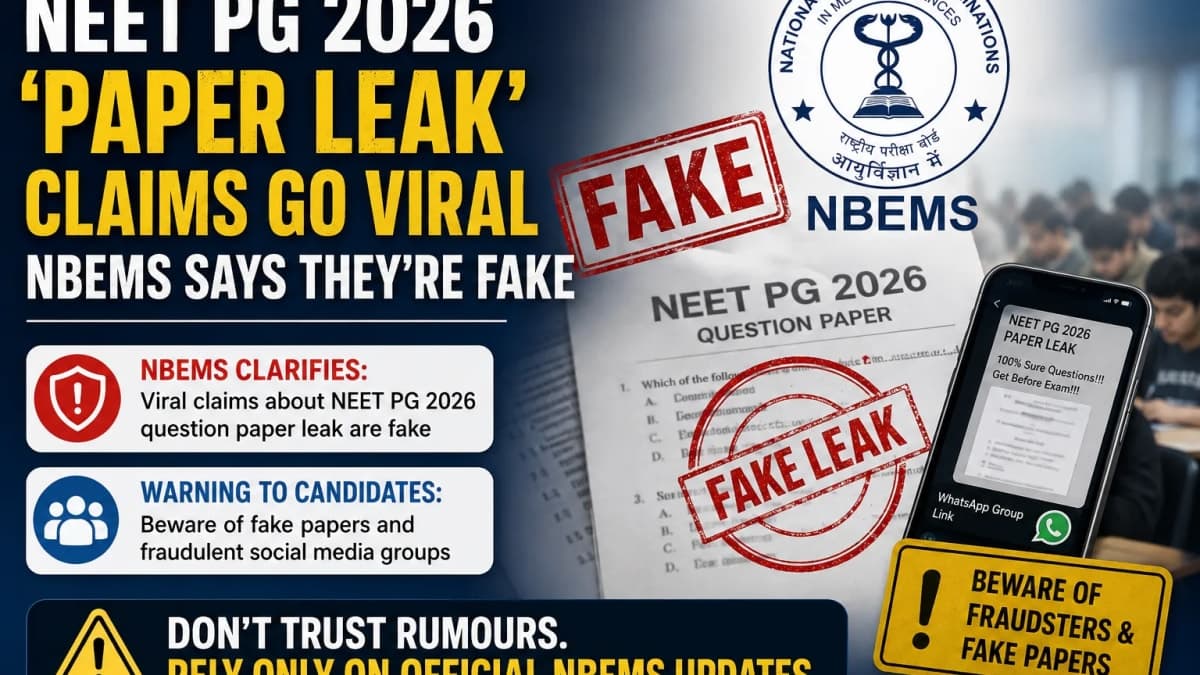
NEET PG 2026 ‘Paper Leak’ Claims Go Viral — NBEMS Says They’re Fake
Viral claims about an alleged NEET PG 2026 question-paper leak have caused concern among medical aspirants, prompting the National Board of Examinations in Medical Sciences (NBEMS) to step in and reject the allegations.
NBEMS cautioned candidates about individuals and online groups claiming that they could provide NEET PG questions or examination material in advance. The examination authority made clear that candidates should not treat such claims as genuine and should remain alert to attempts to exploit anxiety surrounding the high-stakes medical entrance examination.
The clarification is particularly important because even an unverified allegation of a paper leak can spread rapidly through messaging applications and social-media platforms, potentially creating confusion among thousands of candidates preparing for the examination.
What Are the NEET PG 2026 Viral Claims?
Posts and messages circulating online purported to offer access to NEET PG 2026 examination questions or leaked papers.
Such claims can appear convincing to students, particularly when accompanied by screenshots, sample questions, payment demands or assurances that the material has come from someone connected with the examination process.
NBEMS, however, rejected the purported advance access to NEET PG examination questions and warned candidates about misleading claims.
The regulator's intervention effectively draws a distinction between viral allegations and verified evidence. At present, the claims being circulated should not be treated as proof that the NEET PG 2026 examination paper was compromised.
NBEMS Warns Candidates About Fraudsters
The issue is not limited to misinformation. Fake paper-leak claims can also be used as a financial scam.
Fraudsters may attempt to convince anxious candidates that they possess confidential examination material and then demand money in exchange for access. Students who engage with such groups could lose money while receiving fabricated questions that have no connection with the actual examination.
Candidates should therefore rely on official NBEMS communications for examination-related information rather than screenshots, forwarded messages or anonymous social-media accounts.
Why Paper-Leak Rumours Can Have a Serious Impact
NEET PG is a highly competitive examination that plays a major role in postgraduate medical admissions in India.
Candidates typically spend months preparing for the test, making any suggestion of an examination-security breach particularly sensitive.
A genuine paper leak would raise serious questions about fairness because candidates who obtained questions beforehand could gain an unlawful advantage. But false allegations can also cause substantial damage.
They can increase stress among candidates, undermine confidence in the examination process and create an impression of wrongdoing before facts have been independently established.
That makes quick verification and transparent communication especially important.
Viral Posts Are Not Evidence of an Exam Leak
The controversy also demonstrates a broader problem surrounding high-stakes examinations in the social-media era.
A screenshot or forwarded message can reach thousands of people within minutes, while verifying its origin may take considerably longer. Repetition can then make an unsupported claim appear credible even when no evidence has been presented.
For candidates, the safest approach is to distinguish between three things: an allegation circulating online, evidence demonstrating that confidential examination material was actually compromised, and an official finding following investigation.
Those categories should not be treated as interchangeable.
Candidates Should Be Careful With ‘Leaked Paper’ Offers
Students encountering accounts that claim to possess NEET PG questions should avoid making payments or sharing sensitive personal information.
They should also be cautious about joining groups that promise guaranteed questions, answer keys or confidential examination material.
Apart from the possibility of financial fraud, participation in activities involving genuinely stolen examination material could potentially create serious academic or legal consequences.
Candidates who encounter suspicious claims should preserve relevant evidence and use appropriate official reporting channels rather than amplifying the material publicly.
Balanced Analysis: Why NBEMS’ Clarification Matters
NBEMS' rejection of the viral claims is important because examination authorities need to respond rapidly when allegations capable of affecting candidate confidence begin spreading.
At the same time, official denial alone should not become a reason to dismiss every future concern automatically. If credible evidence of an examination-security problem emerges, it should be examined transparently and appropriate action should follow.
The appropriate standard is therefore evidence.
Unverified social-media claims should not be presented as established paper leaks, while genuine evidence of irregularities should receive proper scrutiny.
This distinction protects both candidates and the integrity of the examination process.
What NEET PG 2026 Aspirants Should Do
For aspirants, the controversy should not distract from examination preparation.
Candidates should check examination dates, admit-card information, instructions and official notices through NBEMS' authorised channels. Messages promising advance access to questions should be treated with extreme caution, particularly when money is demanded.
The viral NEET PG 2026 “paper leak” episode ultimately highlights how misinformation can become an additional challenge for students already facing the pressure of a major competitive examination.
Until credible evidence establishes otherwise, the circulating claims should be treated according to NBEMS' clarification: fake and misleading, rather than proof of a confirmed NEET PG 2026 paper leak.
This article is based on reporting published by India Today.