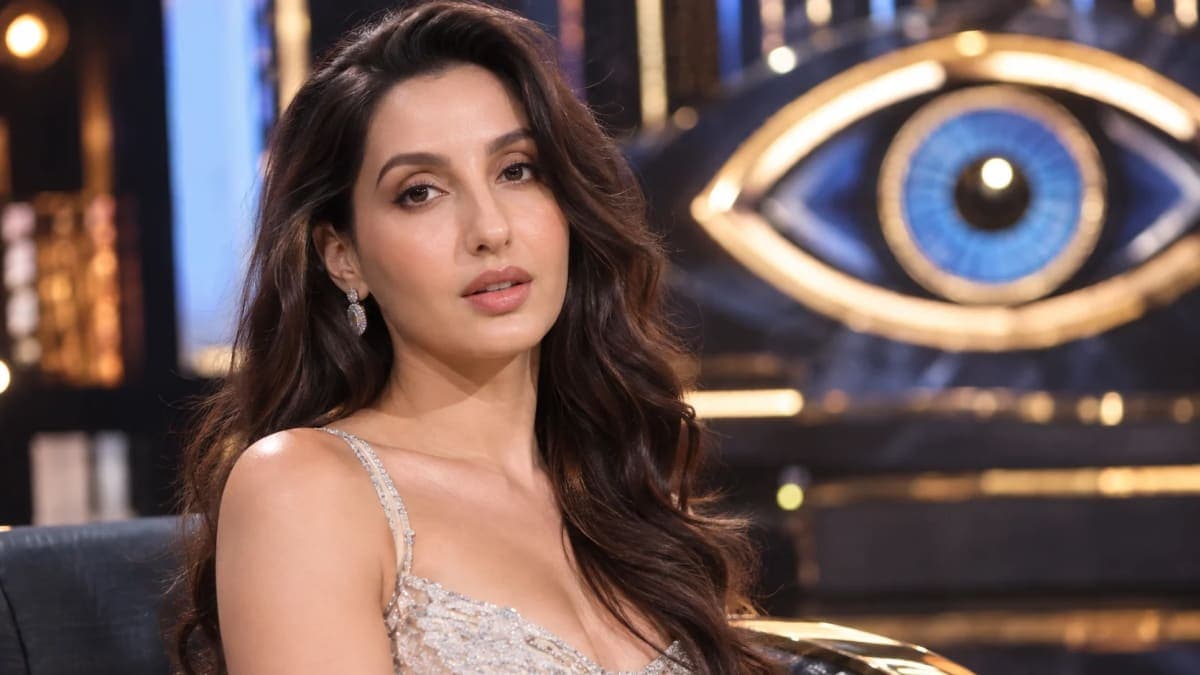
Nora Fatehi has looked back at a crucial period in her early career, revealing that joining Bigg Boss 9 was not originally part of her plan.
Nora Fatehi has opened up about the circumstances that led her to participate in Bigg Boss 9, revealing that she initially had little interest in entering the reality show and eventually agreed after making a strategic request to the makers.
Speaking on the Untriggered podcast, Nora said she wanted an opportunity to participate in the dance reality show Jhalak Dikhhla Jaa. Since the two programmes were associated with the same channel, she proposed an exchange: she would participate in Bigg Boss if she received the opportunity to do Jhalak Dikhhla Jaa. Nora said the arrangement worked out and that she ultimately got Jhalak.
Why Nora Fatehi Initially Said No to Bigg Boss
Nora's comments also shed light on the difficult professional circumstances she says she was facing at the time.
She said she had worked on several songs but was waiting to receive money owed to her. According to Nora, the producers may have paid the agency involved, but the money had not reached her, leaving her fighting to get paid. It was during this period that she received an offer to participate in Bigg Boss.
Her initial response was to reject the opportunity because she felt the reality-show route did not match the career vision she had for herself.
The financial offer, however, prompted her to reconsider. More importantly, Nora began looking at Bigg Boss not simply as a reality programme but as a platform capable of introducing a contestant to a much wider audience.
The Condition That Changed Her Decision
Nora entered Bigg Boss 9 as a wildcard contestant, which influenced the way she evaluated the opportunity. Knowing that a wildcard entrant might have a relatively limited run, she considered whether she could use the opportunity to move toward another goal.
That goal was Jhalak Dikhhla Jaa.
Nora explained her proposal to the makers: “So I told them to give me Jhalak, and in return, I would do Bigg Boss. I got Jhalak in exchange.”
She also reflected on the potential value of reality television, saying: “It is not a bad thing; it is a platform, and it immediately makes you a household name if you are smart.”
Her account suggests that the decision was therefore about more than the immediate payment for Bigg Boss. It also gave her a route toward the dance-focused television opportunity she wanted.
Nora Fatehi's Bigg Boss 9 Journey
Nora joined Bigg Boss 9 as a wildcard contestant in December 2015. Her stay lasted roughly three weeks before she was eliminated in January 2016.
Her time inside the house also drew attention because of her bond with fellow contestant Prince Narula, who went on to win the season. Their interactions became one of the talking points surrounding Nora's stint on the programme.
But from a career perspective, the more consequential development came after Bigg Boss.
The Jhalak Dikhhla Jaa Opportunity Followed
Nora subsequently competed on Jhalak Dikhhla Jaa 9 in 2016, giving her a television platform centered much more directly on dance and performance.
Years later, her association with the franchise came full circle when she returned to Jhalak Dikhhla Jaa as a judge in 2022.
That progression adds context to her latest revelation: Jhalak Dikhhla Jaa was not simply another television appearance for her. According to Nora's own account, securing that opportunity was one of the main reasons she agreed to participate in Bigg Boss in the first place.
From Reality TV to a Wider Entertainment Career
Nora's career expanded considerably in the years after her reality-TV appearances. She became widely associated with major Hindi film dance numbers and songs including Dilbar, O Saki Saki and Garmi, while also appearing as a judge on reality television.
Her latest comments provide a different perspective on those early television appearances. Rather than describing Bigg Boss 9 as an opportunity she immediately wanted, Nora portrays it as a calculated career decision made during a financially difficult period — one that she connected to her larger ambition of establishing herself as a performer.
More than a decade later, the story also illustrates how an opportunity that initially did not fit her plans became a stepping stone toward the dance platform she was actively pursuing.