The political rivalry between Omar Abdullah’s National Conference (NC) and the Bharatiya Janata Party (BJP) has escalated into a street-level confrontation in Jammu and Kashmir, with both parties mobilising supporters around sharply different demands.
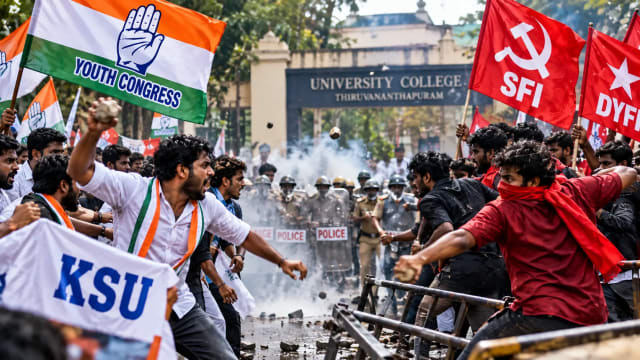
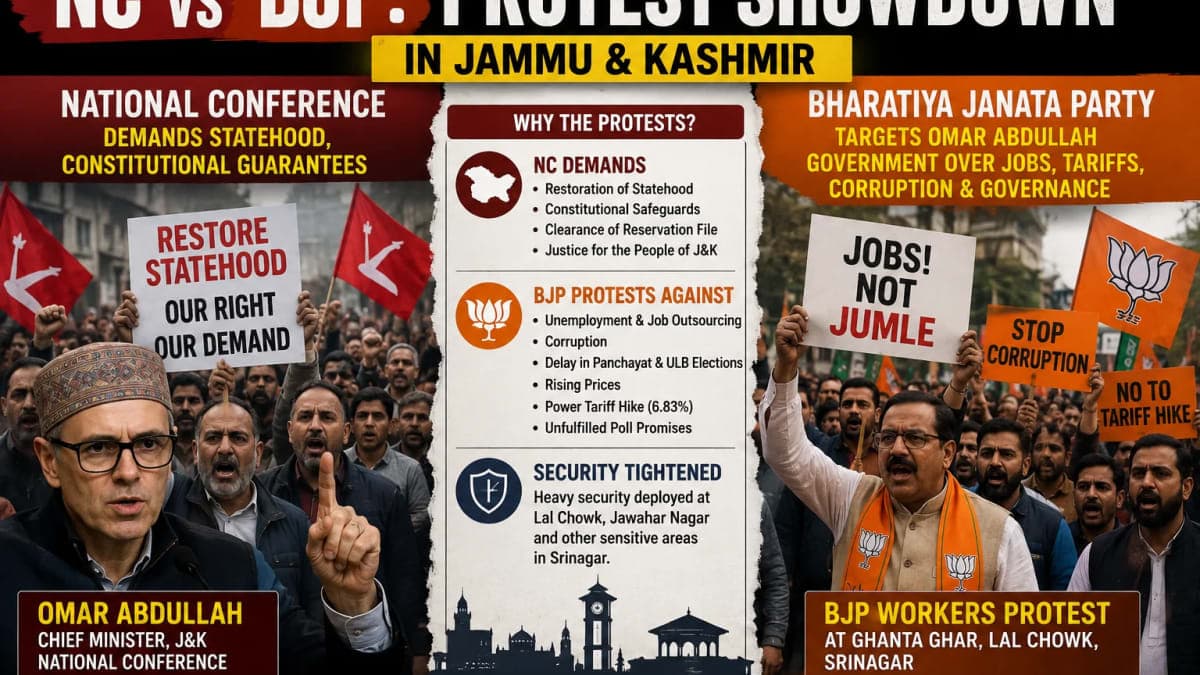
On Wednesday, September 2, BJP leaders and workers gathered at Ghanta Ghar in Srinagar’s Lal Chowk, planning to march towards the Civil Secretariat as part of a protest against what the party describes as failures of the Omar Abdullah-led government.
The National Conference, meanwhile, organised its own demonstrations and moved to protest near BJP offices while renewing its demand for the restoration of Jammu and Kashmir’s statehood and constitutional safeguards.
The competing demonstrations prompted a significant security deployment in Srinagar, particularly around Lal Chowk, Jawahar Nagar and other politically sensitive areas.
The confrontation highlights the unusual political structure that has emerged in Jammu and Kashmir: the National Conference controls the elected Union Territory government, while the BJP leads the government at the Centre.
BJP Targets Omar Abdullah Government Over Jobs and Governance
The BJP’s protest is primarily directed at the performance of the National Conference-led government.
Party leaders have raised issues including unemployment, alleged corruption, outsourcing of government jobs, delays in Panchayat and Urban Local Body elections, rising prices and unfulfilled electoral commitments.
The BJP has also criticised the administration over the recent 6.83% electricity tariff increase, which came into effect from September 1.
Jammu and Kashmir Leader of Opposition Sunil Sharma has accused the NC government of failing to address issues affecting ordinary residents, particularly young people seeking employment.
BJP leader Altaf Thakur, outlining the protest plan, said:
“BJP is protesting on issues of unemployment, corruption and Panchayat elections. We will start from Ghanta Ghar, Lal Chowk, and go to the Secretariat to gherao it.”
The BJP maintains that its mobilisation is intended to hold the elected government accountable for promises made during the 2024 Assembly election campaign.
Those allegations remain political claims made by the opposition and should not be treated as independently established findings.
National Conference Turns Protest Toward BJP
The National Conference responded by directing its political pressure toward the BJP.
The ruling party announced plans for peaceful demonstrations targeting BJP headquarters in Srinagar and Jammu, demanding accountability over commitments made by the Union government regarding the restoration of Jammu and Kashmir’s statehood.
The NC said:
“The National Conference will peacefully gherao the BJP headquarters in Srinagar and Jammu tomorrow, demanding accountability for the promises made by the Union Government in Parliament and before the Supreme Court of India.”
The party outlined several demands, including:
Restoration of Jammu and Kashmir’s statehood
Constitutional guarantees
Clearance of the reservation file
Justice for the people of Jammu and Kashmir
The NC also argued that the electoral mandate received by the government should not be taken for granted.
The parallel demonstrations effectively created two competing accountability campaigns: the BJP demanding answers from the elected territorial government and the National Conference demanding answers from the BJP-led Union government.
Statehood Returns to Centre of J&K Politics
The restoration of statehood remains one of the National Conference’s most important political demands.
Jammu and Kashmir ceased to be a state in August 2019, when the Centre revoked the special constitutional status provided under Article 370 and reorganised the former state into two Union Territories — Jammu and Kashmir, and Ladakh.
In December 2023, the Supreme Court upheld the constitutional validity of the Centre’s Article 370 decision.
At the same time, the court said the restoration of Jammu and Kashmir’s statehood should take place “at the earliest and as soon as possible.”
Assembly elections were eventually held in 2024, resulting in an NC-led government headed by Chief Minister Omar Abdullah.
However, Jammu and Kashmir continues to operate as a Union Territory, leaving the question of full statehood unresolved.
Omar Abdullah and NC Have Stepped Up Pressure on Statehood
The September 2 demonstrations are not an isolated effort by the National Conference.
The party has intensified its statehood campaign in recent months.
In July, NC president Farooq Abdullah, Deputy Chief Minister Surinder Choudhary and party workers participated in a demonstration outside Jammu and Kashmir House in New Delhi demanding restoration of statehood.
Earlier that month, more than 150 representatives from different sections of civil society participated in an NC-organised meeting in Srinagar where a resolution calling for restoration of statehood was adopted.
Chief Minister Omar Abdullah has also repeatedly raised the issue.
The NC’s latest mobilisation therefore appears to be part of a broader effort to keep pressure on the Centre rather than a response limited to the BJP’s September 2 demonstration.
BJP Accuses NC of Using Statehood to Deflect Attention
The BJP has rejected the National Conference’s counter-protest strategy and accused the ruling party of attempting to shift attention away from its own governance record.
Leader of Opposition Sunil Sharma argued that the BJP had announced its protest earlier and that the NC subsequently decided to organise demonstrations on the same day.
He challenged Omar Abdullah to resign and seek a fresh mandate if the chief minister wanted the restoration of statehood to become the defining issue before voters.
Sharma has also accused the NC government of using the statehood debate to distract from unemployment and alleged irregularities involving government jobs.
These statements represent the BJP’s political position; the National Conference disputes the broader allegation that its statehood campaign is merely a diversion from governance issues.
Electricity Tariff Hike Adds Another Flashpoint
The confrontation has also been intensified by the recent electricity tariff increase.
A 6.83% power tariff hike came into effect in Jammu and Kashmir from September 1, adding another issue to the BJP’s campaign against the territorial government.
The increase has put the Omar Abdullah administration under political pressure because electricity costs and subsidies were prominent issues during the election campaign.
The BJP has used the increase as evidence for its broader argument that the government has failed to deliver relief promised to residents.
Omar Abdullah, however, has defended the decision as one taken out of necessity.
The dispute illustrates the difficult political position of the elected government: it must defend administrative decisions while simultaneously arguing that Jammu and Kashmir needs the greater authority associated with restored statehood.
Why the Parallel Protests Are Politically Significant
The September 2 showdown is significant because both parties are trying to establish different definitions of political accountability.
For the BJP, the central question is:
What has the Omar Abdullah government delivered since coming to power?
For the National Conference, the question is different:
When will the Centre fulfil the commitment to restore Jammu and Kashmir’s statehood?
Both arguments speak to different levels of government.
The NC can be questioned about employment, electricity tariffs, local governance and implementation of its electoral programme because it heads the elected administration.
At the same time, the BJP faces questions over statehood because the decision ultimately requires action at the Union level.
That division of authority makes Jammu and Kashmir’s politics fundamentally different from that of a full-fledged state.
Security Tightened Across Key Srinagar Locations
The simultaneous demonstrations also created a law-and-order challenge.
Police and security forces were deployed in large numbers around Lal Chowk and Jawahar Nagar as the BJP prepared for its march towards the Civil Secretariat and the National Conference mobilised near BJP offices.
The competing protest plans placed supporters of the ruling and opposition parties in politically sensitive parts of the city at roughly the same time.
Security arrangements were therefore aimed at preventing the rival demonstrations from turning into a direct confrontation.
The mobilisation is also notable because large political protests in Kashmir have faced significant restrictions in recent years.
A Wider Battle Over Jammu and Kashmir’s Political Future
The NC-BJP confrontation goes beyond one day of protests.
It reflects a larger political argument over how Jammu and Kashmir should be governed after the 2019 constitutional changes and the return of an elected government following the 2024 Assembly elections.
The National Conference wants restoration of statehood and greater constitutional and administrative authority for the elected government.
The BJP, meanwhile, is attempting to make governance performance — particularly employment, transparency, local elections, public services and household costs — the central test of the Omar Abdullah administration.
The result is an unusual political dynamic in which both parties can simultaneously occupy the roles of government and opposition depending on the issue.
The NC governs Jammu and Kashmir but challenges the BJP-led Centre over constitutional and statehood questions. The BJP governs nationally while functioning as the principal opposition to Omar Abdullah’s administration within Jammu and Kashmir.
That dual political structure helps explain why the September 2 protests have become more than competing demonstrations.
They represent a struggle over which government should be held responsible for which problems — and which issues will dominate Jammu and Kashmir’s politics in the months ahead.