September 22, 2026
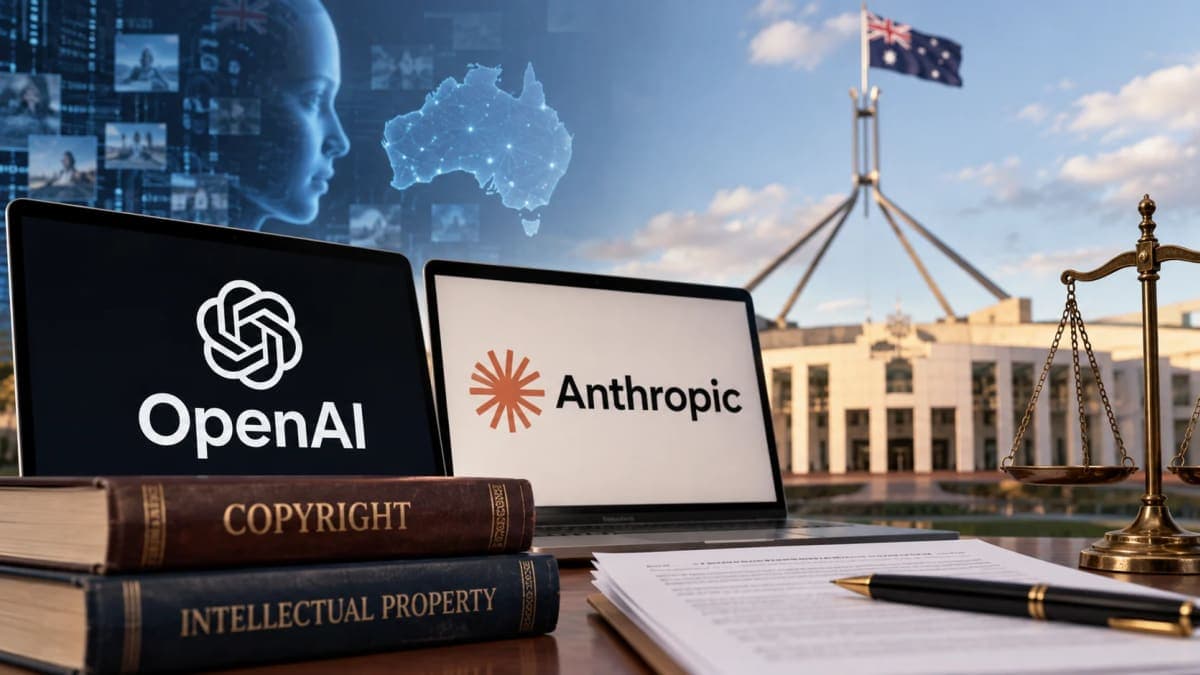
Two of the world's leading artificial-intelligence companies, OpenAI and Anthropic, are pressing Australia to reconsider copyright rules that they say restrict the country's ability to become a major location for training advanced AI models.
In September submissions to a parliamentary inquiry examining laws governing AI, both US-based companies acknowledged that the Australian government has rejected a broad copyright exemption for AI training. Rather than simply seeking an unrestricted exception, however, they proposed frameworks that could permit some training under defined conditions.
The proposals put one of the most difficult questions surrounding generative AI back in focus: when an AI company trains a commercial model on copyrighted material, what permission or compensation should creators receive?
Anthropic Proposes 'Conditional Approval' for AI Training
Anthropic, the developer of Claude, acknowledged in its submission that broad copyright exceptions have not secured widespread support in Australia and have already been ruled out by the government.
It proposed a narrower alternative.
"We believe that the government could permit AI model training through a narrow form of conditional approval."
Anthropic indicated it would consider requirements involving investment or other conditions intended to support Australian creators and cultural activity.
This approach differs from an unrestricted text-and-data-mining exemption because AI companies could be required to satisfy specified conditions before receiving permission to conduct model training.
Exactly what those conditions would include—and how creators would be compensated or able to control use of their work—remains part of the broader policy debate.
What OpenAI Is Asking Australia to Change
OpenAI has similarly argued for a copyright system that provides AI developers with greater ability to train models on information available to the public.
The company called for:
"A balanced copyright framework that allows models to learn from publicly available information"
while also supporting opportunities for rights holders to collaborate with AI developers.
The distinction between information being publicly accessible and being free of copyright restrictions is central to the dispute. Content available on the open internet can still be protected by copyright, meaning accessibility does not automatically amount to permission for commercial AI training.
Australia Has Ruled Out a Broad Text-and-Data-Mining Exception
The Albanese government has previously made clear that it does not support introducing a broad text-and-data-mining exception into Australian copyright law.
In October 2025, the Attorney-General's portfolio said such an exception could allow AI developers to use Australian creators' works without permission or payment. The government instead said it would explore approaches including licensing arrangements and mechanisms for more efficient copyright enforcement.
That position is important because Australian law affects AI training carried out inside Australia.
The Productivity Commission has previously noted that models trained overseas are governed by the laws of the jurisdictions where that copying occurs. Consequently, changing Australian copyright law would primarily influence whether companies choose Australia itself as a location for model training.
Why AI Companies Care About Training Models in Australia
The copyright debate has become intertwined with a much larger question about investment.
AI training requires enormous computing resources, which in turn require data centres, electricity, cooling systems, networking infrastructure and substantial capital expenditure.
Australia's government is currently consulting on how to make the country more attractive for AI infrastructure while ensuring that new investment produces broader economic benefits.
Its September 2026 consultation paper explicitly identifies copyright certainty, AI training and protections for creators as interconnected policy issues.
OpenAI and Anthropic have also linked the copyright debate to their Australian infrastructure ambitions.
OpenAI has signed an offtake agreement with Australian data-centre developer NextDC for a planned Sydney facility, while Anthropic was recently named as a partner in a Queensland data-centre project.
OpenAI Says Existing Rules Affect Investment Decisions
The commercial implications became particularly clear this month.
OpenAI vice president of global policy Ann O'Leary said Australia's existing copyright framework would prevent the company from establishing an AI training centre in the country under the current settings.
"We will not be able to build a … training centre here if the copyright law is as it exists."
The statement was made as Australian officials continued consultations with technology companies and rights-holder groups over possible reforms.
Senior representatives from both OpenAI and Anthropic also met Australian federal ministers this month as the companies pursued expansion opportunities in the country.
Australian Creators Push Back Against Weaker Protections
The technology companies' arguments face substantial resistance from Australia's music, publishing and other creative sectors.
Creators and rights-holder organisations have argued that commercial AI developers should not be permitted to train models on copyrighted works without permission or appropriate compensation.
Australian music-rights organisation APRA AMCOS publicly challenged OpenAI's position this month. Its CEO Dean Ormston said major generative-AI platforms operating in Australia had not approached the organisation to discuss licences for AI training since generative AI became widely available.
The disagreement illustrates that the dispute is not simply about whether Australia should embrace AI.
The harder policy question is how the economic value created by AI should be balanced against the existing legal and economic rights of the people whose books, journalism, music, images and other works may become training data.
Government Has Considered More Limited Copyright Options
Australia's debate has become more complicated following reports about copyright options considered during government consultations.
ABC reported on September 15 that government documents outlined a possible framework under which AI companies could train on some online copyrighted material after reaching agreements with a sufficient number of rights holders and satisfying other requirements.
Under the reported proposal, participation could effectively operate on an opt-out basis for some material, while AI developers would be expected to make efforts to avoid pirated content.
The reported consultation options should not be confused with enacted Australian law. They form part of an ongoing policy process rather than a final copyright regime.
Why Australia's Decision Matters Beyond Copyright
The dispute ultimately involves three competing policy objectives.
Australia wants to attract investment in AI infrastructure and advanced computing. AI companies want sufficient access to data to make domestic model training commercially viable. Creators and publishers, meanwhile, want their existing rights protected and mechanisms ensuring their work is not commercially exploited without consent or compensation.
The government's own AI-infrastructure consultation recognises that copyright policy will be a significant part of creating regulatory certainty for AI investment while maintaining strong protections for creators.
That makes the debate larger than a technical amendment to copyright law. Australia's eventual framework could influence whether future frontier AI models are trained domestically, what obligations developers face when using protected works and whether investment commitments can coexist with compensation and control for rights holders.
What Happens Next?
The issue remains under active consideration.
Australia is seeking public feedback on AI training and infrastructure, while copyright questions continue to be handled through consultations led by the Attorney-General.
The Joint Select Committee on Artificial Intelligence is expected to deliver its report in November 2026, according to Reuters.
Until the government settles on a final approach, Australia's existing copyright framework remains the baseline.
The central unresolved question is therefore not whether Australia will support AI investment, but what legal conditions companies such as OpenAI and Anthropic will have to satisfy if they want to train advanced models using copyrighted material within the country.