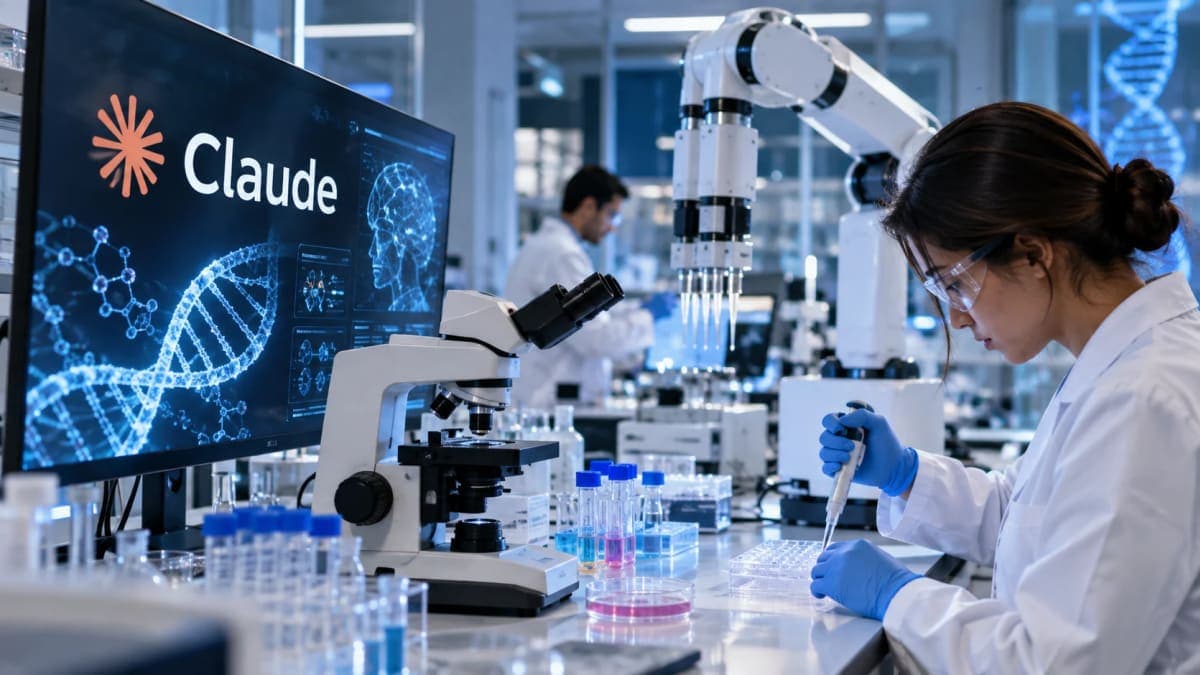
Anthropic, the artificial-intelligence company behind Claude, has established its own physical biology laboratory in the San Francisco Bay Area, marking a significant expansion of its ambitions in life sciences.
The facility is a wet lab, meaning experiments can be performed on physical biological materials rather than being limited to computer simulations, or in silico research.
Reuters reported that two people familiar with the operation confirmed the laboratory's existence. Anthropic's head of life sciences, Eric Kauderer-Abrams, also confirmed that the company is conducting physical biological research.
The development is particularly notable because Anthropic is simultaneously working on technologies designed to connect AI agents with laboratory instruments, potentially allowing models to participate more directly in real-world scientific experimentation.
Why Anthropic Wants a Physical Biology Lab
For AI companies attempting to accelerate biological research, computer modeling only goes so far.
A model can analyze scientific literature, examine molecular structures, propose hypotheses or predict biological interactions, but ultimately many biological ideas need to be tested experimentally.
Kauderer-Abrams summarized that distinction in comments to Reuters:
“We believe that to do biology, the final test is still, and will be for a while, in real lab work.”
He added: “We absolutely are doing that today.”
According to Reuters, Anthropic's operation resembles the approach used by biotechnology companies: some research can be performed internally while other work is conducted with outside partners.
Anthropic has said it is interested in applying AI to areas including rare and neglected diseases. However, the scope of the new facility should not be overstated. An Anthropic spokesperson told Reuters that the laboratory is not specifically a drug-discovery lab.
Claude Is Already Being Connected to Physical Laboratory Equipment
The physical lab comes as Anthropic is separately developing infrastructure intended to connect AI agents with scientific hardware.
In August 2026, the company introduced a research preview of its Model Hardware Standard (MHS), developed initially in collaboration with HHMI Janelia Research Campus.
MHS is designed to provide a common framework through which AI agents can operate different types of physical equipment. Anthropic says the system can work with devices including microscopes, liquid handlers and robotic arms.
The larger goal is to make laboratory equipment easier for AI systems to coordinate.
Rather than requiring separate custom integrations for every machine, Anthropic says MHS can reduce the time required to connect hardware and allow agents to orchestrate multiple instruments.
That creates the possibility of AI participating not just in designing an experiment but also in coordinating parts of its physical execution.
The Bigger Goal: More Autonomous Scientific Experiments
Anthropic has described an eventual system in which scientists specify a high-level biological objective while AI agents help coordinate the physical experimental pipeline.
The company says future systems could generate hardware instructions, execute experiments, analyze results and modify experimental parameters based on incoming data.
There are still substantial limitations.
Anthropic itself says more work is required to improve Claude's reasoning about physical laboratory manipulation. It also wants to expand hardware compatibility to equipment including centrifuges, automated incubators, analytical instruments and sensors.
That distinction matters: Anthropic's announcements describe an effort toward increasingly autonomous laboratory workflows, not evidence that Claude can currently run an entire sophisticated biology laboratory independently.
Anthropic Is Building a Larger Life-Sciences Ecosystem
The wet lab is only one component of Anthropic's expanding push into science and biology.
In June, the company introduced Claude Science, an AI workbench designed for scientists.
Claude Science is configured for areas including genomics, single-cell analysis, proteomics and cheminformatics, and Anthropic says it can connect researchers with more than 60 scientific databases.
The platform is intended to bring scientific databases, computational tools, models and researchers' existing pipelines into a more unified AI-assisted workflow.
Anthropic has also been developing specialized access arrangements for professional biological research.
On September 17, it announced the Life Sciences Verification Program, or LSVP. The program gives verified life-sciences professionals access to Anthropic models under safeguards designed to permit a broader range of legitimate biology-related work than its generally available models allow.
Anthropic said dozens of organizations had already participated through early access when the beta program was opened more broadly.
Why a Physical Lab Changes the Equation
The move into physical experimentation represents an important shift in what AI-assisted science can mean.
Most generative AI interaction occurs entirely in the digital world: a model receives information and produces text, software, analysis or other digital output.
Biology introduces a different feedback loop.
An AI system could theoretically analyze existing scientific knowledge, propose an experiment, interact with automated equipment, receive experimental measurements and use those results to determine the next step.
Anthropic's work on MHS explicitly points toward such closed-loop experimentation.
A physical laboratory therefore provides something computational modeling cannot: empirical feedback from biological systems.
AI and Biology Also Bring Safety Questions
Anthropic's push into biology is taking place alongside its research into the potential biological risks posed by increasingly capable AI systems.
The company has previously investigated whether access to advanced language models could improve a person's ability to perform biological laboratory tasks. Anthropic says it conducted a preliminary wet-lab study in 2024 comparing participants who had access to Claude with participants relying on internet access.
At the same time, Anthropic continues to modify safeguards governing biology-related requests.
In August 2026, the company said an update to Claude Fable 5's safeguards reduced biology-related model fallbacks by approximately 85% in its testing, with the aim of allowing more legitimate biological and healthcare-related queries while retaining protections against dangerous applications.
The combination illustrates the balancing act facing frontier AI developers: making models more useful to legitimate scientists while controlling access to capabilities that could potentially be misused.
From AI Assistant to Experimental Science
Anthropic's new laboratory should therefore be viewed as part of a broader transition rather than an isolated project.
Claude began primarily as a language-based AI assistant. Anthropic is now building scientific software around it, connecting AI agents with physical hardware and conducting biology experiments in a real laboratory.
The crucial question is how much of the scientific cycle AI systems can eventually handle reliably.
For now, human scientists and established laboratory processes remain central. But Anthropic's wet lab and its work on AI-controlled scientific equipment show where the company wants to go: toward a system in which AI doesn't merely analyze the results of experiments — it increasingly participates in carrying them out.