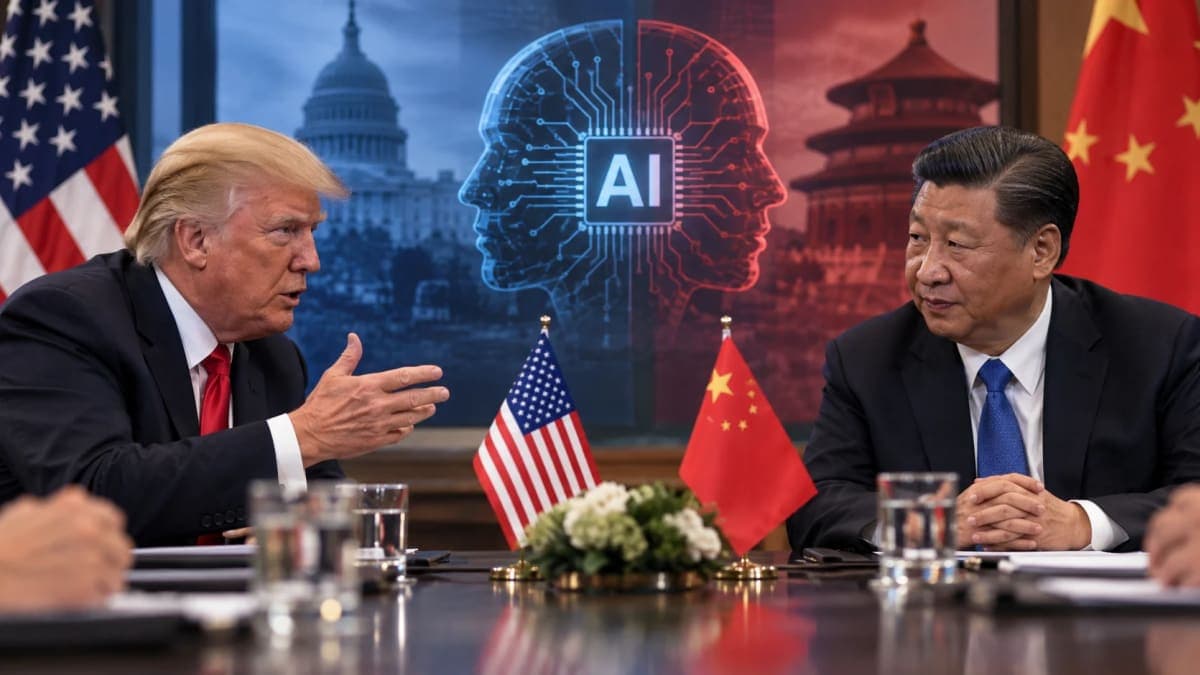
The United States and China may disagree on almost every major aspect of the global AI race, but there is one issue they increasingly have in common: what happens if increasingly powerful artificial intelligence systems cause problems neither country can easily contain?
That question is starting to find its way into diplomacy.
Washington and Beijing have been moving toward discussions about AI and its risks, with the subject expected to feature in the wider diplomatic engagement between US President Donald Trump and Chinese President Xi Jinping.
Reuters reported earlier in September that preparations were underway for a dedicated AI safety dialogue. At the same time, a White House official told the news agency that no AI-related meeting was formally scheduled for mid-September at that point. Trump and Xi are due to meet in Washington on September 24.
China had already confirmed the broader direction months earlier. In May, the Chinese government said Trump and Xi had held “constructive exchanges” on artificial intelligence and agreed that their governments would conduct a dialogue on the subject.
That does not mean Washington and Beijing are suddenly moving toward a shared vision for AI.
Far from it.
Both countries can see risks emerging from increasingly capable AI systems. The harder part is agreeing on which risks matter most, what should be done about them and how much either side is prepared to constrain its own companies or technological ambitions.
Washington is looking closely at AI-powered cyber threats
Cybersecurity could provide one of the more practical starting points.
Reuters reported, citing people familiar with preparations, that Washington wants to discuss ways to monitor AI-directed cyberattacks. One idea reportedly considered by the US side would involve American and Chinese AI laboratories sharing certain information that could help prevent or respond to AI-related cyber incidents.
That concern fits closely with the Trump administration's broader AI strategy.
A June 2026 executive order presented advanced AI as an important economic and national-security technology while also recognising the security risks that come with more capable systems.
Among other measures, it directed US agencies to strengthen cyber defences, establish an AI cybersecurity clearinghouse and create a classified process for evaluating the cyber capabilities of advanced AI models.
But the same order also makes clear what the administration does not want.
It says the framework should not introduce mandatory government licensing, pre-clearance or permitting requirements for companies developing or releasing new AI models.
That gives Washington's position an important tension.
The US government wants stronger protection against dangerous uses of advanced AI, particularly where national security is concerned. At the same time, it does not want regulation that it believes could slow American innovation while Chinese companies continue developing competing systems.
AI safety is therefore being discussed in the middle of an AI race, not separately from it.
China has its own idea of what AI safety should look like
Beijing is not arguing that AI should simply develop without rules.
Chinese policy documents regularly describe artificial intelligence as something that should be safe, controllable and governed.
At the World AI Conference in Shanghai in July, an international AI ethics action plan released under the guidance of China's Ministry of Industry and Information Technology and other parties called for ethical governance across the AI lifecycle.
The plan included tiered risk controls, more flexible governance and cooperation among governments, companies, researchers and other institutions.
Chinese officials have also pushed for a broader international approach.
Assistant Foreign Minister Liu Bin said in July that China's vision combines development with security, openness and international cooperation while keeping AI “secure and controllable.”
Beijing has also argued that developing countries should have a larger role in deciding how artificial intelligence is governed internationally.
Earlier Chinese-backed governance documents have addressed cybersecurity, personal-information protection, human oversight, risk testing, AI-generated disinformation and malicious uses of the technology.
There is clearly some common ground here.
Neither Washington nor Beijing wants AI systems to become easy tools for large-scale cyberattacks or other forms of malicious activity.
The bigger disagreement is likely to be over how those risks should be controlled — and which risks each government considers most urgent.
The real complication is the AI race itself
This is where AI diplomacy becomes difficult.
The United States and China are not neutral observers trying to write rules for a new technology. They are two of the countries competing most aggressively to lead it.
For Washington, AI policy is tied closely to national security, intellectual property and maintaining an American technological advantage.
Beijing, meanwhile, has repeatedly criticised restrictions that it sees as attempts to hold back China's technological development. Its international AI proposals also emphasise broader access to AI technology and greater participation by developing economies.
That means even a technical safety discussion can quickly turn into a geopolitical one.
Suppose American and Chinese AI laboratories agree to exchange information about dangerous capabilities discovered in advanced models. How much information should they actually share?
Could those disclosures reveal commercially sensitive research?
How would either side know whether a request made in the name of safety was genuinely about reducing risk rather than learning more about a competitor's technology?
There is also a basic trust problem.
If one country delays the release of a particularly powerful model because of a safety concern, it would want some confidence that the other side would not simply use the opportunity to move ahead.
These are not easy problems to solve through a single diplomatic meeting.
AI companies are having their own debate about speed and safety
Governments are not the only ones arguing about how quickly advanced AI should move.
Anthropic CEO Dario Amodei has recently called for more careful pacing as frontier AI systems become increasingly capable.
He has warned about several possible risks, including loss of control over advanced systems, AI-assisted cyberattacks, biological misuse and major disruption to jobs and the economy.
One of his concerns is that competition itself could make the problem worse. If companies or countries believe slowing down will allow a rival to pull ahead, they may be less willing to act cautiously even when they recognise a genuine risk.
That is not quite the position being taken by the Trump administration.
Washington has placed greater emphasis on rapid innovation and has pushed back against what it describes as excessive regulation.
Its June executive order argues that American AI leadership has benefited from avoiding “overly burdensome regulation,” even while setting up new mechanisms for assessing the security risks posed by frontier models.
This is an important distinction.
There is no single American position on how AI safety should work.
Technology companies, researchers, government agencies and policymakers disagree about how fast frontier systems should advance, which risks require intervention and how much regulation is justified.
China has its own mix of government priorities, commercial interests and national-security concerns.
So what could Washington and Beijing actually agree on?
A sweeping agreement controlling the development of frontier AI looks far more difficult than cooperation on a few specific problems.
One realistic starting point could be an incident-response channel.
Imagine an advanced AI system being used in a major cyberattack that affects infrastructure in both countries. Washington and Beijing would have an interest in quickly understanding what happened before either side wrongly blamed the other.
That kind of communication mechanism would not require the two countries to agree on semiconductor export restrictions, industrial subsidies or which country should lead the AI industry.
Researchers have suggested that early talks should concentrate on these narrower technical issues.
A Brookings analysis published in July argued for discussions covering cybersecurity threats, weapons-related misuse and failures in AI reliability. It also recommended putting genuine technical experts in the room alongside senior government officials.
The US-China Business Council has made a similar case, calling for formal channels through which the two countries could discuss AI safety, major AI incidents, policy developments and technical evaluation standards.
That would still be a limited form of cooperation.
But limited may be exactly what is possible.
Analysis: AI guardrails may start with preventing a crisis
It is probably too early to think of US-China AI talks as an attempt to create one global rulebook for artificial intelligence.
The two countries remain deeply divided over technology policy, national security, trade and access to advanced computing.
A more realistic goal would be establishing ways to communicate when an AI-related problem threatens both sides.
Cyberattacks are the clearest example. But the same logic could apply if an advanced model were stolen, an autonomous system behaved unpredictably or a criminal group used powerful AI capabilities developed in one country to attack targets in another.
There is a familiar idea behind this.
Strategic rivals do not need to trust each other completely to recognise that misunderstandings can make a dangerous situation worse.
The difference with AI is speed.
Artificial intelligence is developing far faster than traditional diplomatic processes usually move. Governments are discussing safety mechanisms while companies continue releasing more capable models and investing heavily in the next generation of systems.
At the same time, neither Washington nor Beijing wants a safety agreement that gives the other side a technological advantage.
One meeting will not remove that tension.
The more immediate test is whether the two governments can find a handful of risks they consider serious enough to discuss even while they continue competing elsewhere.
For now, that may be what US-China AI guardrails actually look like — not a grand agreement on how artificial intelligence should be governed, but a way for two technological rivals to keep talking if something goes seriously wrong.