PM Modi Calls for United Action Against Terrorism at SCO Summit
Bishkek, Kyrgyzstan: Prime Minister Narendra Modi used his address at the 26th Shanghai Cooperation Organisation (SCO) Summit to call for a broader and more coordinated campaign against terrorism, arguing that international efforts cannot stop at responding to individual attacks.
Speaking in Bishkek on September 1, Modi said terrorism remained a serious challenge to humanity and called on SCO members to target the networks and structures that enable terrorist activity.
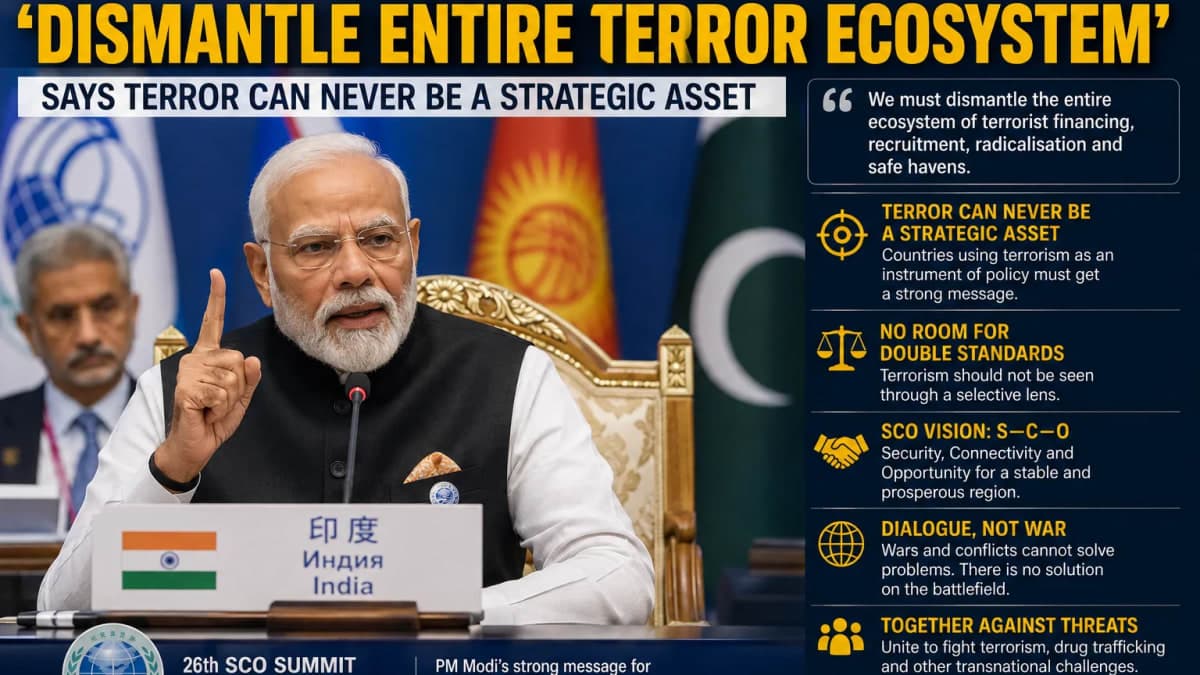
“We must dismantle the entire ecosystem of terrorist financing, recruitment, radicalisation, and safe havens,” Modi said.
He also urged SCO countries to adopt a consistent approach to the issue, saying there should be no place for “double standards” in combating terrorism.
His remarks came at a summit attended by leaders including Pakistan Prime Minister Shehbaz Sharif, Chinese President Xi Jinping and Russian President Vladimir Putin, among others.
Modi: Terrorism Cannot Be a ‘Strategic Asset’
One of the strongest portions of Modi's address focused on governments that provide support or sanctuary to terrorists.
Without naming a particular country in that section of his official speech, Modi said countries that use terrorism as an instrument of policy and provide shelter or support to terrorists should receive an unequivocal message.
“Terrorism can never be a strategic asset for anyone,” he said.
The presence of Pakistan's Prime Minister Shehbaz Sharif gave the remarks additional diplomatic significance, and multiple Indian media reports interpreted them as a message directed in part at Pakistan.
However, Modi did not explicitly name Pakistan while making those remarks in the official text of his address.
That distinction is important: the criticism of countries supporting terrorists is confirmed from Modi's speech, while identifying Pakistan as the specific target is an interpretation based on the wider context of India-Pakistan relations and India's longstanding allegations concerning cross-border terrorism.
Beyond an ‘Action-Reaction’ Approach
Modi argued that counterterrorism policy should not be limited to reacting after attacks occur.
Instead, his comments outlined a preventive approach targeting several stages of the terrorist infrastructure: financing, recruitment, radicalisation and safe havens.
That framing broadens the counterterrorism challenge beyond armed groups themselves.
Financing can sustain networks and operations; recruitment provides personnel; radicalisation can generate future members and supporters; and safe havens can give organisations space to organise and operate.
By identifying all four areas, Modi's message to the SCO was that counterterrorism cooperation should focus on disrupting the infrastructure that enables terrorist organisations to survive.
Security Becomes First Pillar of India's SCO Vision
Modi organised India's broader vision for the SCO around three words:
S — Security
C — Connectivity
O — Opportunity
Security occupied the first position.
The Prime Minister linked peace and stability with the SCO region's ability to pursue economic development and deeper cooperation.
He also referred to threats beyond terrorism, including drug trafficking and other transnational security challenges.
The emphasis reflects the SCO's origins as an organisation with a strong focus on regional security, even as its agenda has expanded into economic, diplomatic, cultural and connectivity issues.
India Backs Connectivity — With a Sovereignty Condition
Connectivity formed the second pillar of Modi's SCO framework.
India, he said, supports initiatives that connect markets, facilitate trade and create new routes for development.
But he attached an important condition.
Connectivity projects, Modi said, must respect the sovereignty and territorial integrity of all countries.
The formulation is consistent with India's established position that major regional infrastructure projects should respect national sovereignty.
The issue has particular geopolitical significance because the SCO brings together India and China alongside Russia, Pakistan and Central Asian countries with differing strategic and connectivity priorities.
Modi Says Wars Cannot Be Solved on Battlefield
The Prime Minister also used the summit to address ongoing international conflicts.
Modi reiterated India's preference for diplomatic solutions, saying wars and conflicts should ultimately be resolved through dialogue and diplomacy rather than military means.
“There is no solution on the battlefield,” he said.
His comments came as the SCO discussed security challenges extending well beyond its immediate membership.
West Asia Crisis Has Global Consequences, Modi Says
Modi specifically referred to instability in West Asia to argue that modern conflicts rarely remain geographically contained.
He said disruptions originating in one region can affect countries elsewhere through energy security, maritime trade and global supply chains.
According to Modi, countries in the Global South can bear a particularly heavy cost from such disruptions.
The argument connected India's security message at the SCO with economic concerns: instability can affect not only governments and military calculations but also fuel supplies, shipping routes, prices and trade.
Afghanistan Remains Part of SCO Security Discussion
Afghanistan also featured in Modi's remarks.
He said the SCO's objective of building a peaceful and secure Eurasian region was closely connected to peace and stability in Afghanistan.
India, Modi said, has contributed to development and humanitarian assistance for the Afghan people and would continue doing so.
Afghanistan remains particularly relevant to the SCO because several member countries either border the country or have direct security and economic interests in its stability.
People-to-People Cooperation Forms Part of the Long-Term Vision
Modi's speech was not limited to security.
Under the “Opportunity” component of India's SCO vision, he emphasised civilisational connections, youth engagement and people-to-people cooperation.
He highlighted initiatives including the SCO Start-up Forum, Young Authors' Conclave and Young Scientists' Forum.
Modi also referred to India's earlier proposal for an SCO Civilizational Dialogue Forum, saying its first meeting would be held in India this year.
The initiatives indicate India's attempt to position SCO cooperation as broader than government-to-government security diplomacy.
Why Modi's Terrorism Message at SCO Matters
The setting makes the Prime Minister's remarks particularly significant.
The SCO brings together countries with different—and sometimes competing—security interests, including India, China, Russia and Pakistan.
Reaching agreement on terrorism can therefore involve difficult questions over how terrorist organisations are identified, which groups should face international action and how responsibility for providing financing or safe havens should be determined.
Modi's insistence on eliminating “double standards” directly addresses that problem from India's perspective.
Rather than restricting the discussion to individual attacks or terrorist organisations, his speech sought to put the entire support architecture—money, recruitment, radicalisation and sanctuary—at the centre of the debate.
A Security Message With a Wider Diplomatic Context
Modi's intervention at the 26th SCO Summit ultimately combined three themes: security, economic connectivity and diplomatic engagement.
His strongest language, however, was reserved for terrorism.
The Prime Minister's message was that responding to individual terrorist attacks is insufficient if the structures that finance, recruit, radicalise and shelter terrorist networks remain intact.
Whether SCO members can translate that principle into coordinated policy is a separate question.
But India's position at the Bishkek summit was clear: terrorism should not be treated selectively, governments should not regard terrorist organisations as instruments of strategic policy, and regional cooperation should target the broader ecosystem that allows terrorism to survive.