PM Modi Begins Central Asia Visit Ahead of SCO Summit in Kyrgyzstan
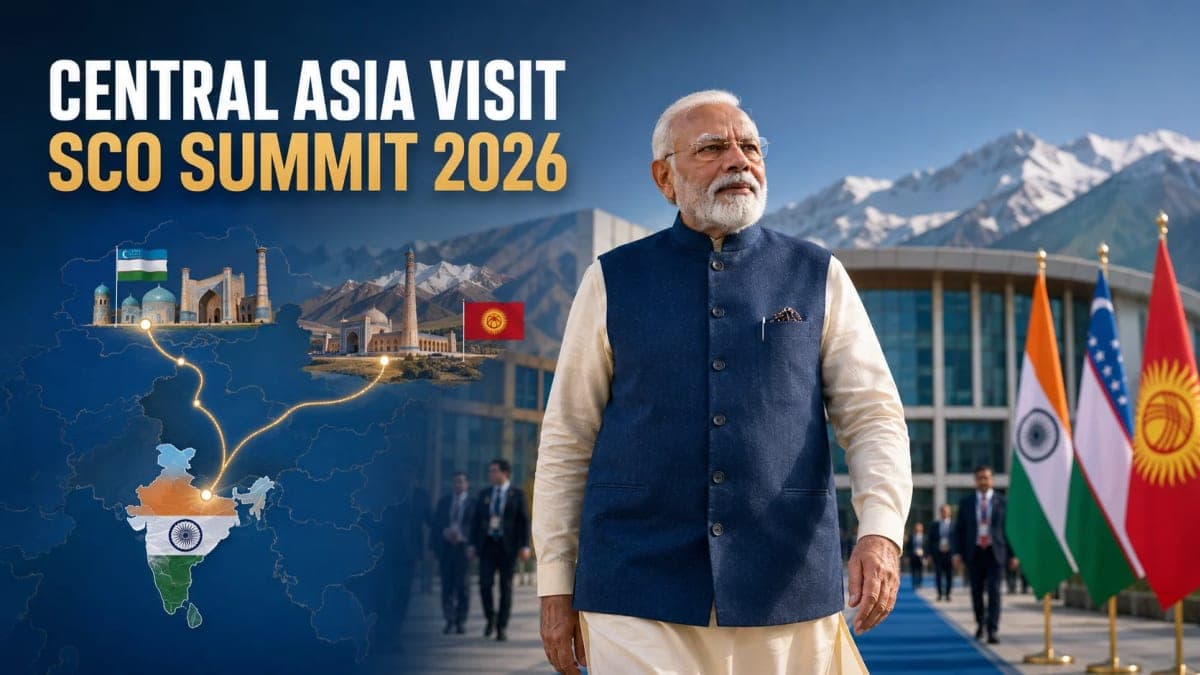
Prime Minister Narendra Modi has begun a four-day visit to Uzbekistan and Kyrgyzstan aimed at strengthening India’s partnerships in Central Asia and advancing New Delhi’s regional priorities at the Shanghai Cooperation Organisation summit.
The August 29–September 1, 2026, visit starts with bilateral engagements in the Uzbek capital, Tashkent. Modi will then travel to Bishkek, Kyrgyzstan, for the 26th SCO Summit, scheduled for August 31 and September 1.
The trip brings together two strands of India’s regional diplomacy: closer cooperation with individual Central Asian countries and engagement with a larger organisation whose members hold different—and sometimes competing—security and economic interests.
First Stop: State Visit to Uzbekistan
Modi is visiting Tashkent on August 29 and 30 at the invitation of Uzbek President Shavkat Mirziyoyev. It is his fourth visit to Uzbekistan, reflecting the sustained diplomatic contact between the two countries.
Delegation-level talks are expected to review cooperation in trade, investment, defence, energy, education and digital connectivity. The two leaders are also set to consider how India’s Viksit Bharat 2047 ambitions could interact with Uzbekistan’s development programme for 2030.
Expanding commercial relations will be an important part of the discussions. India sees Uzbekistan as a significant partner because of its location, population and economic potential, while Uzbekistan is seeking technology, investment and diversified international partnerships.
However, deeper economic ties require more than high-level political support. Transport limitations, regulatory differences, payment arrangements and the absence of direct overland access between India and Central Asia continue to complicate trade.
Cultural Diplomacy on the Tashkent Agenda
During his stay in Tashkent, Modi is scheduled to visit the memorial dedicated to former Indian prime minister Lal Bahadur Shastri, who died in the city in January 1966 after signing the Tashkent Declaration.
He will also visit the Mahatma Gandhi Centre at the Tashkent State University of Oriental Studies. These engagements highlight the historical and cultural dimension of India–Uzbekistan relations alongside the visit’s economic and strategic agenda.
Such activities form part of India’s broader effort to build regional relationships through education, culture and people-to-people exchanges rather than through government agreements alone.
Modi to Attend 26th SCO Summit in Bishkek
The second part of the tour will take Modi to Kyrgyzstan at the invitation of President Sadyr Zhaparov. The 26th SCO Summit coincides with the organisation’s 25th anniversary.
India became a full SCO member in 2017 and has used the forum to raise concerns about terrorism, sovereignty and regional connectivity. Modi is expected to present India’s approach around three themes: security, connectivity and opportunity.
The prime minister has said India wants to work with other SCO members towards a region free from terrorism, separatism and extremism. These issues remain especially important for New Delhi because instability in the wider Eurasian region can affect India’s security and economic interests.
Modi is expected to address the summit and hold bilateral meetings with participating leaders. The official programme does not mean that every possible meeting reported in advance should be treated as confirmed unless formally announced.
Why the SCO Matters to India
The SCO provides India with a diplomatic platform that includes major Eurasian powers and Central Asian republics. Its membership includes countries with which India has strong partnerships as well as countries where significant political or security differences remain.
Participation allows New Delhi to remain involved in discussions concerning Afghanistan, counterterrorism, regional stability, energy cooperation and trade corridors.
The organisation is also a difficult diplomatic environment. Its members do not always agree on the meaning of terrorism, the design of connectivity projects or the rules that should govern regional cooperation. India has repeatedly argued that transport initiatives must respect sovereignty and territorial integrity.
Consequently, the value of the SCO lies partly in maintaining communication among countries whose interests do not fully align. It should not automatically be viewed as a bloc capable of resolving every disagreement among its members.
Central Asia’s Strategic Importance
Central Asia occupies an important position between South Asia, China, Russia, Europe and the Middle East. The region has substantial energy and mineral resources and is becoming increasingly relevant to conversations about supply chains, transport links and digital infrastructure.
For India, the region offers potential markets, energy partnerships and security cooperation. It also has historical and cultural connections with the subcontinent.
India’s central difficulty is geography. Pakistan lies between India and most Central Asian markets, while alternative routes through Iran and the Caspian region require considerable infrastructure and international coordination.
The International North-South Transport Corridor and Iran’s Chabahar Port could support wider connectivity, but turning these projects into dependable commercial routes remains a gradual process.
Security, Connectivity and Economic Opportunity
The three priorities identified by Modi are closely connected. Improved physical and digital links could increase trade, but economic corridors need a stable security environment. Similarly, counterterrorism cooperation is more effective when countries share information and agree on threats.
India will therefore seek practical cooperation while retaining its independent position on regional disputes. Progress is likely to be incremental, particularly because the SCO includes governments with contrasting strategic priorities.
World Nomad Games Add Cultural Dimension
Modi is also scheduled to attend the opening ceremony of the sixth World Nomad Games in Kyrgyzstan. The event showcases Central Asia’s traditional sports and cultural heritage.
His attendance adds a public-diplomacy element to a visit otherwise dominated by strategic and economic discussions. It also signals India’s attempt to engage with the region through cultural respect and civilisational connections.
What the Visit Could Achieve
The tour provides India with an opportunity to strengthen its relationship with Uzbekistan, engage Kyrgyzstan and communicate its regional priorities to the wider SCO membership.
Its immediate outcomes may include agreements, diplomatic commitments and new areas of bilateral cooperation. The more important measure, however, will be whether these commitments lead to higher trade, workable connectivity, educational exchanges, investment projects and stronger security coordination.
Modi’s visit underscores India’s intention to remain an active participant in Central Asian affairs. Yet its lasting significance will depend on sustained implementation after the summit concludes.
This article is based on reporting published by TOI.