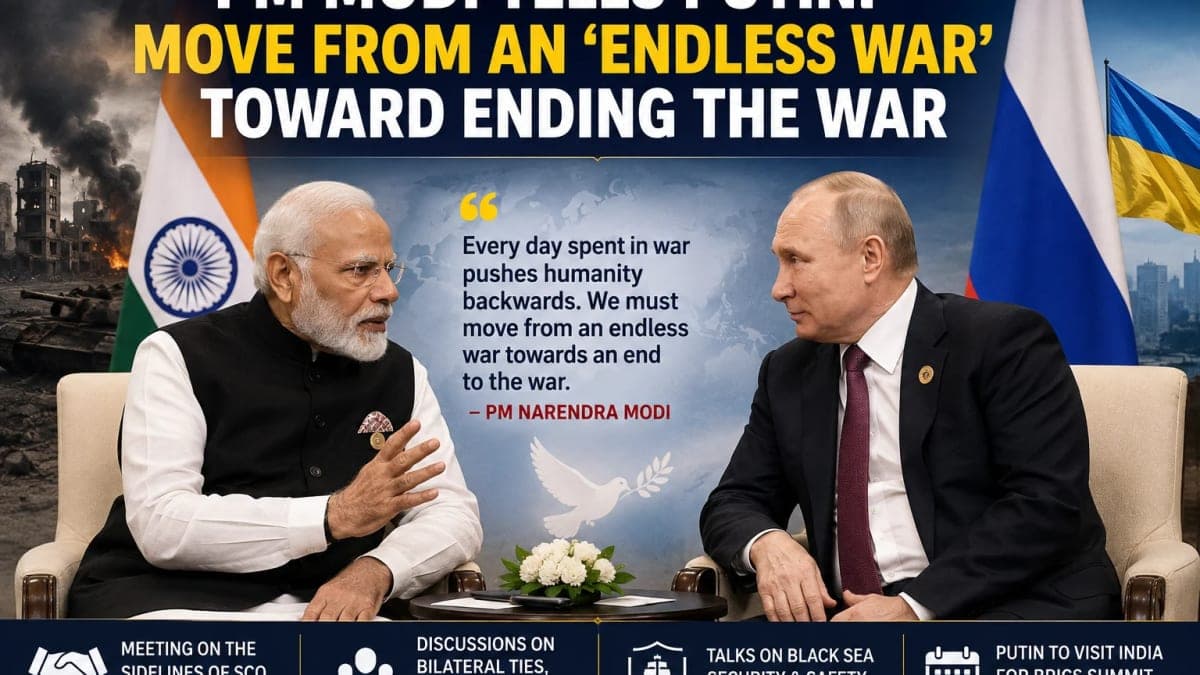
Prime Minister Narendra Modi delivered a renewed appeal for peace in Ukraine during talks with Russian President Vladimir Putin, saying the world needs to move away from an “endless war” and towards an end to hostilities.
The two leaders met on Monday, August 31, on the sidelines of the Shanghai Cooperation Organisation (SCO) summit in Bishkek, Kyrgyzstan. Modi reiterated India's position that dialogue and diplomacy should guide efforts to resolve conflicts and said New Delhi would continue supporting initiatives aimed at achieving peace.
His remarks were significant because India has maintained close strategic and economic relations with Russia throughout the Ukraine conflict while repeatedly calling for a negotiated settlement.
Modi: Every Day of War Pushes Humanity Backwards
During his opening remarks to Putin, Modi placed the humanitarian consequences of prolonged conflict at the centre of his message.
“Every day spent in war pushes humanity backwards, while every step taken towards peace fills humanity with a new hope and enthusiasm,” Modi said.
He then made one of his clearest appeals for ending the fighting:
“We must move from an endless war towards an end to the war. This is essential for the well-being of humanity.”
Modi added that India would continue supporting efforts aimed at peace.
The prime minister described the peaceful resolution of disputes as a “call of humanity” and invoked India's association with Mahatma Gandhi and Gautama Buddha to underline his message that disputes should ultimately be addressed through peaceful means.
Putin Responds to Modi's Peace Appeal
Putin acknowledged Modi's remarks during their exchange.
According to a Kremlin transcript cited by Reuters, the Russian president responded: “Thank you very much, Prime Minister. We are moving forward along this path.”
The Kremlin later said Putin briefed Modi on developments surrounding what Moscow calls its “special military operation” in Ukraine.
However, substantial differences between Russia and Ukraine over the conditions required to end the conflict remain unresolved. Moscow has maintained that a settlement must address its stated conditions, while Ukraine has rejected Russian demands it considers unacceptable.
That distinction is important: Modi's comments represented a diplomatic call for ending hostilities, but there was no announcement from the meeting of a ceasefire agreement or new peace framework.
India's Ukraine Position Remains Consistent
Modi's latest remarks build on a position India has articulated repeatedly since Russia launched its full-scale invasion of Ukraine in February 2022.
During a meeting with Putin in Samarkand in September 2022, Modi famously said that “today's era is not of war.”
During his Moscow visit in July 2024, Modi again argued that solutions to conflicts cannot ultimately be found on the battlefield.
The Bishkek message advances the same diplomatic theme but uses sharper language: the objective, Modi argued, should now be to move from continuing war towards ending it.
India has avoided publicly aligning itself entirely with either Moscow or Western governments over the conflict. Instead, New Delhi has maintained relations with Russia while advocating dialogue and diplomacy.
India-Russia Economic Ties Remain Important
The peace appeal came alongside discussions about the broader India-Russia relationship.
Modi praised the continuing development of economic ties between the two countries and emphasised the importance of advancing cooperation while protecting their respective national interests.
India remains one of the world's major purchasers of Russian oil. Energy trade between India and Russia expanded significantly after Western sanctions and restrictions reshaped global energy flows following Russia's invasion of Ukraine.
Beyond energy, India and Russia maintain cooperation across areas including defence, investment, trade, fertilisers and strategic affairs.
The Ministry of External Affairs said the leaders reviewed bilateral cooperation covering political, economic, defence, energy, space, mobility and people-to-people relations.
Black Sea Security and Indian Seafarers Also Discussed
The conversation extended beyond the broader Ukraine peace process.
According to India's Ministry of External Affairs, Modi and Putin exchanged views on regional and international developments, including conflicts affecting the Black Sea region and West Asia.
The impact of those conflicts on maritime commerce and the safety and security of Indian seafarers was also discussed.
This gives India's peace diplomacy an additional practical dimension: instability surrounding major maritime routes can directly affect Indian citizens, shipping networks, energy supplies and international trade.
Modi and Putin Highlight Their Strategic Partnership
Despite Modi's public appeal over Ukraine, the meeting also demonstrated the continuing strength of India-Russia relations.
The two countries describe their relationship as a “Special and Privileged Strategic Partnership,” and both leaders agreed to remain engaged in strengthening it amid wider geopolitical uncertainty.
After their bilateral discussions, Modi and Putin travelled together to the opening ceremony of the World Nomad Games in Bishkek.
Modi also referred to Putin as “my friend,” highlighting the personal rapport the two leaders have maintained alongside the institutional relationship between New Delhi and Moscow.
Putin Expected in India for BRICS Summit
The Bishkek meeting is not expected to be the final Modi-Putin engagement this month.
Modi said he looked forward to welcoming Putin to India for the 18th BRICS Summit scheduled for September 12–13, 2026.
That meeting could provide another opportunity for discussions on Ukraine as well as trade, energy and the broader India-Russia strategic relationship.
Why Modi's ‘Endless War’ Message Matters
Modi's comments reflect India's attempt to balance two important objectives.
New Delhi wants to preserve a longstanding strategic relationship with Moscow, particularly in areas such as energy and defence, while simultaneously presenting itself as a supporter of diplomacy and an eventual negotiated settlement in Ukraine.
The choice of words is therefore noteworthy.
Rather than announcing a specific peace formula or publicly endorsing the demands of either side, Modi framed ending the conflict as a humanitarian necessity.
For India, that approach allows it to continue engaging Russia directly while arguing that continued warfare carries costs far beyond Russia and Ukraine — affecting global trade, energy markets, maritime security and the broader international economy.
Whether those diplomatic appeals contribute to substantive negotiations will depend on decisions in Moscow and Kyiv and on the wider international diplomatic process. For now, Modi's message in Bishkek was unmistakable: continued warfare should give way to a path towards peace.