BJP Sharpens Attack on Rahul Gandhi’s Youth Campaign
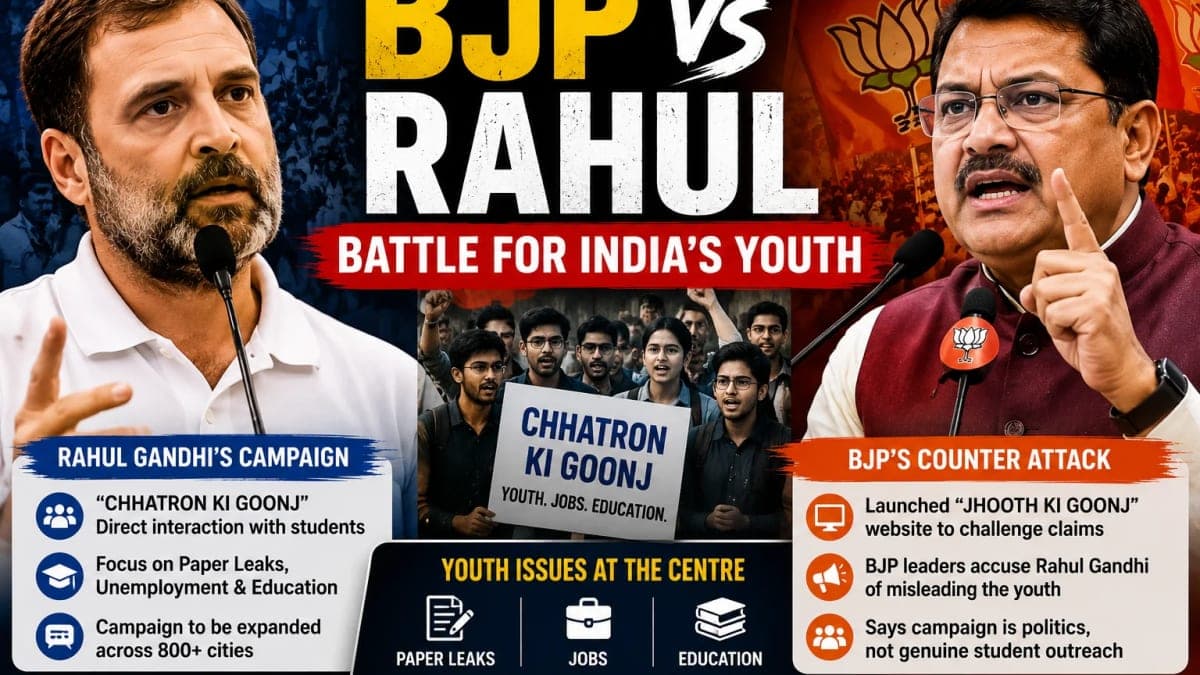
The political contest for India's young voters is becoming increasingly visible, with the Bharatiya Janata Party stepping up its criticism of Leader of Opposition Rahul Gandhi and his nationwide student outreach initiative, “Chhatron Ki Goonj.”
The latest confrontation came after BJP leaders highlighted a website titled “Jhooth Ki Goonj,” which presents itself as a response to claims made by Gandhi during his youth-focused programmes.
BJP spokespersons used the website to accuse the Congress leader of misleading young Indians and argued that his political allegations should be challenged with facts.
The attack represents another escalation in an increasingly aggressive political exchange surrounding Gandhi's attempt to place students, employment and education-related concerns at the centre of Congress's outreach.
What Is Rahul Gandhi’s ‘Chhatron Ki Goonj’ Campaign?
“Chhatron Ki Goonj” is a Congress-led initiative built around direct interactions between Rahul Gandhi and students.
The programme has focused on issues that have become politically important among younger Indians, including examination irregularities, paper leaks, recruitment problems, unemployment and the rising cost of education.
Rather than relying exclusively on traditional political rallies, the format gives students an opportunity to participate in conversations and raise concerns directly.
Congress has indicated plans to expand the initiative across hundreds of cities, potentially turning it into one of the party's largest organised youth outreach programmes.
That scale also helps explain why the campaign has attracted close attention from its political opponents.
BJP Brings ‘Jhooth Ki Goonj’ Into the Political Fight
The BJP's latest response has introduced another digital element into the confrontation.
Party leaders cited “Jhooth Ki Goonj,” a website that seeks to challenge statements associated with Gandhi's campaign.
BJP national spokesperson and MP Sudhanshu Trivedi was among the leaders who sharply criticised Gandhi, accusing him of spreading falsehoods and arguing that his attacks were motivated by political frustration.
Other BJP representatives also promoted the website through social-media posts.
The strategy suggests that the party does not intend to leave Congress's youth messaging unanswered. Instead, it is attempting to challenge the credibility of the campaign while offering its own interpretation of the issues Gandhi raises.
Pune Event Became Another Political Flashpoint
The confrontation had already intensified following a “Chhatron Ki Goonj” programme in Pune.
The event included an interaction with women students and focused on questions surrounding education, employment and women's role in society.
BJP Maharashtra vice-president Keshav Upadhye subsequently described Gandhi's programme as a political exercise rather than a genuine attempt to address student concerns.
The Congress rejected that criticism.
Congress national secretary Sachin Sawant argued that the BJP had become uncomfortable with the response Gandhi was receiving from young people.
The conflicting reactions illustrate how both parties are trying to define the meaning of the same campaign.
Congress presents it as a platform for students.
The BJP portrays it as opposition politics packaged as youth outreach.
Paper Leaks, Jobs and Education Become Political Battlegrounds
The significance of “Chhatron Ki Goonj” extends beyond Rahul Gandhi himself.
Several issues being raised through the campaign have already generated concern among students and job aspirants.
Competitive examinations affect millions of young Indians hoping to enter universities, professional courses or government employment. Allegations of paper leaks or recruitment irregularities can therefore quickly become politically sensitive.
Employment is another major factor.
For younger voters, political debates about economic growth are often experienced through a much more personal question: whether education will ultimately lead to a stable and meaningful job.
Congress is attempting to connect these concerns to a wider political argument about opportunities available to India's youth.
The BJP's increasingly forceful response indicates that it does not want the opposition to dominate that conversation.
Rahul Gandhi Pitches Youth as India’s Major Strength
During an earlier “Chhatron Ki Goonj” event in Prayagraj, Gandhi described India's young population as one of the country's greatest strengths.
He linked his message to three themes — “dard, data and daulat,” or pain, data and wealth — while arguing that young Indians face pressures ranging from expensive education and unemployment to problems surrounding recruitment examinations.
His speeches have also included direct criticism of the BJP and RSS.
That combination means “Chhatron Ki Goonj” operates on two levels.
It provides Congress with a platform to discuss student concerns, while simultaneously giving Gandhi a stage from which to challenge the ruling party's political and economic record.
BJP Is Building Its Own Gen Z Outreach
The political competition is not limited to attacking Congress.
The BJP has also been developing strategies aimed specifically at younger Indians.
That is important because India's Gen Z electorate is becoming an increasingly significant political constituency.
Young people consume political information differently from previous generations. Instagram, YouTube, short-form videos, online creators, memes and digital communities can shape political conversations alongside television, newspapers and conventional rallies.
Political parties therefore need more than speeches from large stages.
They increasingly need messaging designed for smartphones and direct digital engagement.
The competing youth initiatives suggest that both the BJP and Congress recognise this transformation.
Why Young Voters Matter So Much
The political battle over young Indians could become increasingly important as parties prepare for future elections.
First-time voters and younger adults represent a substantial section of India's electorate, but they cannot automatically be treated as a single political bloc.
Their priorities can vary considerably.
Some may place employment at the top of their agenda. Others may focus on entrepreneurship, education, national security, inflation, technology, social issues or opportunities for economic mobility.
This makes youth politics particularly competitive.
Winning younger voters requires more than creating a campaign specifically labelled for them. Parties must convince them that proposed solutions can actually improve their opportunities.
Digital Politics Enters a New Phase
The emergence of “Jhooth Ki Goonj” alongside “Chhatron Ki Goonj” also demonstrates how political campaigning is changing.
Opposition campaigns can now generate digital counter-campaigns almost immediately.
A political speech can be clipped, challenged and redistributed across social platforms within hours. Websites, videos, graphics and short posts can all become instruments in a wider battle over political credibility.
This creates opportunities for voters to compare competing claims.
But it also creates risks.
When political communication becomes dominated by accusations and counter-accusations, substantive questions about employment, examinations and education can become secondary to the fight over who controls the narrative.
Balanced Analysis: The Real Test Is What Parties Offer Young Indians
Both sides have clear political incentives.
For Congress, “Chhatron Ki Goonj” provides Rahul Gandhi with an opportunity to establish a direct connection with students while highlighting issues on which the opposition believes the government is vulnerable.
For the BJP, allowing those claims to circulate without challenge could enable Congress to shape perceptions among a strategically important group of voters.
Its aggressive counterattack is therefore politically understandable.
But neither criticism nor outreach alone will ultimately determine whether young voters are persuaded.
The more important question is what each party offers on education quality, affordable learning, transparent examinations, recruitment, skills development, entrepreneurship and employment.
Political messaging may attract attention.
Policy outcomes are more likely to determine whether that attention becomes lasting support.
Youth Could Become One of India’s Biggest Political Battlegrounds
The confrontation surrounding “Chhatron Ki Goonj” offers an early indication of how important young voters may become in India's next phase of electoral politics.
Rahul Gandhi is attempting to build a political narrative around the frustrations and aspirations of students.
The BJP is simultaneously challenging his credibility while strengthening its own youth engagement.
As both sides compete for attention, India's students and young voters are likely to hear increasingly aggressive claims about who understands their problems better.
Ultimately, however, they will have their own opportunity to judge those claims.
For India's political parties, the battle for Gen Z may increasingly depend not on who speaks the loudest, but on who can demonstrate the most credible path from education to opportunity.
This article is based on reporting published by TOI.