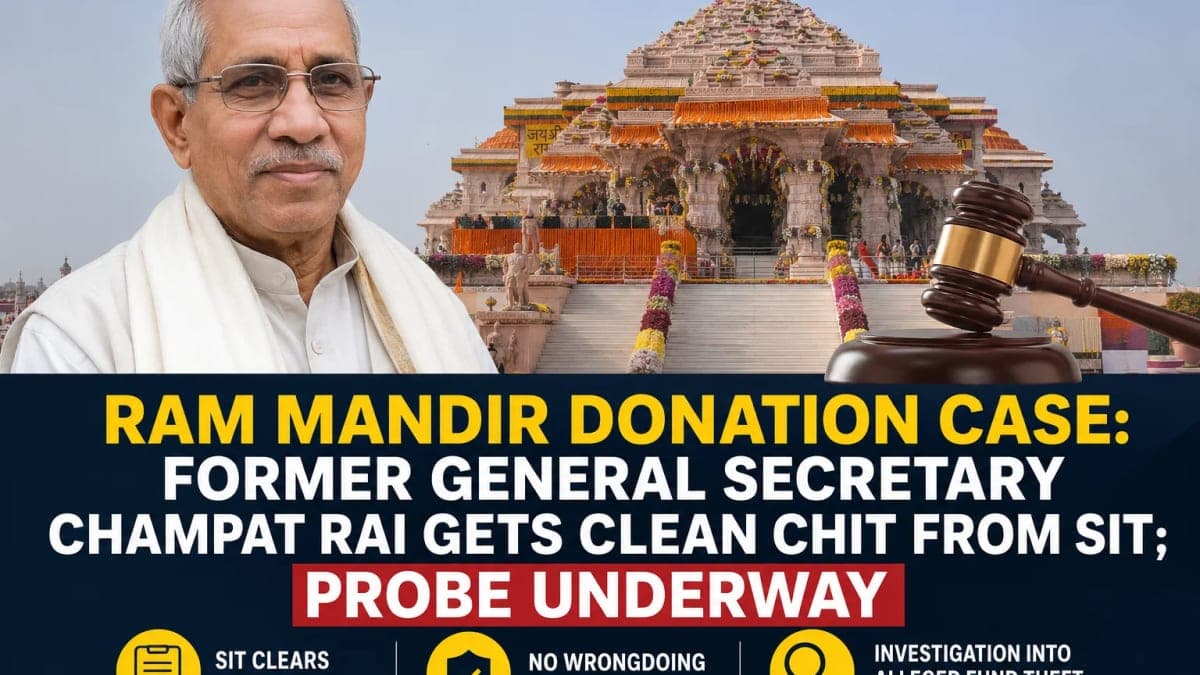
Ram Mandir Donation Case: Champat Rai Gets Relief in SIT Report
Ayodhya: Former Shri Ram Janmabhoomi Teerth Kshetra Trust general secretary Champat Rai has received a clean chit in the Special Investigation Team’s inquiry into the alleged theft and misappropriation of donations made to the Ram Mandir in Ayodhya.
According to an official statement reported on Tuesday, the Uttar Pradesh Home Department has submitted the SIT’s final report to the Shri Ram Janmabhoomi Teerth Kshetra Trust. The report clears both Champat Rai and former trustee Anil Mishra of wrongdoing in connection with the alleged theft of temple donations.
The finding marks an important development in a controversy that has drawn attention not only because of the money involved but also because the Ram Mandir receives donations from devotees across India and abroad.
How the Donation Controversy Developed
The controversy emerged following allegations of financial irregularities in the handling of offerings and donations received at the Ayodhya temple. Authorities began examining procedures surrounding the receipt, counting, custody and deposit of donations.
An SIT was constituted to investigate the allegations, while an FIR was registered following an interim report. Champat Rai and Anil Mishra subsequently stepped down on moral grounds as scrutiny of the temple administration intensified.
Investigators also recorded Rai’s statement and sought information about how donations were collected, counted, secured and ultimately deposited. Rai denied involvement in the alleged theft and maintained that he had acted after becoming aware of concerns surrounding the donations.
SIT Findings Bring Major Relief for Champat Rai
The final SIT finding is significant because earlier stages of the controversy had generated questions over whether senior trust officials could face responsibility for the alleged irregularities.
The final report, however, has cleared Rai and Mishra of wrongdoing in the alleged donation theft. This distinction is important: a clean chit for particular senior officials does not by itself mean that every allegation or every aspect of the wider case was unfounded.
Investigative and legal attention has also focused on other individuals and on how the temple’s donation-management system operated. Authorities have previously made arrests and examined records and documents as part of the broader case.
Earlier Trust Review Also Found No Wrongdoing by Rai
Before the latest reported SIT conclusion, the Ram Mandir Trust had separately said that it found no wrongdoing by Champat Rai during its own deliberations.
Trust officials also maintained that gold and silver donated to the temple remained safe and accounted for. At the same time, administrative changes were introduced following the controversy.
The SIT’s final findings therefore add an investigative dimension to the earlier position taken by the trust regarding Rai.
Why the Case Matters
The Ram Mandir is one of India’s most prominent religious institutions, and its construction and administration have attracted extraordinary public attention. Donations to such an institution depend heavily on confidence that money and valuables offered by devotees are handled transparently.
For that reason, the controversy goes beyond determining whether an individual office-bearer committed wrongdoing. It also raises broader questions about financial controls, accountability, auditing procedures and the systems used to manage large volumes of religious donations.
Earlier reporting on the SIT inquiry indicated that investigators had examined administrative and supervisory weaknesses and that structural reforms in temple management were among the issues raised during the investigation.
Accountability and Institutional Reform Remain Key
Rai’s clearance is an important outcome for him personally because it separates him from allegations of direct wrongdoing in the SIT’s final findings.
However, the controversy has also highlighted the difference between individual criminal responsibility and institutional accountability.
Even where senior officials are not found personally responsible for alleged theft, an organisation managing substantial public donations can still face questions about whether its internal safeguards were strong enough to prevent irregularities.
Stronger documentation, independent audits, clearly defined responsibilities, secure donation-counting procedures and transparent financial reporting could therefore remain important lessons from the episode.
Balanced Analysis
The SIT’s clean chit should be treated as a significant investigative finding rather than overshadowed by earlier speculation surrounding Champat Rai. Allegations against an individual should ultimately be judged on evidence, and the final report reportedly finds no wrongdoing by Rai or Mishra in connection with the alleged donation theft.
At the same time, clearing senior officials does not automatically answer every governance question raised by the controversy. The wider investigation and legal process concerning alleged misappropriation can establish responsibility wherever evidence supports it.
For the Ram Mandir Trust, the longer-term challenge will be ensuring that its financial systems inspire the same degree of public confidence as the religious institution itself.
Conclusion
The SIT’s final report represents a major development in the Ram Mandir donation controversy, giving former general secretary Champat Rai and former trustee Anil Mishra relief from allegations of wrongdoing connected with the alleged theft.
With the report submitted to the Shri Ram Janmabhoomi Teerth Kshetra Trust, attention is likely to remain on the legal proceedings involving other aspects of the case and on any administrative reforms adopted to strengthen the management of devotees’ donations.
This article is based on reporting published by mint.