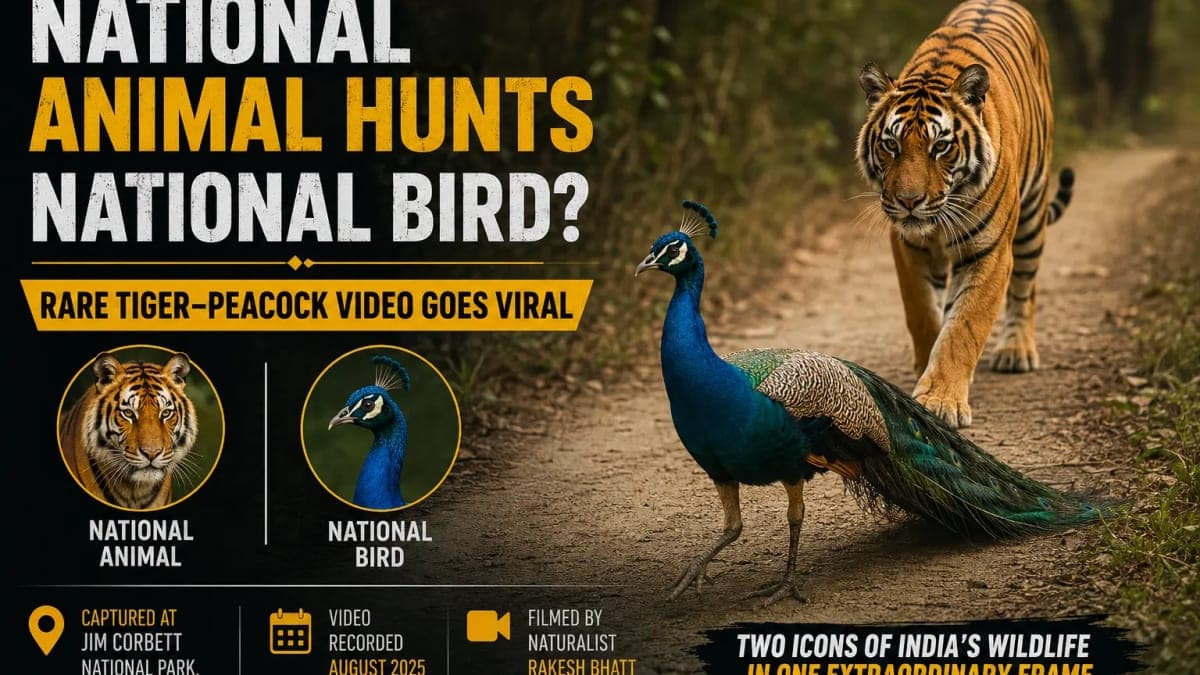
Tiger and Peacock Share a Rare Frame
Wildlife encounters can be unpredictable, but some moments stand out simply because of the species involved. A viral clip featuring a tiger and a peacock has become one such moment.
The footage was captured by naturalist Rakesh Bhatt and shows the tiger moving quietly along a forest path behind a peacock. Reports identified the location as Jim Corbett National Park in Uttarakhand. The video gained considerable attention after being shared around Independence Day, with viewers particularly drawn to the symbolism of seeing two of India's best-known wildlife icons together.
“National Animal Meets National Bird” Captures Attention
The unusual pairing gave the footage an additional layer of significance. The Government of India recognizes the tiger as the National Animal and the peacock as the National Bird. Government records state that the two were re-notified in these roles on May 30, 2011.
This connection helped transform an interesting wildlife sighting into a symbolic moment online. Social media users described the scene in terms of strength, beauty and India's natural heritage.
Chief Conservator of Forests Dr. P.M. Dhakate also shared the footage, crediting Rakesh Bhatt and highlighting the appearance of the national animal and national bird together in a single frame.
Was the Tiger Actually Hunting the Peacock?
Although the scene naturally creates suspense — and headlines describing it as the national animal “hunting” the national bird are attention-grabbing — the visible sequence should be interpreted carefully.
Reports describing the footage say the tiger is walking quietly behind the peacock. The available accounts do not establish that the tiger successfully attacked, caught or killed the bird.
That distinction matters when viral wildlife videos are presented as news. Animal behaviour can easily be misinterpreted when a short clip is viewed without the moments immediately before or after it.
Why the Video Matters Beyond Its Viral Appeal
The popularity of the footage highlights the public fascination surrounding India's wildlife. Tigers occupy the role of apex predators in many forest ecosystems, while Indian peafowl are among the country's most recognizable birds.
Both animals also carry significant conservation importance. Government information notes that tigers and peacocks receive protection under India's wildlife-protection framework, while important habitats have been designated as protected areas.
The viral clip therefore offers more than an unusual visual. It provides an opportunity to draw attention toward the habitats that allow different species — predators, birds and countless other animals — to coexist within functioning ecosystems.
Social Media Virality and Wildlife Awareness
Short wildlife videos can introduce millions of people to scenes they may never experience personally. That visibility can encourage curiosity about forests, biodiversity and conservation.
At the same time, viral content often attracts dramatic captions that may go beyond what a short video can actually prove. Responsible sharing means separating what is clearly visible from assumptions about an animal's intentions.
In this case, the confirmed spectacle is compelling enough: India's national animal and national bird were captured moving through the same natural landscape in an exceptionally memorable frame.
Balanced Analysis
The tiger-peacock video succeeds on two levels. Visually, it presents a rare encounter between two iconic species. Symbolically, it connects strongly with India's wildlife identity, which explains why the footage attracted such enthusiastic reactions around Independence Day.
However, describing the encounter definitively as a “hunt” risks overstating what the available footage establishes. A tiger following another animal may suggest predatory interest, but a short video alone cannot necessarily confirm the full behavioural context.
The larger takeaway is the biodiversity represented by the scene. Viral wildlife encounters can generate valuable interest in conservation, provided that fascination is accompanied by accurate descriptions and respect for wild animals and their habitats.
This article is based on reporting published by The Indian Express.