Panel Recommends Higher WMA Limit
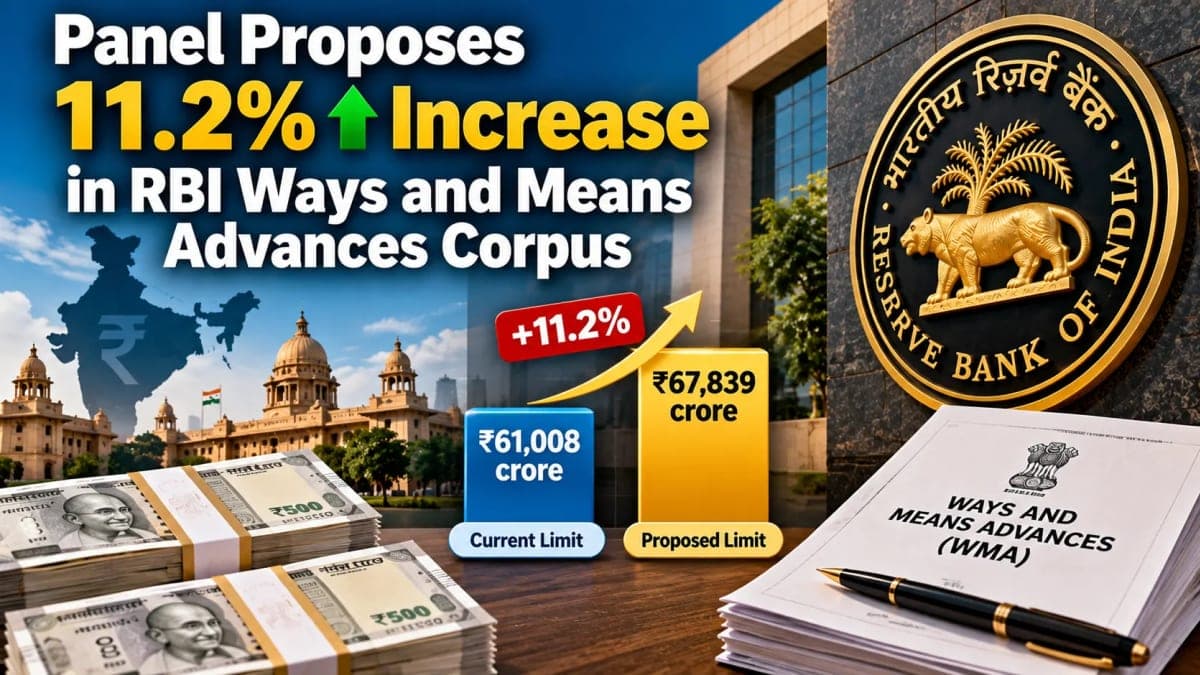
A Reserve Bank of India-appointed panel has proposed increasing the aggregate Ways and Means Advances (WMA) limit for states to ₹67,839 crore, an increase of 11.2% from the current ₹61,008 crore.
The committee, headed by former Karnataka Additional Chief Secretary I S N Prasad, was constituted on April 30, 2026. It recommended linking state-wise WMA limits primarily to revenue receipts, rather than total expenditure. The RBI released the committee's report on September 29.
What Are Ways and Means Advances?
WMA is a short-term funding facility provided by the RBI to help state governments manage temporary gaps between their cash receipts and payments. It is designed as a cash-management mechanism rather than a way to finance regular budget deficits.
The higher proposed limit reflects the expansion in state budgets and the possibility that governments may require greater short-term liquidity support.
Annual Increase Could Be Capped at 4%
The committee has also recommended reviewing WMA limits every year using the latest three years of accounts data. Future annual increases should generally be capped at 4%, while no state's revised limit should fall below its existing level.
It also proposed stricter overdraft rules, including reducing the maximum continuous overdraft period from 14 working days to 10 and the quarterly ceiling from 36 working days to 30.
Why the Proposal Matters
A larger WMA limit could give states more room to deal with short-lived cash-flow pressures without immediately turning to market borrowing. At the same time, tighter overdraft rules reinforce the principle that RBI liquidity support should remain temporary.
The panel also cautioned against states concentrating too much market borrowing in the final quarter of the financial year, as heavy issuance over a short period could increase borrowing costs.
The ₹67,839 crore figure remains a committee recommendation, rather than an already implemented new WMA limit.