Youth-Led CJP’s ‘School Thik Karo’ Campaign Gains Political Attention
A campaign that began with an inspection of a government school in rural Maharashtra is rapidly developing into a wider debate over the condition of India’s public education system.
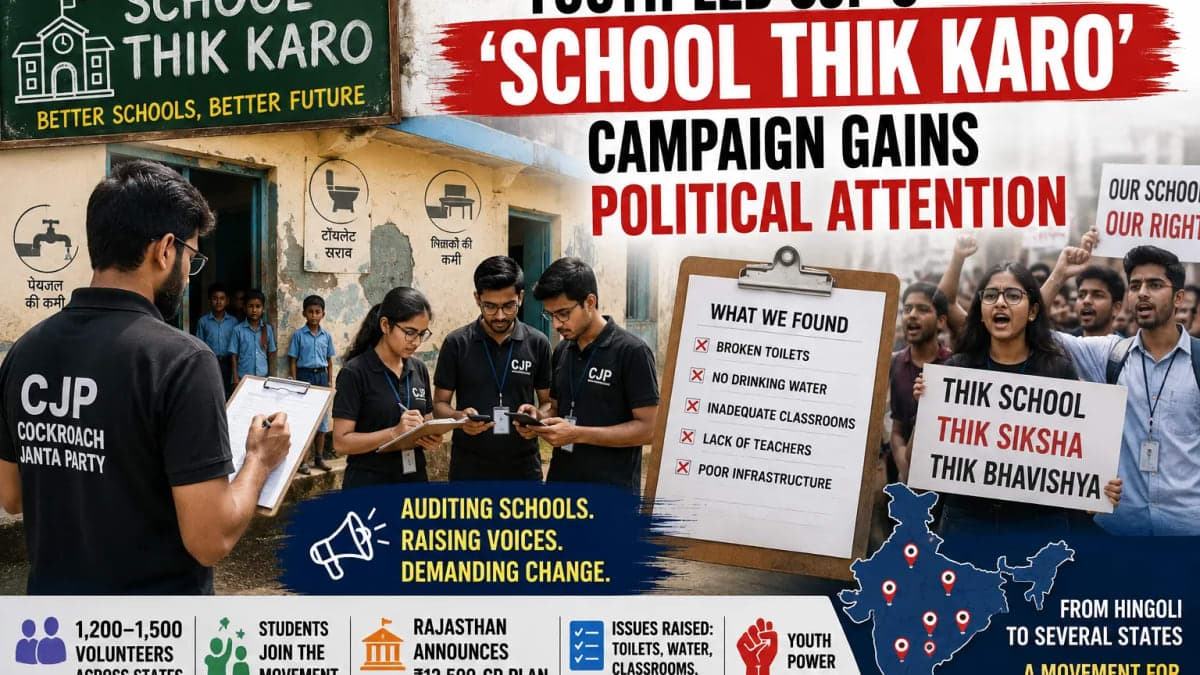
The Cockroach Janta Party (CJP), led by founder and convenor Abhijeet Dipke, launched its “School Thik Karo” campaign on Independence Day, August 15, with the aim of encouraging citizens to examine conditions at government schools and demand improvements where basic facilities are missing.
What initially appeared to be a local infrastructure campaign has since expanded into several states, attracting students, volunteers, social media users, education officials and political attention.
The campaign is particularly notable for its focus on everyday problems that directly affect students — toilets, drinking water, benches, classrooms, electricity, cleanliness, teachers and building safety.
Campaign Began From a Government School in Hingoli
The initiative began at a Zilla Parishad school in Santuk Pimpri village in Maharashtra’s Hingoli district, where Dipke conducted an infrastructure audit.
The exercise highlighted deficiencies including problems with safe drinking water, insufficient benches, poor toilet conditions, broken windows and inadequate infrastructure.
Instead of restricting the campaign to one school, CJP encouraged citizens elsewhere to conduct similar audits and document the conditions they encountered.
The idea was relatively straightforward: inspect public schools, identify problems, document them and seek action from the relevant authorities.
That approach helped the campaign spread rapidly through social media.
Hundreds of Volunteers Join School Audits
The campaign soon moved beyond its original location.
According to CJP representatives cited in media reports, roughly 1,200 to 1,500 volunteers participated in school audits during the early phase of the movement.
Reports from different locations highlighted issues ranging from inaccessible or poorly maintained toilets and drinking-water shortages to classrooms without fans, damaged infrastructure and shortages of teaching staff.
The campaign encourages participants to record these deficiencies and raise them with local authorities while using social media to increase public visibility.
The scale of participation has helped transform what began as a local initiative into a broader conversation about government-school infrastructure.
Students Add Their Voices to the Movement
One of the most significant developments has been the participation of schoolchildren themselves.
Students in different parts of the country have been raising concerns about the physical condition of their schools and demanding basic facilities.
That gives the campaign a different political dimension.
Education debates in India often revolve around examinations, admissions, curriculum and competitive tests. “School Thik Karo,” however, puts attention on something more fundamental: whether children have safe classrooms, functioning toilets, clean drinking water, enough teachers and basic learning infrastructure.
By placing these issues at the centre of public discussion, the campaign has made school infrastructure increasingly difficult for political parties and governments to ignore.
Rajasthan Announces ₹12,500-Crore School Infrastructure Plan
The campaign has attracted particular attention in Rajasthan.
Amid public scrutiny over school conditions, student protests and approaching local elections, the Rajasthan government announced a major ₹12,500-crore programme to improve school infrastructure over three years.
The development came as pressure over government-school facilities was growing, with CJP’s campaign and opposition demands adding to the political debate.
It would be too simplistic to attribute such a large government programme entirely to a single campaign. Education budgets and infrastructure decisions involve multiple administrative and political factors.
However, the timing illustrates how school conditions have become an increasingly visible political issue.
Political Parties Are Taking Notice
The growing campaign highlights a broader change in youth-focused politics.
Young voters have traditionally been approached through issues such as employment, examinations, recruitment and higher education.
“School Thik Karo” shifts some of that attention towards younger students and the quality of basic public services available to them.
The campaign’s message also has potential political reach because government schools serve families across rural, semi-urban and urban India.
Problems involving toilets, classrooms, teachers and drinking water are not abstract policy questions. They are visible problems that parents and students experience directly.
That makes education infrastructure an issue capable of crossing conventional political divisions.
Maharashtra Authorities Monitor Complaints
The campaign has also attracted attention from Maharashtra’s education authorities.
As videos and reports about school conditions circulated online, officials indicated that complaints and social-media reports were being monitored so legitimate problems could be addressed.
Meanwhile, campaign activity expanded into Mumbai municipal schools.
CJP representatives also approached the Brihanmumbai Municipal Corporation’s education authorities seeking permission for citizen audits of civic schools.
These developments demonstrate both the reach of the campaign and the administrative questions created by citizen-led inspections.
Campaign Also Faces Pushback
The movement has not expanded without controversy.
In Rajasthan, authorities issued guidelines restricting unauthorised entry, photography and videography on school premises after campaign-related activity.
In Mumbai, a civic-school headmaster lodged a complaint following an inspection by CJP members.
Separately, CJP founder Abhijeet Dipke faced an FIR in Maharashtra's Latur over allegations connected with entry into a school, disruption and threats to teachers.
These developments raise an important issue surrounding citizen audits.
Public scrutiny of government institutions can promote accountability, but schools are also controlled environments involving children, teachers and safety requirements. Inspections therefore need to balance transparency with permission requirements, student privacy and the normal functioning of classrooms.
Why ‘School Thik Karo’ Is Politically Significant
The campaign matters because it converts a broad policy subject — education reform — into a collection of highly visible local problems.
A damaged toilet can be photographed.
A classroom without enough benches can be documented.
A broken window, unsafe roof or non-functional water facility can be shown directly to parents, officials and millions of social-media users.
That makes infrastructure shortcomings easier for citizens to understand than complicated education statistics or budget documents.
Social media further changes the equation by allowing a problem at one village school to become part of a national discussion within hours.
From Online Videos to Accountability
One of the campaign’s strengths is its decentralised model.
Instead of depending entirely on a central organisation to visit thousands of schools, it encourages local residents and volunteers to document conditions themselves.
If carried out responsibly, such citizen participation can supplement formal government inspections and help authorities identify overlooked problems.
But viral visibility alone does not repair schools.
For the campaign to produce lasting results, complaints ultimately need to translate into administrative action, funding, repairs, teacher appointments and continued maintenance.
That will be a more meaningful measure of success than the number of videos or posts generated online.
A School in Hingoli Shows What Follow-Up Can Look Like
The school in Dipke’s native village, where the campaign began, subsequently received new benches and what Dipke described as its first computer system.
That provides an early example of how public attention can be followed by tangible improvements.
However, improving individual schools is very different from addressing infrastructure gaps across a vast public-school network.
The larger challenge will be creating systems that identify deficiencies regularly and ensure repairs do not depend on a school becoming viral on social media.
A Broader Debate About Public Education
The campaign also raises a deeper question about India's education system.
For millions of families, government schools remain central to accessing affordable education. When these institutions lack basic facilities, the consequences extend beyond physical discomfort.
Poor infrastructure can affect attendance, health, safety and the overall learning environment.
CJP has also raised concerns about the rising cost of private education and argued that stronger government schools are essential for ensuring that family income does not determine the quality of education available to a child.
That argument could help move the political debate beyond individual school repairs towards the broader role of public education.
Balanced Analysis: Activism Must Be Matched by Governance
“School Thik Karo” demonstrates how social media and youth participation can rapidly elevate local civic issues into national political conversations.
Its strongest contribution may be its simplicity: rather than debating education only through ideology or electoral promises, it asks whether a school actually has the facilities children need every day.
At the same time, campaigners must operate responsibly.
Schools cannot become unrestricted spaces for political activity or social-media content. Permissions, student privacy, classroom disruption and the rights of teachers must remain important considerations.
Governments, meanwhile, cannot use procedural concerns as a substitute for addressing genuine infrastructure deficiencies.
The most productive outcome would therefore combine responsible citizen scrutiny with transparent and timely government action.
What Happens Next?
The biggest test for “School Thik Karo” will be whether its early momentum produces lasting improvements.
The campaign has already succeeded in drawing attention to conditions inside government schools and placing basic education infrastructure more firmly in the political conversation.
But long-term impact will depend on measurable outcomes: repaired classrooms, functioning toilets, reliable drinking water, sufficient teachers, safer buildings and better learning environments.
If those changes follow, the campaign could become an example of how youth-led civic activism can influence public policy.
If attention fades without structural improvement, it risks becoming another short-lived social-media movement.
For now, however, “School Thik Karo” has managed to make the physical condition of government schools a much more visible political question.
This article is based on reporting published by TOI.