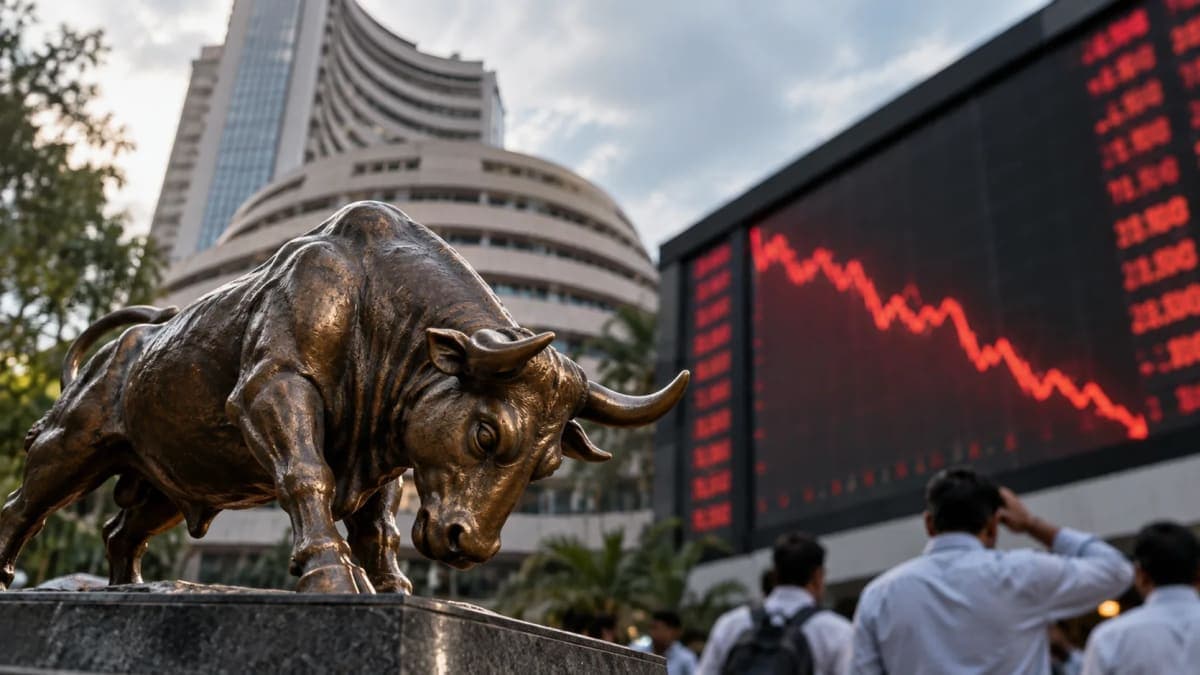
The Indian stock market has entered one of its most difficult stretches in recent months.
By the close of trading on September 15, the BSE Sensex had lost more than 2,900 points in September, while the benchmark NSE Nifty 50 had fallen to a five-month low.
The latest session intensified the damage. On September 15, the Sensex dropped 777.94 points, or 1.04%, to 74,003.82. The Nifty 50 fell 279.50 points, or 1.19%, to 23,118.60.
September has therefore become more than a routine bout of profit-taking.
Several pressures that investors can sometimes absorb individually—high crude oil prices, rising global bond yields, a weaker rupee, increasing domestic inflation and foreign institutional selling—are now appearing at the same time.
That combination helps explain why the market's mood has changed so quickly.
The Sensex Has Fallen More Than 2,900 Points This Month
The scale of the September correction becomes clearer when viewed beyond a single trading session.
The Sensex and Nifty managed to close higher on only two sessions during the month through September 15, according to market data reported by Business Standard.
Over the same period, the Sensex lost more than 2,900 points, while the latest sell-off took it to 74,003.82.
The Nifty's September 15 close of 23,118.60 was its lowest in about five months.
Importantly, the weakness has not remained confined to a handful of heavyweight stocks. On September 15, mid-cap and small-cap indices also fell by more than 2%, indicating broader risk reduction across the market.
Financial and automobile shares were particularly weak, while information-technology stocks provided an unusual pocket of support during the session.
Why Is the Indian Stock Market Falling?
There is no single trigger behind September's decline.
Instead, investors are repricing Indian equities against a less comfortable macroeconomic backdrop.
And the biggest change may be happening outside the stock market itself.
1. Crude Oil Above $100 Is a Problem India Cannot Easily Ignore
Brent crude was trading around $108 a barrel on September 15–16 as geopolitical tensions and supply disruptions kept energy markets under pressure.
That matters disproportionately for India because the country depends heavily on imported crude oil.
Expensive oil can affect the economy through several channels at once.
It can increase India's import bill, put pressure on the current account, raise costs for companies using fuel or petrochemical inputs, add to inflation and increase demand for dollars from oil importers.
Those effects can eventually feed into both corporate earnings expectations and interest-rate assumptions.
This is one reason the current oil rally is more significant for Indian equities than a normal short-term commodity fluctuation.
2. The Bond Market Is Giving Equity Investors Another Reason to Worry
The sell-off is not limited to India.
US Treasury yields have risen sharply, with the benchmark 10-year US yield moving above 5%, its highest level since 2007.
That changes the relative attractiveness of equities.
When investors can earn higher yields from government debt, the return they demand from riskier assets such as stocks generally increases.
Higher bond yields can therefore compress equity valuations—particularly for companies whose share prices depend heavily on profits expected many years into the future.
For emerging markets such as India, there is another complication.
Higher US yields can encourage international investors to shift capital toward dollar assets, making foreign flows into emerging-market equities less attractive at the margin.
3. The Federal Reserve Is Back at the Centre of the Market Story
Markets are also focused on the US Federal Reserve's September policy decision.
Investors have been pricing in another tightening step as inflation concerns remain elevated.
This matters to India even though the Federal Reserve sets US—not Indian—interest rates.
Higher US rates can strengthen the relative appeal of dollar assets and influence foreign capital flows, bond yields and currencies across emerging markets.
The impact becomes more important when the rupee is already under pressure.
4. The Rupee Has Slipped Close to 96 Against the Dollar
The Indian rupee closed at 95.9550 per US dollar on September 15, its weakest level in more than a month.
Higher crude prices are particularly uncomfortable for the currency because Indian oil importers require dollars to pay overseas suppliers.
A weaker rupee can then make imported commodities even more expensive in local-currency terms.
This creates a potential feedback loop:
Higher oil → larger dollar demand → weaker rupee → more expensive imports → greater inflation pressure.
Reuters reported that central-bank intervention likely helped prevent a larger decline in the currency during the September 15 session.
5. India's Inflation Numbers Have Also Turned Less Comfortable
The pressure from oil has arrived just as domestic inflation is moving higher.
Official Ministry of Statistics and Programme Implementation data show that India's Consumer Price Index inflation increased to 4.82% in August 2026, from 4.45% in July.
Food inflation was even higher at 5.95%.
That does not mean inflation is out of control.
But the direction matters to financial markets.
If oil remains expensive while domestic price pressures are already increasing, investors have more reason to consider the possibility that monetary conditions could remain tight—or become tighter.
That matters particularly for rate-sensitive sectors such as banking, financial services, automobiles and real estate.
Foreign Investors Are Selling, But Domestic Institutions Are Providing a Cushion
Foreign selling has added another layer of pressure.
On September 15 alone, foreign institutional investors sold Indian equities worth approximately ₹2,978 crore on a net basis, according to exchange data cited by Reuters.
Domestic institutional investors, however, bought approximately ₹2,686 crore.
That difference is important.
Foreign selling has undoubtedly contributed to market weakness, but India's large domestic institutional investor base is absorbing part of the supply.
Without that domestic buying, the effect of foreign withdrawals could potentially be more pronounced.
It also means the September decline should not simply be described as “foreign investors abandoning India.” The actual flow picture is more nuanced: overseas selling is being met, at least partly, by domestic institutional demand.
The Market Is Also Competing With a Busy IPO Pipeline
Another less obvious factor is the unusually active primary market.
A heavy schedule of IPOs can temporarily divert liquidity from already-listed shares as investors allocate capital to new offerings.
That does not by itself explain a 2,900-point Sensex decline.
But when secondary-market sentiment is already weak, the movement of liquidity toward new issues can add another source of pressure.
It is therefore better viewed as an amplifier, rather than the fundamental cause of the September correction.
Why Banks and Auto Stocks Are Feeling More Pressure
The September 15 sector performance offers clues about what investors are worried about.
Financial stocks fell about 1.8%, while automobile shares declined roughly 2%.
Both sectors are sensitive to interest rates and domestic economic conditions.
Higher borrowing costs can affect loan demand, consumer financing and valuation multiples.
Automakers face an additional challenge from energy and commodity costs.
By contrast, India's IT index gained approximately 2.2% during the September 15 session.
That divergence illustrates why describing the current episode simply as a broad “market crash” misses useful information. Investors are also rotating between sectors based on how they expect oil, rates, currencies and global technology trends to affect future earnings.
JantaScope Analysis: Why This Sell-Off Is Different From a One-Day Panic
The most useful way to understand September's decline is to separate market symptoms from the underlying macroeconomic mechanism.
The symptoms are obvious: falling stock indices, foreign selling, a weaker rupee and rising bond yields.
The underlying issue is that the price of money and energy is simultaneously becoming less favourable.
Oil above $100 increases India's external and inflation risks.
Higher US Treasury yields increase the opportunity cost of holding equities.
A weaker rupee can amplify imported inflation.
Higher domestic inflation reduces the flexibility available to the Reserve Bank of India.
And foreign investors comparing India with other markets now have to make that decision against much higher global risk-free yields.
None of these factors automatically implies a prolonged bear market.
But together they create a substantially more difficult environment for equity valuations than investors faced when oil and bond yields were lower.
There Is an Interesting Contradiction in India's Economy
The stock-market weakness should also not be confused with evidence that every part of India's economy is deteriorating.
India continues to show resilience in several underlying economic indicators.
At the same time, financial markets are forward-looking. Investors are not only asking how the economy performed last quarter—they are trying to estimate what expensive energy, higher interest rates and inflation could do to corporate profits over the next several quarters.
That distinction explains how economic growth can remain relatively strong while share prices decline.
Markets price expectations, not simply the latest GDP number.
One External-Sector Number Investors Should Not Miss
There is another important piece of context.
India recorded an overall Balance of Payments surplus of $20.8 billion in July 2026, according to RBI data, helped by unusually strong foreign-exchange inflows.
That provides a counterweight to the more negative market narrative.
It does not eliminate the risks from expensive crude oil or a weakening currency, but it demonstrates why India's external position cannot be judged from the rupee or equity market alone.
For investors, the crucial question is whether those capital inflows remain strong if global interest rates stay elevated.
What Investors Should Watch Next
Instead of focusing only on whether the Sensex rises or falls a few hundred points in the next session, several indicators can provide a clearer picture of whether September's pressure is becoming structural.
Brent crude: Sustained prices above $100 would keep India's import and inflation risks elevated.
US 10-year Treasury yield: A persistent yield above 5% would continue to challenge equity valuations globally.
Federal Reserve policy: The rate decision and guidance on future tightening will influence global capital allocation.
FII flows: Continued foreign selling would remain a headwind, particularly if domestic institutional buying weakens.
USD/INR: Further rupee depreciation could increase concerns around imported inflation.
Indian inflation: August CPI has already risen to 4.82%; future readings will determine whether this represents a sustained acceleration.
RBI policy expectations: Investors will increasingly assess whether inflation and currency pressure change the domestic interest-rate outlook.
The Bigger Picture
The Sensex losing more than 2,900 points in September is significant, but the number itself does not explain what is happening.
The more important story is the simultaneous shift in several financial variables.
Oil has surged above $100. US Treasury yields have crossed 5%. India's inflation has risen. The rupee has weakened toward 96 per dollar. Foreign investors have been selling.
Together, these developments are forcing investors to reconsider both corporate earnings assumptions and the valuations they are willing to pay for those earnings.
That makes the coming sessions particularly important.
A decline in oil or global bond yields could remove some of the macroeconomic pressure. Persistent strength in both would keep investors focused on inflation, interest rates, the rupee and corporate margins.
For now, September's 2,900-point Sensex decline is best understood not as the result of one dramatic trigger, but as the market's response to a noticeably tougher combination of oil, inflation, interest rates and global capital conditions.


