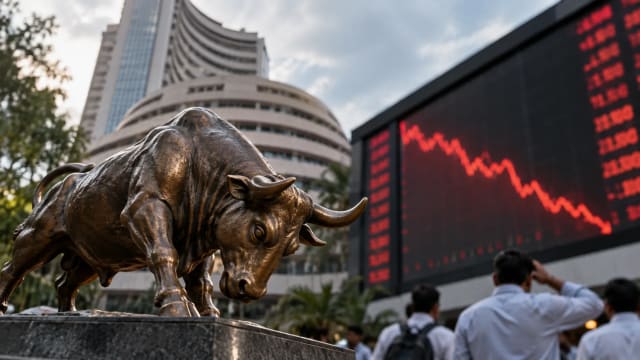
Nifty Ends at Five-Month Low as Selling Deepens
Indian equities enter Wednesday’s session facing an important test after the Nifty 50 closed at a five-month low on September 15, with a sharp reversal wiping out the market’s early gains.
The Nifty 50 dropped 279.50 points, or 1.19%, to 23,118.60, while the BSE Sensex fell 777.94 points, or 1.04%, to 74,003.82. The Nifty traded as high as roughly 23,588 during the session before finishing at its low, highlighting how selling strengthened as the day progressed.
The fall extended a difficult period for Indian equities. In the previous week, the Nifty had already recorded its fifth consecutive weekly decline, with the benchmark losing about 4.8% over five weeks.
There is, however, an early indication that Wednesday may begin more steadily. Reuters reported that GIFT Nifty futures were signalling a higher opening after Tuesday’s selloff, although elevated oil prices and uncertainty surrounding US monetary policy remain significant constraints.
That makes the next session less about whether stocks can bounce temporarily and more about whether the conditions behind the recent correction are beginning to change.
What Triggered Tuesday’s Sharp Fall?
The latest decline was not driven by a single company or sector-specific event. Several macro pressures converged at the same time.
1. Crude Oil Has Become a Major Problem for Indian Equities
Brent crude was trading around $108 a barrel early Wednesday after another strong rise. Reuters reported Brent around $108.3, while Tuesday's surge reflected continuing concerns over supply disruptions.
That matters disproportionately for India because the country is a major importer of crude oil.
Persistently expensive oil can increase India's import bill, put pressure on the rupee, complicate the inflation outlook and raise costs for businesses that depend heavily on fuel and petroleum-derived inputs.
In other words, the equity market is not simply reacting to a higher commodity price. Investors are assessing how long expensive energy could remain a drag on India's broader macroeconomic environment.
2. Bond Yields Are Competing With Equities
The second pressure is coming from global fixed-income markets.
The US 10-year Treasury yield has moved above 5%, while rising domestic bond yields have also reflected concerns about inflation and the possibility of tighter monetary conditions. Reuters reported that India's benchmark government bond yield reached a four-month high on September 15.
High bond yields matter for stocks in several ways.
They increase the return investors can potentially receive from comparatively safer fixed-income assets, increase discount rates used to value future corporate earnings and can make expensive equity valuations harder to justify.
The effect can become especially important for emerging markets when rising US yields are accompanied by a stronger dollar.
3. Foreign Investors Remain Net Sellers
Foreign institutional investors sold a net ₹2,977.86 crore of Indian equities on September 15, according to provisional market data cited in Wednesday's market reports.
Domestic institutional investors were buyers, purchasing a net ₹2,686.05 crore.
That contrast is significant.
Domestic institutions are absorbing part of the selling pressure, but Tuesday's figures show that their purchases did not fully offset foreign selling.
Continued foreign outflows could therefore remain an important variable for the Nifty, particularly if high US yields and a strong dollar keep global capital tilted away from emerging-market risk.
Rupee Weakness Adds Another Layer of Pressure
Equities are not the only Indian asset reacting to the global environment.
The rupee closed around ₹95.96 per US dollar on Tuesday, its weakest level in more than a month according to Reuters, as rising crude prices and expectations of tighter US monetary policy pressured the currency.
Reuters also reported that intervention by the Reserve Bank of India likely prevented a larger decline.
Oil, the rupee, inflation expectations and interest rates are therefore increasingly connected parts of the same market story.
If crude remains elevated, India's demand for dollars to finance energy imports can remain high. Persistent currency weakness can then add to imported inflation concerns, potentially complicating the RBI's policy choices.
The Selloff Was Broad — But IT Was a Major Exception
One of the clearest signs of Tuesday's weakness was the breadth of the decline.
Nifty Auto fell about 2%, financial services dropped around 1.9%, metals declined roughly 2.5%, energy lost around 2.1%, and realty fell about 4%, according to market data.
IT moved in the opposite direction.
The Nifty IT index gained approximately 2.2%, providing one of the few major pockets of support for the benchmark.
The divergence is important because it suggests investors are not abandoning Indian equities uniformly. Instead, money is being redistributed according to changing sensitivity to oil, interest rates, global technology developments and earnings expectations.
That distinction could matter if the broader market attempts a recovery.
Market Anxiety Has Clearly Increased
India VIX, widely used as a gauge of expected near-term market volatility, closed at approximately 13.43, rising more than 9% during Tuesday's session.
A rising volatility index alongside falling equity benchmarks indicates that investors are demanding greater protection against short-term market swings.
It does not by itself predict further declines, but it confirms that uncertainty has increased substantially.
Why the Federal Reserve Decision Matters So Much
The next major global trigger comes from Washington.
The Federal Reserve's official calendar confirms that its two-day Federal Open Market Committee meeting runs from September 15 to September 16, with the policy statement scheduled for 2:00 p.m. US Eastern Time on September 16, followed by the press conference at 2:30 p.m.
Markets are focused not only on the rate decision itself but also on what policymakers signal about inflation and the future path of interest rates.
Reuters reported that currency markets were pricing a high probability of a 25-basis-point US rate increase ahead of the decision.
For Indian investors, the transmission channel is straightforward: higher US rates can support US bond yields and the dollar, which can make emerging-market assets relatively less attractive and increase pressure on currencies such as the rupee.
Can Nifty Rebound From Here?
A short-term rebound after a sharp fall is possible, and early GIFT Nifty indications pointed toward a firmer opening on Wednesday.
But an opening bounce should not automatically be interpreted as the end of the correction.
The more useful question is whether the factors responsible for the decline begin to reverse.
Three developments would be particularly important.
Crude oil: A sustained retreat from the current elevated levels could reduce pressure on India's inflation, currency and corporate-cost outlook.
Global yields and the Fed: Stabilisation in US Treasury yields after the Federal Reserve decision could reduce one of the biggest external pressures on emerging-market valuations.
Foreign flows: A reduction in persistent FII selling would indicate that global investors are becoming less defensive toward Indian equities.
Without improvement in at least some of these variables, rallies could remain vulnerable to renewed selling.
A More Important Signal Than the Nifty Headline
One underappreciated feature of the current correction is that the benchmark alone may not fully capture investor stress.
Tuesday's Nifty decline was accompanied by sharp losses across several economically sensitive sectors and a rise in volatility, while IT bucked the broader trend.
That makes market breadth and sector participation especially useful indicators in the next rebound attempt.
If the Nifty rises primarily because a handful of heavyweight stocks recover while autos, financials, metals, realty and the broader market remain weak, the improvement would be relatively narrow.
A recovery accompanied by broader sector participation would represent a materially different market structure.
What Investors Should Watch on September 16
For Wednesday's market, five indicators deserve close attention: Brent crude around the $108 zone, the rupee near ₹96 per dollar, the direction of US Treasury yields, foreign institutional flows and the breadth of any Nifty recovery.
The Federal Reserve's policy announcement will then become the next major global catalyst.
The distinction is important: oversold markets can rebound even when the underlying macro pressures remain unresolved.
For that reason, the durability and breadth of any recovery may provide more information than the opening move itself.
Bottom Line
The Nifty's fall to 23,118.60, its lowest closing level in five months, reflects a combination of expensive crude oil, rising global yields, foreign investor selling and uncertainty over monetary policy rather than a single isolated shock.
Early indicators suggest Indian equities could attempt to stabilise after Tuesday's heavy selloff. But whether that becomes a sustained recovery will depend considerably on developments outside the stock market itself — particularly oil, bond yields, the rupee, foreign flows and the Federal Reserve.
The next move in the Nifty may therefore tell investors less than the forces driving that move.