South Korea has widened the reach of its espionage law, closing a gap that had made it difficult to use traditional spying charges in cases involving countries other than North Korea.
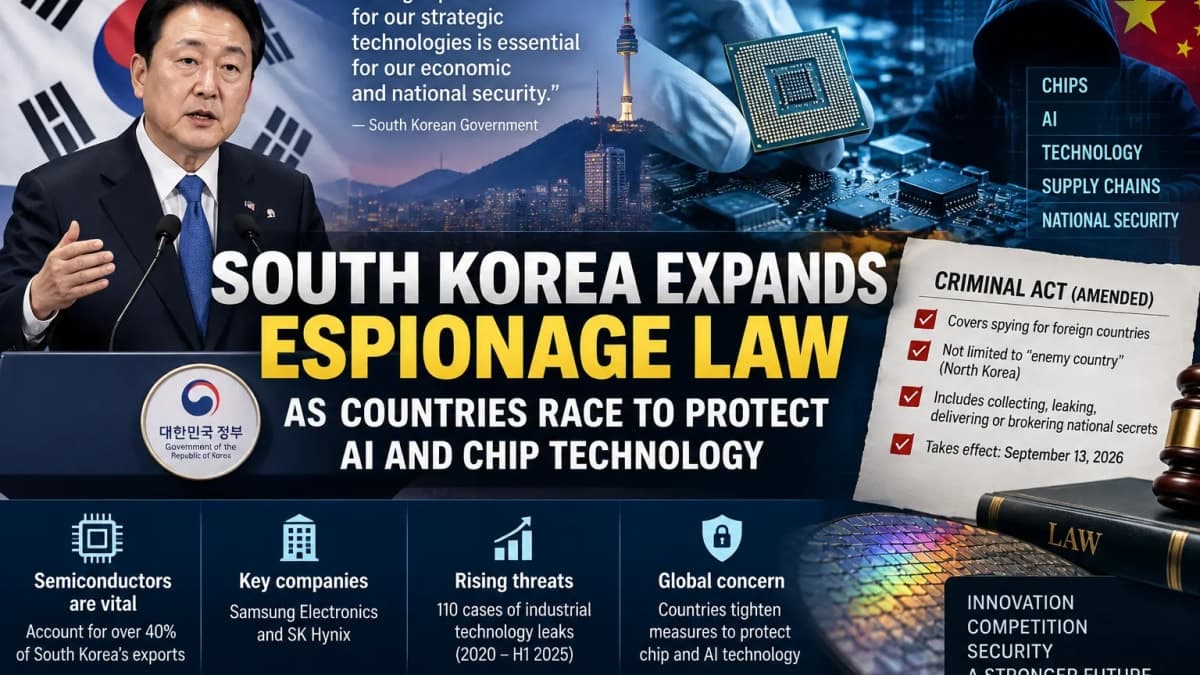
The revised provisions of the Criminal Act took effect on September 13, 2026, following an amendment promulgated in March. The change extends potential espionage liability to certain acts carried out for foreign countries or equivalent organisations, rather than limiting the offence to conduct benefiting an “enemy country.”
That distinction carries growing importance for South Korea. Its economic strength is closely tied to semiconductors, while the artificial intelligence boom has made advanced chips, memory technology and manufacturing expertise increasingly valuable strategic assets.
The amendment gives prosecutors a broader tool. It does not, however, turn every case of corporate information theft into espionage.
South Korea Closes a Long-Standing Gap in Its Spy Law
For decades, South Korea's Criminal Act framed espionage primarily around assistance to an enemy state, a concept historically associated with North Korea.
That created a difficult legal boundary when authorities investigated the suspected transfer of sensitive information to other countries.
The amended framework expands the scope. It covers specified conduct involving national secrets when undertaken for a foreign country or an organisation treated as equivalent under the law. Such conduct can include collecting, detecting, leaking, delivering or brokering protected information, as well as assisting those activities.
South Korea already had other laws available for pursuing industrial technology theft and trade-secret violations. The significance of the new provision is narrower but potentially powerful: prosecutors are no longer confined by the old enemy-state requirement when considering an espionage charge.
The facts of each case will still matter. Authorities must establish that the information and conduct satisfy the elements set out in the law.
Chip Technology Sits at the Centre of South Korea's Security Concerns
The legal change arrives as Seoul pays closer attention to the loss of advanced industrial technology.
South Korea is home to Samsung Electronics and SK Hynix, two companies that occupy central positions in the global memory-chip industry. Their technological capabilities have become more valuable as artificial intelligence companies demand increasingly sophisticated processors and high-bandwidth memory for data centres.
Semiconductors now account for more than 40% of South Korea's exports, according to recent reporting.
That dependence means the loss of proprietary manufacturing knowledge can have consequences well beyond an individual company. A major technology leak can affect export competitiveness, supply chains and South Korea's position in industries that governments increasingly view through a national-security lens.
Official figures illustrate the scale of the concern.
Data cited from the Korea Economic Research Institute and the Ministry of Trade, Industry and Energy recorded 110 cases of industrial technology leaking overseas between 2020 and the first half of 2025.
South Korea recorded 33 technology-leak cases in 2025, with more than half linked to China, according to reporting based on government figures.
Those numbers require some care. A technology-leak investigation is not automatically an espionage case, and an allegation does not establish criminal responsibility. The expanded law introduces another possible route for prosecution when the specific legal conditions for espionage are met.
China's Chip Expansion Adds Pressure
South Korea's effort to strengthen its legal protections is unfolding against rapid changes in the Asian semiconductor industry.
Chinese manufacturers have spent heavily to build domestic chip capabilities and reduce reliance on foreign technology.
One of the companies making progress is CXMT, which held roughly 10% of the global DRAM market in the second quarter of 2026, according to Counterpoint Research data cited by Bloomberg.
Samsung held approximately 38% of the market, while SK Hynix accounted for about 25%.
The gap remains substantial, but CXMT's growth adds another competitive force to a market long dominated by South Korean companies and US-based Micron.
South Korean authorities have meanwhile investigated cases involving former semiconductor employees accused of improperly transferring technology or expertise abroad.
Such cases can be commercially and politically sensitive, particularly when they involve China. They also require a basic distinction: hiring engineers from a competitor or another country is not itself espionage. The legal issue is whether protected information was unlawfully obtained or transferred and whether the conduct meets the requirements of the relevant criminal statute.
AI Raises the Value of Memory-Chip Expertise
Artificial intelligence has added urgency to a competition that was already intense.
Training and operating advanced AI systems requires enormous computing capacity. Alongside graphics processors and specialised accelerators, those systems depend heavily on high-bandwidth memory capable of moving large volumes of data quickly.
That has put South Korean memory manufacturers in an unusually important position.
SK Hynix has become a major supplier of high-bandwidth memory for AI computing, while Samsung is investing heavily to compete across advanced memory and semiconductor manufacturing.
The technology involved is not limited to finished chip designs. Manufacturing processes, materials, production equipment, engineering techniques and accumulated expertise can all influence whether a company can produce advanced semiconductors reliably and at scale.
Protecting that knowledge has consequently become part of a broader contest over who controls the infrastructure underpinning the AI economy.
Technology Protection Is Becoming a Global Policy Issue
South Korea's approach fits a wider international shift.
The United States has progressively tightened controls on exports of advanced semiconductor technology and chipmaking equipment to China. Washington has also worked with allies that occupy important positions in semiconductor supply chains.
European authorities are confronting their own technology-security cases.
Belgian prosecutors, for example, have pursued a case involving a Belgian-Chinese researcher suspected of industrial espionage connected with semiconductor technology from the bankrupt chipmaker BelGaN.
Prosecutors allege that intellectual property and trade secrets were improperly transferred to a Chinese company. The suspect has denied the allegations, and the case has not resulted in a conviction.
BelGaN worked with gallium nitride semiconductor technology, which has applications ranging from electric vehicles and power electronics to aerospace and military systems.
The case illustrates why governments increasingly struggle to separate industrial competition neatly from national security. The same underlying technology can have commercial, civilian and defence applications.
A Broader Law Creates New Questions for Businesses
Stronger espionage provisions also create practical concerns for companies operating internationally.
South Korean defence businesses have raised questions about whether broad definitions could complicate legitimate dealings with overseas customers and partners. Technology companies face similar challenges because modern research and manufacturing depend on cross-border supply chains, multinational workforces and frequent exchanges of technical information.
The amended law does not make ordinary international cooperation illegal.
Prosecutors would still need to demonstrate that the conduct falls within the statute, including requirements concerning the information involved and its connection to a foreign country or equivalent organisation.
How courts interpret those boundaries will therefore matter almost as much as the wording of the amendment itself.
An overly narrow interpretation could leave the gaps lawmakers were trying to close. An excessively broad one could create uncertainty for legitimate research, recruitment and international business.
Espionage Is No Longer Only About Military Secrets
The larger change taking place in South Korea is not confined to criminal law.
Advanced technology has altered what governments consider strategically sensitive.
A semiconductor manufacturing process developed inside a private company can influence commercial competitiveness, artificial intelligence capability and military systems. The engineers who understand that process may possess knowledge that cannot simply be reproduced from patents or published research.
That makes industrial expertise an increasingly valuable target.
South Korea's expanded espionage law reflects this changing definition of strategic information. By extending the law beyond the traditional enemy-state framework, Seoul has given authorities another mechanism for dealing with cases involving foreign actors.
The difficult part comes next: applying that authority precisely enough to protect genuine national secrets without treating ordinary international competition or legitimate movement of skilled workers as espionage.
For a country whose economic future is closely tied to chips, AI and advanced manufacturing, that distinction will carry consequences far beyond the courtroom.