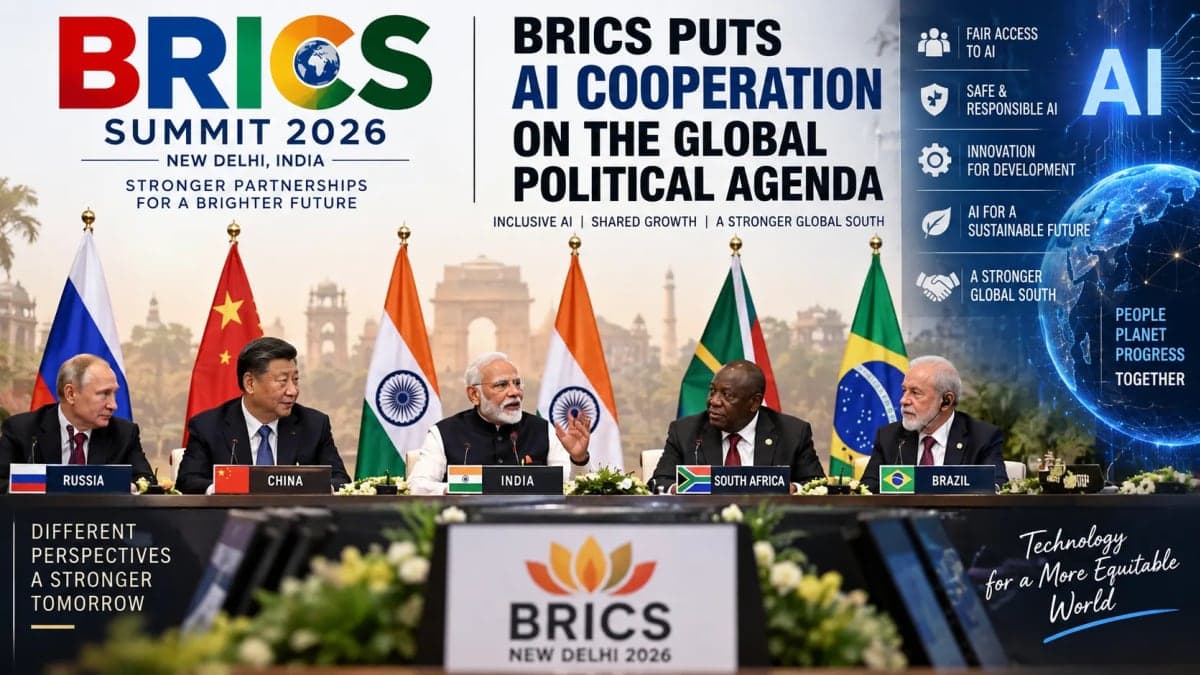
BRICS Pushes for Deeper AI Cooperation as Global South Seeks Greater Voice in Technology Governance
Artificial intelligence is becoming a foreign-policy issue for BRICS, not merely another area of technological cooperation.
At the 18th BRICS Summit in New Delhi, leaders placed AI within a broader discussion about development, international governance and the influence emerging economies should have over technologies likely to shape future economic growth.
The New Delhi Declaration supports greater cooperation on artificial intelligence while calling for systems that are safe, secure, inclusive and reliable. It also identifies access to AI resources, scientific research, innovation, energy efficiency and applications with social benefits as areas for collaboration.
For BRICS, however, the larger issue is participation. The bloc wants developing economies, particularly those in the Global South, to have a stronger role in deciding how AI is developed and governed rather than simply adapting to standards established elsewhere.
AI Governance Moves Beyond the Technology Track
BRICS has discussed digital transformation and emerging technologies for years. The New Delhi summit gives AI a more explicitly political dimension.
Members committed to implementing the BRICS Leaders' Statement on the Global Governance of Artificial Intelligence, providing a common reference point for future cooperation.
The language does not create a BRICS-wide regulatory regime. Nor does it require members to adopt identical national AI laws. Instead, it establishes broad principles around access, safety, security and development while leaving governments considerable room to determine their own policies.
That flexibility is important for an expanded grouping whose members differ substantially in technological capacity, regulatory systems and economic priorities.
China has developed one of the world's largest AI industries. India has a rapidly expanding digital economy and technology workforce. Other BRICS members are approaching AI from different stages of infrastructure, investment and research capacity.
A rigid common regulatory framework would therefore be difficult. Agreement on broader principles offers a more practical starting point.
Global South Wants a Say in Writing AI Rules
The debate over AI governance is also a debate over economic power.
Advanced computing infrastructure, leading AI models and much of the investment behind them remain concentrated among a relatively small number of countries and technology companies. That concentration has raised concerns that developing economies could become consumers of AI systems without gaining comparable influence over the standards governing them.
BRICS is positioning itself against that outcome.
Prime Minister Narendra Modi used the summit to argue that the Global South should have a formative role in the governance of emerging technologies, including artificial intelligence, biotechnology and quantum computing.
The argument closely resembles BRICS' long-standing position on institutions such as the International Monetary Fund and the United Nations: global rules should better reflect the economic weight and interests of emerging economies.
AI has effectively joined that institutional debate.
New Delhi Declaration Connects Access With Safety
The BRICS approach does not present wider access and stronger safeguards as competing objectives.
The declaration calls for artificial intelligence that is accessible while also being safe, secure, reliable and inclusive. It supports scientific cooperation and innovation alongside the development of trustworthy AI systems.
Energy efficiency is also included, an increasingly relevant issue as the computing infrastructure required to train and operate advanced AI models places greater demands on electricity systems and data centres.
This combination reflects a practical concern for developing economies. Countries seeking to expand AI adoption must deal simultaneously with infrastructure costs, skills shortages, access to computing resources and regulatory questions.
For many of them, the challenge is not simply regulating advanced AI. It is acquiring the capacity to use it competitively in the first place.
India and China’s AI Initiatives Enter the BRICS Framework
The declaration also acknowledges major AI initiatives hosted by two of the bloc's largest technology economies.
BRICS leaders welcomed India's AI Impact Summit held in February 2026 and recognised its contribution to international discussions around artificial intelligence.
They also acknowledged the World AI Conference and High-Level Meeting on Global AI Governance in Shanghai.
Including both events in the declaration gives BRICS governments additional forums through which their broader principles can be developed into more specific cooperation.
India has separately advocated stronger collaboration among BRICS countries in advanced computing, semiconductors, quantum technology and artificial intelligence. Such cooperation could eventually involve research institutions, governments and industry rather than being limited to diplomatic statements.
Education Becomes Part of the AI Strategy
The summit also linked AI policy to education and workforce development.
BRICS leaders backed the safe, ethical and human-centred use of artificial intelligence and other emerging technologies in education. The declaration encourages exchanges of best practices, stronger digital literacy and deeper links among universities, research institutions and industry.
It also supports cooperation in science, technology, engineering and mathematics education and vocational training.
These provisions address a constraint that access to software alone cannot solve. Countries need engineers, researchers, skilled workers and institutions capable of adapting AI to local industries and public services.
Without that capacity, wider availability of AI systems may do relatively little to narrow the technological gap between economies.
Cooperation Spreads Into Manufacturing and Finance
The declaration treats AI less as a standalone industry than as a technology likely to reshape several parts of the economy.
BRICS industrial cooperation covers smart manufacturing, robotics and technologies associated with Industry 4.0. The bloc is also developing institutional mechanisms intended to help manufacturers, including smaller businesses, adopt advanced production technologies.
The New Delhi Declaration welcomed the establishment of the India Centre for BRICS Industrial Competencies as part of those efforts.
Financial authorities are also exchanging experiences involving AI, cybersecurity and quantum computing, including their implications for financial systems.
The bloc has additionally discussed how artificial intelligence could support green-economy objectives.
Taken together, those initiatives suggest that practical cooperation may emerge sector by sector even if BRICS never develops a single regulatory model for AI.
Intellectual Property Adds a Difficult Policy Question
One of the more consequential elements of the declaration concerns intellectual property.
BRICS leaders recognised the importance of intellectual-property rights in the digital environment, including questions surrounding material used for AI training. The declaration refers to fair remuneration for rights holders while also recognising the priorities of developing countries.
Reconciling those positions will not be simple.
AI developers depend on large volumes of data, while publishers, artists and other rights holders increasingly seek greater control and compensation when protected material is used to train commercial systems.
Developing economies have another concern: rules designed to protect intellectual property should not make access to advanced technology prohibitively expensive or deepen existing technological dependence.
The declaration acknowledges those competing interests but does not resolve them. National laws and future international negotiations will determine how that balance develops.
Jobs Remain a Less Developed Part of the Agenda
The summit devoted considerable attention to skills, education and technological capacity, but detailed policies addressing AI-driven labour disruption were less prominent.
That omission could become increasingly important as adoption spreads.
Automation is unlikely to affect every economy or occupation in the same way. Countries with large working-age populations, extensive service industries or significant informal employment may face different pressures from economies where labour markets are smaller or more heavily industrialised.
Training workers for new technology is part of the response. Governments may eventually need more detailed policies for occupations that are reduced, reorganised or displaced as AI becomes more capable.
For BRICS members, that makes employment policy a likely test of whether broad principles on inclusive AI can be translated into domestic economic measures.
Cooperation Without a Single BRICS AI Regulator
Nothing agreed in New Delhi amounts to the creation of a supranational BRICS authority capable of regulating artificial intelligence across member states.
National governments retain responsibility for their own rules.
That may ultimately be a feature rather than a weakness of the bloc's approach. BRICS encompasses countries with different political systems, industrial structures and attitudes towards data, technology companies and state regulation.
A common set of principles allows them to coordinate internationally without requiring regulatory uniformity at home.
The more important development from New Delhi is therefore political.
Artificial intelligence is being folded into the same BRICS conversation as development finance, trade, institutional reform and the representation of emerging economies in global decision-making.
For the Global South, the question is no longer simply how quickly countries can adopt AI. It is whether they can influence the rules, institutions and economic relationships that develop around it.
The New Delhi summit shows that BRICS intends to make that question part of its international agenda.