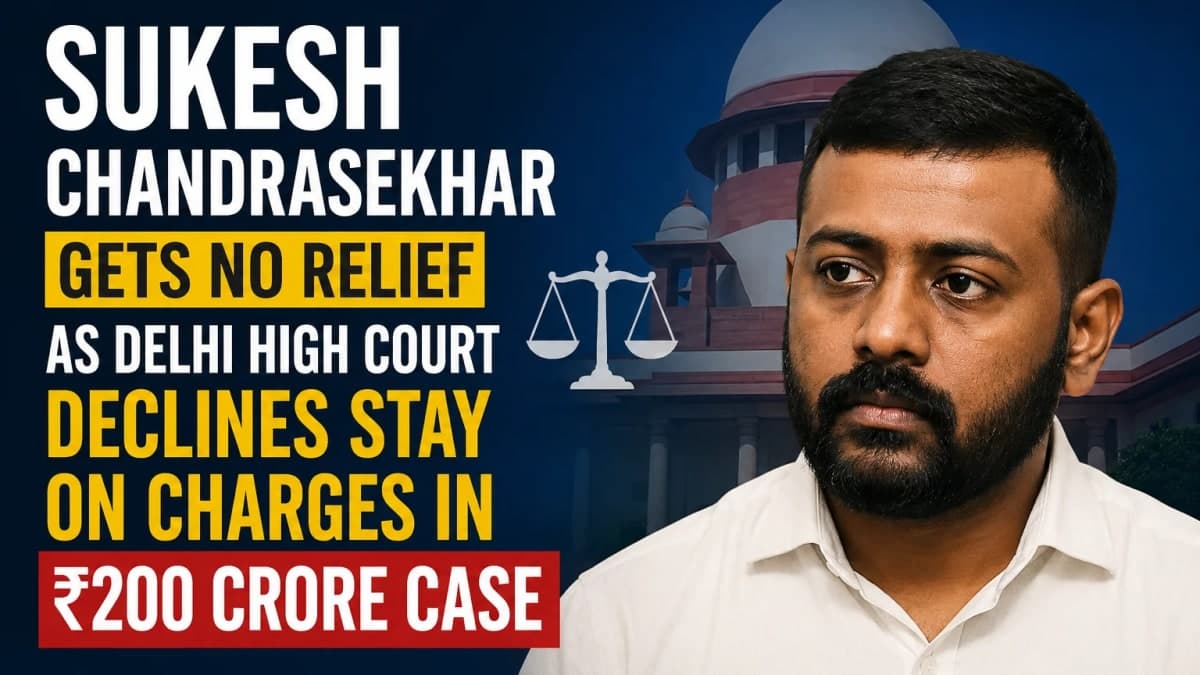
Delhi High Court Refuses Interim Relief to Sukesh Chandrasekhar
Sukesh Chandrasekhar has failed to secure immediate relief from the Delhi High Court in the case involving allegations of extortion and money laundering amounting to around ₹200 crore.
The High Court declined to stay the charges against Chandrasekhar, effectively allowing the criminal proceedings before the trial court to move forward.
The development represents another important stage in a case that has attracted considerable public attention because of the scale of the alleged financial wrongdoing and the involvement of several high-profile names.
The court's decision does not amount to a determination of Chandrasekhar's guilt or innocence. Instead, it concerns whether the framing of charges and the resulting trial proceedings should be halted while his legal challenge remains pending.
What the ₹200 Crore Case Is About
The proceedings stem from allegations that Chandrasekhar was at the centre of a sophisticated operation involving extortion and the movement of proceeds allegedly generated through criminal activity.
Investigators have alleged that approximately ₹200 crore was extorted in connection with the broader case. Separate but connected proceedings have involved allegations under anti-organised-crime and anti-money-laundering laws.
The Enforcement Directorate has investigated the money trail and alleged laundering of proceeds linked to the case, while Delhi Police has pursued the underlying extortion allegations.
The case has drawn extensive attention because investigators have also examined financial transactions, communications and gifts allegedly connected with several individuals.
Trial Court Had Ordered Framing of Charges
Earlier, a Delhi court ordered charges to be framed against multiple accused in proceedings connected with the case.
In the money-laundering matter, the court found sufficient grounds at the charge-framing stage to proceed against several accused under provisions of the Prevention of Money Laundering Act.
The prosecution has relied on a range of material gathered during its investigation, including financial transactions, digital communications and other records.
Framing of charges is a procedural stage at which a court determines whether sufficient material exists for an accused to face trial. It does not itself establish criminal liability.
Why the High Court Decision Matters
The refusal to grant a stay is significant because it prevents the challenge before the High Court from automatically delaying the trial.
Long-running criminal cases frequently involve applications challenging charges before higher courts. When a stay is granted, proceedings before the trial court can effectively be frozen until the challenge is resolved.
By declining interim protection in this instance, the High Court has allowed the judicial process at the trial level to continue.
At the same time, Chandrasekhar retains the ability to pursue legal remedies against orders he disputes. The absence of a stay should therefore not be interpreted as a final rejection of every argument raised by the defence.
High-Profile Nature of the Case
The ₹200 crore case has remained in the spotlight partly because actor Jacqueline Fernandez is among those who have faced proceedings in the connected money-laundering matter.
The broader investigation has generated multiple legal challenges involving different accused, making the case procedurally complex.
Such complexity also means that individual court orders must be viewed carefully. Relief granted or denied to one accused, or in one proceeding, does not necessarily determine the outcome of separate petitions or the ultimate trial.
Balanced Analysis: What Happens Next?
The High Court's refusal to stay the charges strengthens the possibility that the trial can progress without another immediate procedural interruption.
For prosecutors, continuation of the proceedings provides an opportunity to place evidence before the trial court and seek to establish the allegations through the normal criminal justice process.
For Chandrasekhar and the other accused, the trial provides the opportunity to challenge the prosecution's evidence, question witnesses and present their respective defences.
The distinction between framing charges and proving charges remains crucial. At the framing stage, courts are not required to decide whether the prosecution has established guilt beyond reasonable doubt.
That much higher standard applies when the evidence is examined during the trial.
The latest Delhi High Court decision therefore represents an important procedural setback for Chandrasekhar, but it does not constitute a finding of guilt. The eventual outcome will depend on the evidence, arguments and judicial findings as the proceedings advance.
This article is based on reporting published by Moneycontrol.