Supreme Court Sets Deadline for Election Commission
The Supreme Court has imposed a time-bound framework for resolving the ongoing battle over the All India Trinamool Congress name and its reserved “Flowers & Grass” election symbol.
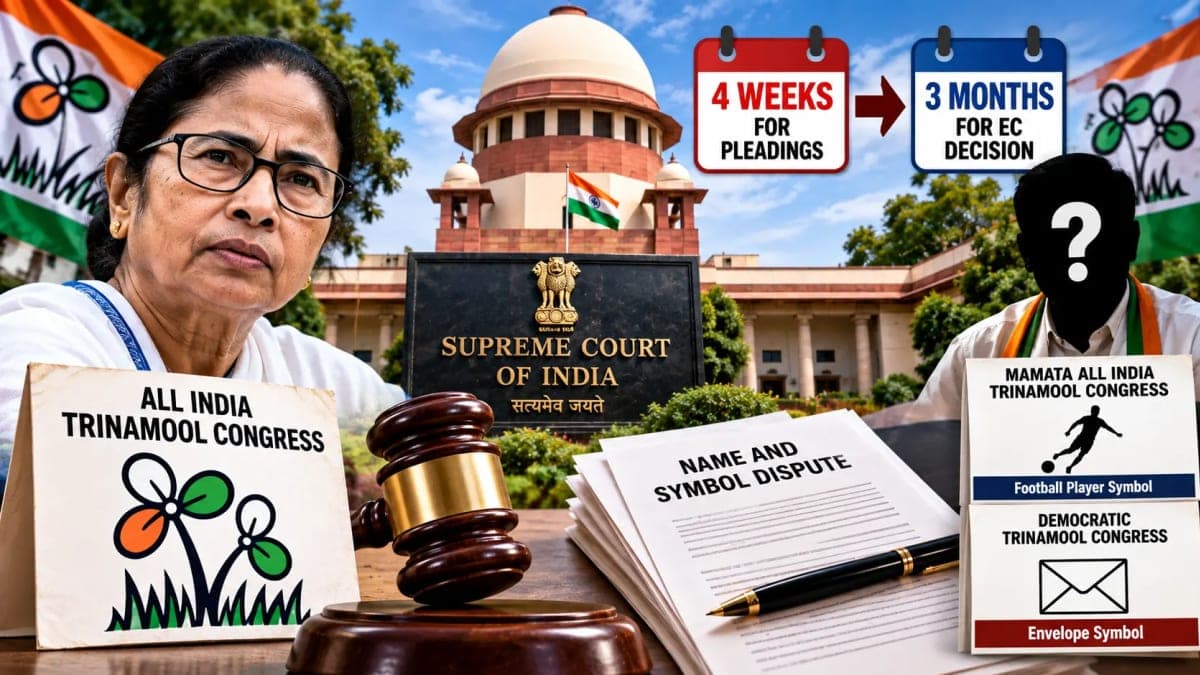
On September 28, a three-judge bench comprising Chief Justice of India Surya Kant and Justices Joymalya Bagchi and V Mohana directed the rival factions to complete their pleadings before the Election Commission within four weeks.
Once that process is complete, the Election Commission will have another three months to adjudicate the dispute.
This means the overall timeline can extend to roughly four months from the Supreme Court's order, rather than three months from September 28.
What Is the TMC Symbol Dispute?
The dispute concerns competing claims over control of the All India Trinamool Congress, including the right to use its established party name and reserved “Flowers & Grass” symbol.
The Election Commission earlier concluded on an interim basis that rival groups existed within the party and that their competing claims required a substantive determination under Paragraph 15 of the Election Symbols (Reservation and Allotment) Order, 1968.
Pending that decision, the Commission froze the original party name and symbol, preventing either faction from using them.
The dispute involves the faction led by Mamata Banerjee and a rival group. Reports have differed on how the leadership of the rival faction is described, with some identifying Arup Roy and others referring to Ritabrata Banerjee in connection with the competing group.
Mamata Banerjee Challenged the Interim Freeze
Former West Bengal Chief Minister Mamata Banerjee approached the Supreme Court challenging the Election Commission's interim decision to freeze the established TMC name and symbol.
Her side argued for an expedited resolution of the dispute rather than allowing the proceedings before the Election Commission to continue for an extended period.
The Supreme Court had earlier asked the poll body to indicate how much time it would realistically need to reach a final decision.
That question led to the deadline now fixed by the Court.
Election Commission Sought More Time
During the proceedings, the Election Commission sought a longer period to adjudicate the competing claims.
Its counsel pointed to the large volume of affidavits and evidence that can arise in disputes over political-party control and sought six months after completion of the pleadings.
The Supreme Court did not accept that proposed timeline.
Instead, it gave both factions four weeks to complete their submissions and directed the Election Commission to finish its adjudication within the following three months.
The Court indicated that the Commission could approach it if an exceptional situation made compliance with the deadline difficult.
Supreme Court Suggests Using Technology
An unusual aspect of the hearing was the discussion around using technology to process the potentially large volume of documents.
Justice Joymalya Bagchi suggested that artificial intelligence and machine-learning tools could assist with tasks such as reading and processing documents and thereby help accelerate the proceedings.
The Election Commission's counsel acknowledged that technology could provide assistance to some extent, while also pointing out the practical complexity of handling large numbers of affidavits submitted by party members and supporters.
The suggestion does not change the legal responsibility of the Election Commission to assess the evidence and decide the dispute.
What Happens to the TMC Name and Symbol Until Then?
The original “All India Trinamool Congress” name and “Flowers & Grass” symbol remain affected by the Election Commission's interim arrangement while the substantive dispute is pending.
For the relevant West Bengal by-elections, the Election Commission allotted temporary names and symbols to the rival groups.
The Mamata Banerjee-led faction was allotted the name Mamata All India Trinamool Congress and the football player symbol.
The rival faction was allotted the name Democratic Trinamool Congress and the envelope symbol.
These are interim arrangements and do not determine which faction will ultimately receive the original party identity.
Why the Election Symbol Matters
An election symbol can carry considerable political importance in India because it serves as a highly visible identifier connecting voters with a political party.
When a recognised political party splits into competing groups, deciding which group represents the original organisation can therefore have consequences beyond the right to display a particular image on the ballot.
The decision can affect the party's established identity, organisational continuity and electoral branding.
Under Paragraph 15 of the Election Symbols Order, the Election Commission has the authority to determine disputes involving rival sections or groups of a recognised political party.
Previous Party Splits Provide Context
India has seen several prominent disputes over political-party names and symbols.
During the Shiv Sena split, the Election Commission temporarily froze the party's name and “Bow and Arrow” symbol before eventually deciding the rival claims.
A similar political and legal contest emerged following the split in the Nationalist Congress Party.
Those cases provide procedural context, but they do not determine the outcome of the current TMC dispute. The Election Commission must examine the evidence and competing claims in this case independently.
Has the Supreme Court Decided Which Faction Is the Real TMC?
No.
This distinction is essential.
The Supreme Court's September 28 direction deals with the timeline for deciding the dispute, not with which faction is entitled to the original TMC name or “Flowers & Grass” symbol.
The Court specifically clarified that it had not expressed an opinion on the merits of the competing claims.
The substantive determination remains with the Election Commission.
Why the Deadline Matters
The order reduces uncertainty over how long the factional dispute can remain unresolved.
The rival groups now have a defined four-week period to finish filing their evidence and responses, followed by a three-month window for the Election Commission to reach its decision.
The timeline is especially significant because the dispute affects a well-established party name and symbol and has already required temporary arrangements for elections.
The next crucial stage will therefore be the completion of pleadings before the Election Commission. After that, attention will shift to how the poll body evaluates the rival claims over organisational control, party identity and the reserved election symbol.


