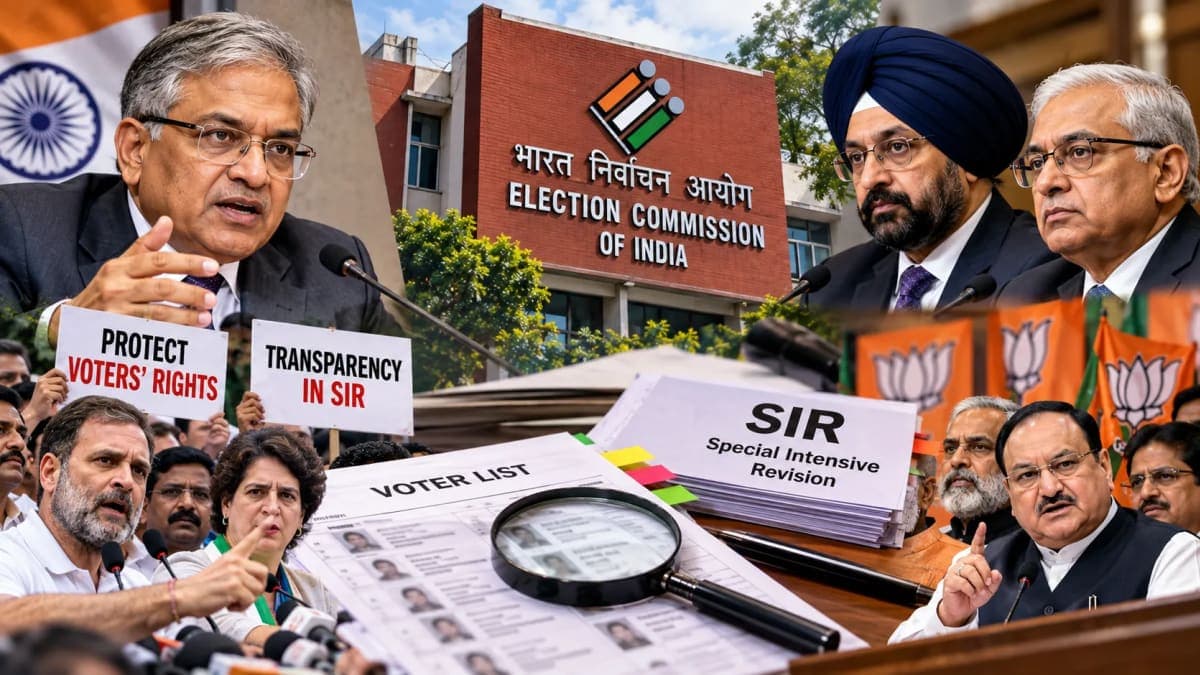
The controversy surrounding India's Special Intensive Revision (SIR) of electoral rolls has entered a new phase, with the Election Commission of India announcing procedural changes even as Opposition parties intensify criticism of the exercise and of Chief Election Commissioner Gyanesh Kumar.
At the centre of the latest dispute are reports that Election Commissioners Sukhbir Singh Sandhu and Vivek Joshi raised objections or concerns on multiple occasions over Election Commission decisions, including issues connected with SIR and electoral-roll administration. The Indian Express reported that the two commissioners recorded objections 14 times over a 10-month period.
The Election Commission, however, has pushed back against suggestions that these exchanges undermine its SIR decisions. It says the nationwide SIR order and subsequent schedules received the Commission's unanimous approval.
What triggered the latest Election Commission controversy?
The immediate controversy intensified following reporting about differences within India's three-member Election Commission.
According to The Indian Express, Sandhu and Joshi raised objections or concerns on record on 14 occasions during a 10-month period, involving matters ranging from the SIR process to electoral-roll administration.
The ECI has characterised such exchanges differently.
Responding to the controversy, it said commissioners had raised operational queries or inputs during the drafting and deliberation stages and described such discussions as part of normal institutional decision-making intended to improve the electoral process and protect voter rights.
That distinction is important: the existence of internal queries or objections does not by itself establish that the final nationwide SIR decisions lacked the Commission's approval.
ECI says key SIR decisions were unanimous
The Election Commission issued a detailed clarification after a meeting involving CEC Gyanesh Kumar and Election Commissioners Sandhu and Joshi on September 26.
According to the Commission, its June 24, 2025 order initiating SIR across states and Union Territories—beginning with Bihar—was unanimously approved.
It said subsequent schedules covering other states and Union Territories were also unanimously approved. The Commission further stated that the Supreme Court upheld the SIR order in its May 27, 2026 decision.
The ECI also said SIR had already been completed in 20 states and Union Territories, including Bihar and West Bengal, while the final number of electors would only be known after final publication in the remaining Phase III states.
Voters issued notices will get doorstep document collection
Alongside its defence of the SIR process, the Commission announced changes intended to make verification easier for voters.
People issued notices because they are unmapped or have "logical discrepancies" will generally no longer have to visit an Electoral Registration Officer or Assistant Electoral Registration Officer's office simply to submit documents.
Instead, Booth Level Officers will visit affected voters' homes, collect documents and upload them to ECINet for consideration by the Electoral Registration Officer.
Physical hearings will be required only in exceptional circumstances determined by the ERO, with online hearings preferred where appropriate. An elector can also authorise an adult family member to attend a required hearing on their behalf.
The Commission additionally directed district election authorities to establish help desks and special camps for groups including homeless people, labourers, people living in night shelters and economically disadvantaged voters.
Delhi and Maharashtra get more time
The Election Commission also extended SIR-related deadlines in Delhi and Maharashtra.
In Delhi, the deadline for filing claims and objections has been extended to October 30, 2026, while disposal of notices, claims and objections can continue until November 30.
For Maharashtra, claims and objections can now be filed until October 12, with disposal allowed until November 10.
The Maharashtra changes followed a request from the state's Chief Electoral Officer for modifications to aspects of the notice procedure.
ECINet to undergo independent-expert review
Another significant development concerns ECINet, the Election Commission's digital electoral-management system.
The ECI has ordered a review to verify that the platform operates in accordance with relevant election laws and rules.
A committee headed by a Senior Deputy Election Commissioner will conduct the review and include an independent expert from an IIT or IIIT.
The Commission says field officials already receive role-based access reflecting their statutory authority, while any additional flexibility identified during the review can be incorporated.
It has also decided that future IT modules and portal initiatives will be discussed by the Committee of Officers before receiving Commission approval.
Opposition says ECI's response does not settle its concerns
The Commission's September 26 decisions have not ended the political dispute.
Opposition parties have argued that the ECI's response fails to adequately address their concerns about transparency, institutional decision-making and administration of the SIR process.
Some Opposition parties have also called for CEC Gyanesh Kumar's removal, while INDIA bloc leaders are expected to discuss the Election Commission controversy and a possible coordinated campaign at a meeting scheduled for September 30.
These are political demands and allegations by Opposition parties; they should not be treated as findings that the CEC committed wrongdoing.
BJP leaders defend Election Commission
The BJP and Union government figures have responded strongly to the Opposition campaign.
BJP president and Union Minister J.P. Nadda accused the Congress and INDIA bloc of attempting to create confusion over the electoral process.
Union Minister Ramdas Athawale also defended Gyanesh Kumar and said the CEC should not resign under Opposition pressure. He argued that maintaining accurate and transparent electoral rolls was necessary for democracy.
Again, these statements represent the political position of government and BJP leaders rather than independent conclusions about the disputed SIR process.
Why the distinction between internal dissent and final decisions matters
One of the most important issues in understanding the controversy is separating three different questions.
First, there is evidence from reporting that individual Election Commissioners raised objections, questions or concerns during internal deliberations.
Second, the Election Commission maintains that these exchanges were part of the normal process of developing proposals and that the final major SIR orders were approved unanimously.
Third, Opposition parties argue that the reported internal differences raise broader questions about transparency and how decisions were reached.
The existence of the first does not automatically prove or disprove either side's broader political interpretation. What can currently be established is that disagreements or queries were reportedly raised during deliberations, while the ECI says the final nationwide SIR decisions received unanimous approval.
What happens if a voter's name is missing?
The controversy also has a practical dimension for voters.
The Election Commission says anyone omitted during SIR—or subsequently left off the rolls—can still apply to the relevant Electoral Registration Officer for inclusion through the continuous updation process.
That provision also applies to young people and first-time voters seeking enrolment.
The ECI has directed Chief Electoral Officers, District Election Officers and Electoral Registration Officers to launch special enrolment drives for eligible voters whose names are missing.
What comes next?
The SIR controversy is now unfolding on institutional, legal and political fronts simultaneously.
The Election Commission has changed aspects of the verification procedure, extended deadlines in Delhi and Maharashtra, ordered an ECINet review and committed to circulating meeting agendas in advance and issuing minutes for Commission meetings.
Opposition parties, meanwhile, are continuing their campaign over the SIR and the leadership of the Election Commission, while BJP leaders are defending the institution and challenging the Opposition's allegations.
The next major political development is expected around the INDIA bloc's proposed September 30 meeting. The more consequential long-term question, however, will be how the revised procedures affect voter inclusion and how the remaining SIR process is completed.
Sources
Primary official source: Election Commission of India statement released through the Press Information Bureau on September 26, 2026. Press Information Bureau
Additional reporting: The Indian Express, Business Standard, PTI, Hindustan Times and India Today. The Indian Express's reporting was used for the claims concerning internal objections; those claims are distinguished above from the Election Commission's official account


