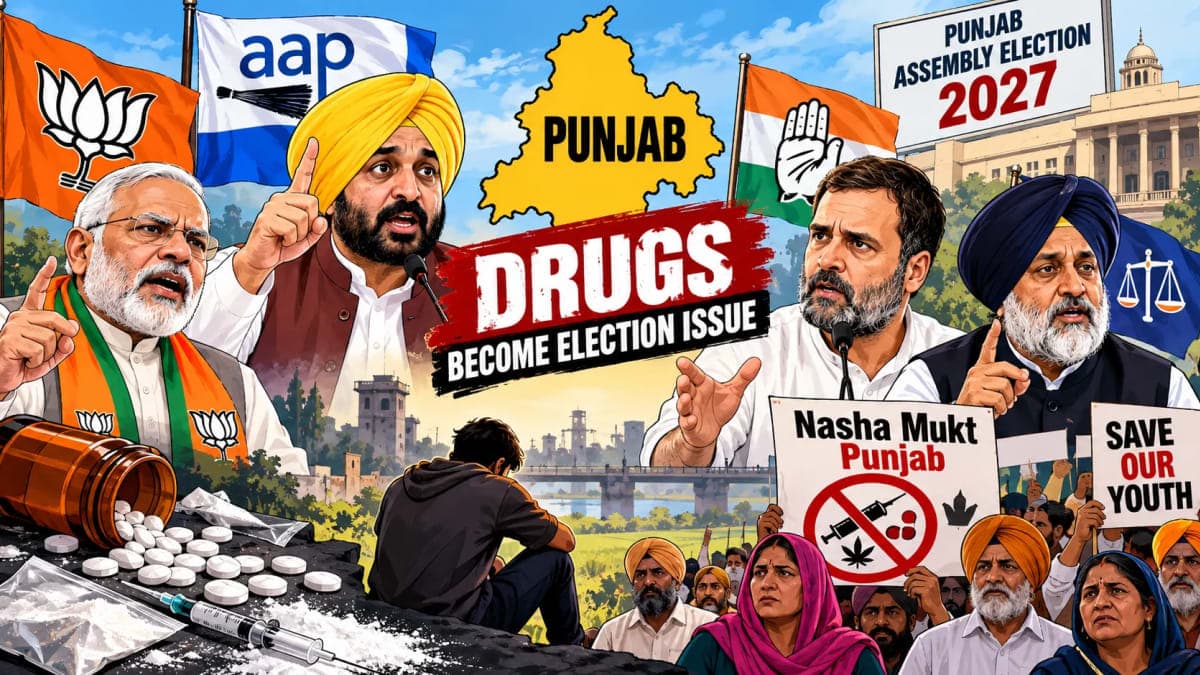
Drug issue moves to the centre of Punjab's election debate
With Punjab expected to hold its next Assembly election in 2027, the state's continuing struggle with drug trafficking and addiction is becoming one of the central subjects of political campaigning.
The issue is not new to Punjab elections. What has changed is the political positioning of the major parties. AAP, which came to power in 2022, is now defending its performance in government, while the BJP, Congress and SAD are challenging its record and making drugs a prominent part of their campaigns.
The debate has consequently moved beyond questions of policing and addiction treatment. It is increasingly becoming a wider argument over governance, accountability and which government should bear responsibility for a problem that has persisted across multiple administrations.
BJP takes anti-drug campaign across Punjab
The BJP has made the issue highly visible through its Nasha Mukt Punjab Yatra, launched on September 18.
Four parallel yatras were planned from Madhopur, Fatehgarh Sahib, Fazilka and Talwandi Sabo, covering nearly 4,000 kilometres and reaching across Punjab's 117 Assembly constituencies over 13 days. The campaign was scheduled to converge in Jalandhar on September 30.
Through the campaign, BJP leaders have accused the Bhagwant Mann government of failing to meet its commitments on eliminating illegal drugs. The party has also brought families affected by addiction and drug-related deaths into its public outreach.
These are political arguments made by the BJP and should be distinguished from independently established assessments of the government's overall anti-drug performance.
AAP turns the argument toward previous governments
The ruling AAP has responded by questioning the record of the parties now attacking it.
Chief Minister Bhagwant Mann has highlighted the BJP's earlier alliance with the Shiromani Akali Dal, which governed Punjab between 2007 and 2017, arguing that parties that previously held power should also answer for how the drug problem developed during earlier administrations.
AAP leaders have defended the Mann government's anti-drug efforts and accused opposition parties of attempting to undermine the campaign for political purposes.
AAP MP Sanjay Singh, for example, has alleged that the BJP, Congress and SAD are trying to discredit the government's anti-drug drive. That is an allegation from the ruling party, not an independently established finding.
The result is a political contest in which both the current government's record and the actions of previous governments are being scrutinised.
Congress focuses on accountability and recent controversies
Congress is also trying to place the drug issue prominently in its campaign against the AAP government.
The political confrontation intensified in September after the death of Gulzar Singh in Sangrur. Opposition parties organised protests and demanded accountability, while the state government disputed opposition allegations surrounding the episode. Punjab Police constituted a Special Investigation Team in connection with the matter.
A separate controversy emerged after Jagseer Singh, also known as Jagga, allegedly consumed a poisonous substance outside the Sangrur Deputy Commissioner's office after raising concerns about alleged drug sales in his village. BJP and Congress criticised the government over the incident, while AAP questioned the opposition's account of the circumstances.
The competing claims surrounding such incidents remain politically contested and should not be treated as established conclusions without the findings of investigations.
Shiromani Akali Dal launches its own campaign
SAD has also entered the anti-drug political mobilisation.
The party has launched a women-focused “Maawan-Dheeyan Insaaf” campaign led by Bathinda MP Harsimrat Kaur Badal. Its outreach combines the drug issue with grievances raised by families and communities in rural Punjab.
That creates an unusual political situation: AAP, BJP, Congress and SAD all say combating drugs is a priority, but they disagree sharply over responsibility for the persistence of the problem and the effectiveness of measures taken so far.
Why the drug issue remains politically significant
Punjab's drug problem has remained in public debate for years and has consequences that extend beyond electoral politics.
Drug trafficking involves law enforcement and border-security questions, while addiction creates challenges involving healthcare, rehabilitation, employment and family welfare. Effective policy therefore requires more than arrests or seizures alone; prevention, treatment and rehabilitation are also relevant to evaluating long-term outcomes.
For voters trying to assess competing political claims, campaign statements alone provide an incomplete picture. Trends in drug seizures, trafficking cases, convictions, overdose deaths, treatment demand and rehabilitation outcomes can provide more concrete measures of whether conditions are improving.
The same caution applies when attributing responsibility. Because Punjab's drug problem has existed under governments led by different political parties, its continuation cannot by itself establish that one particular administration created the underlying crisis.
A familiar issue, but political roles have changed
One of the striking features of the 2026 debate is how the parties' roles have shifted.
AAP, once an opposition party attacking established governments over Punjab's drug problem, must now defend its own record after more than four years in office. BJP and SAD, which previously governed Punjab together, are now campaigning separately and questioning the current administration. Congress, which governed from 2017 to 2022, is also attacking AAP's handling of the issue.
That history makes the 2027 debate partly a comparison of governing records rather than simply a contest of promises.
What to watch ahead of the 2027 election
As campaigning develops, the political argument is likely to focus increasingly on measurable outcomes: whether the supply of narcotics has been disrupted, whether major trafficking networks have been prosecuted, whether treatment is reaching people struggling with addiction and whether communities are experiencing meaningful improvements.
Opposition parties are currently using the drug issue to challenge AAP's governance, while AAP is asking voters to compare its actions with those of previous administrations.
The scale of political mobilisation around the subject already shows that Punjab's drug problem will be an important part of the debate ahead of the 2027 Assembly election. Whether individual campaign claims are supported by evidence will require scrutiny of official data and verified outcomes rather than political rhetoric alone.


