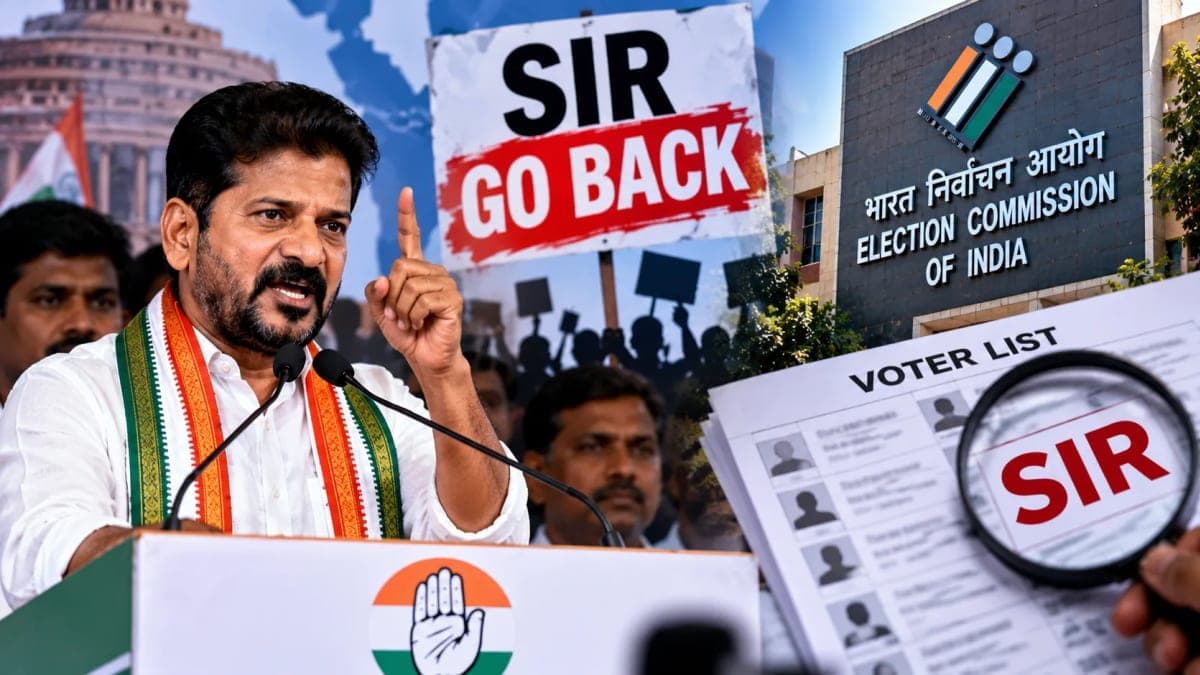
Revanth Reddy Calls for Nationwide Campaign Against SIR
Telangana Chief Minister A. Revanth Reddy has sought to turn opposition to the Special Intensive Revision of electoral rolls into a nationwide political campaign.
Speaking at the Pratidin Conclave in New Delhi on September 28, Reddy said a countrywide movement under the slogan “SIR Go Back” could be launched against the electoral-roll revision exercise.
He drew a comparison with the historic “Simon Go Back” protests against the Simon Commission during India’s freedom struggle.
The comparison was political rhetoric used by the chief minister and should not be interpreted as an equivalence between the two historical situations.
What Did Revanth Reddy Allege?
Reddy alleged that the SIR process was being used to remove voters considered politically opposed to the BJP-led central government.
He further claimed that artificial intelligence and information from social-media platforms were being used to identify such voters.
These are allegations made by the Telangana chief minister. The available reporting does not establish them as independently proven facts.
Reddy has made similar allegations about the SIR process in Telangana in recent weeks, arguing that eligible voters could be excluded from electoral rolls.
Reddy Seeks Opposition Unity
The Telangana chief minister also sought a wider opposition response rather than treating SIR as an issue concerning Congress alone.
According to UNI, Reddy referred to opposition leaders including Mamata Banerjee, Sharad Pawar, Uddhav Thackeray and M.K. Stalin while calling for political unity over the electoral-roll issue.
His intervention indicates an attempt to elevate the SIR dispute from individual state-level concerns into a national opposition issue.
Whether such a coordinated nationwide campaign takes shape will depend on decisions by Congress and other opposition parties.
What Is SIR?
SIR, or Special Intensive Revision, is an exercise conducted by the Election Commission to scrutinise and update electoral rolls.
The underlying purpose of electoral-roll revision is to ensure that eligible voters are correctly registered while entries relating to people who have died, permanently shifted, are duplicated or are otherwise ineligible are appropriately dealt with.
The political controversy concerns how that verification is being conducted and whether safeguards are sufficient to prevent eligible voters from being wrongly excluded.
That distinction is important: removal of an entry during a revision does not by itself establish improper voter deletion, while wrongful exclusion of eligible voters would raise serious electoral-rights concerns.
Telangana Has Already Raised Concerns With Election Commission
Reddy's latest remarks follow earlier interventions by the Telangana government over the SIR process.
In August, the chief minister wrote to Chief Election Commissioner Gyanesh Kumar seeking additional time for claims and objections.
At the time, Reddy highlighted 73.39 lakh entries placed under categories covering absentee, shifted, dead and duplicate voters and expressed concern that some temporarily relocated voters could potentially be treated as permanently shifted.
He sought a four-week extension of the claims-and-objections period and additional measures to help voters respond to notices.
This provides important context to his latest call: his opposition to the exercise did not begin with the New Delhi speech.
Why the SIR Dispute Matters
Electoral rolls determine who can participate in an election, making their accuracy fundamental to the electoral process.
Two objectives have to be balanced.
Election authorities need mechanisms for identifying outdated, duplicate and otherwise invalid entries. At the same time, those mechanisms need adequate safeguards so legitimate voters are not inadvertently removed.
The dispute over SIR therefore extends beyond the immediate political contest between Congress and BJP.
Questions about notices, documentation, verification, claims and objections, appeals and final inclusion directly affect voter access to elections.
Congress Expands Its Campaign Over Electoral Rolls
Reddy's statement also comes amid wider Congress protests over the Election Commission and electoral-roll revisions.
Congress workers held protests across states on September 28, including demonstrations demanding the resignation of Chief Election Commissioner Gyanesh Kumar.
Reddy is also expected to raise Telangana's SIR concerns during the Congress Working Committee meeting in Delhi.
Reports ahead of the meeting said he was expected to present details of the Telangana revision process and advocate a broader protest programme.
His “SIR Go Back” proposal therefore fits into a wider Congress effort to intensify political scrutiny of the electoral-roll exercise.
Claims and Verified Facts Must Be Separated
The controversy involves several strong political allegations, making attribution particularly important.
It is verified that Reddy has raised concerns about possible exclusion of eligible voters, requested an extension of the SIR timetable and now called for a nationwide movement.
His broader assertions that the exercise is deliberately targeting voters on the basis of their political preferences remain allegations.
Those claims should therefore not be presented as established evidence of electoral manipulation unless supported by independently verified records or authoritative findings.
Balanced Analysis
Reddy's “SIR Go Back” call raises the political stakes around an already contentious voter-list revision exercise.
For Congress, the issue offers a common platform around which it can attempt to coordinate with other opposition parties. For election authorities, the central question is whether the revision can remove invalid entries while providing sufficient opportunities for legitimate voters to establish their eligibility.
The existence of disputes over electoral rolls does not itself establish deliberate manipulation. At the same time, because voter registration determines access to the ballot, credible complaints about wrongful exclusions warrant transparent procedures and verifiable responses.
The next phase will therefore depend not only on political protests but also on measurable evidence: draft and final electoral-roll data, reasons for deletions, restoration of eligible names, claims and objections, and the Election Commission's responses to specific complaints.
Conclusion
Telangana Chief Minister Revanth Reddy's call for a nationwide “SIR Go Back” movement signals an attempt to broaden opposition to the Special Intensive Revision beyond Telangana.
His concerns over eligible voters potentially being excluded have been raised with the Election Commission before, including through a request for more time in the claims-and-objections process.
However, his allegations that SIR is being deliberately used to remove voters opposed to the BJP remain political claims rather than established findings.
As the dispute develops, verified voter-roll data and the Election Commission's handling of specific exclusion complaints will be critical to assessing the competing claims.


