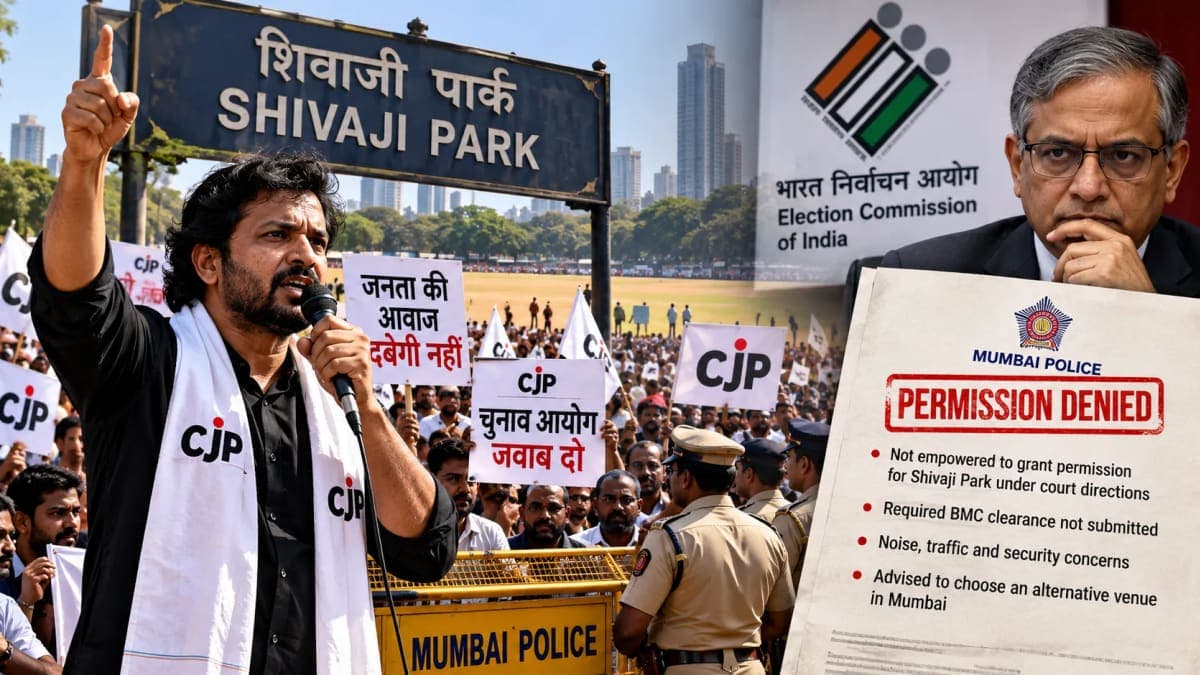
The Cockroach Janta Party’s (CJP) plan to begin an October 2 protest campaign from Mumbai’s Shivaji Park has run into a permission hurdle, with Mumbai Police saying they are not empowered to approve the proposed gathering at the venue under existing court directions and Maharashtra government guidelines.
An application seeking permission for the protest was submitted on September 26, 2026, and the police communicated their position on September 27. CJP founder Abhijeet Dipke subsequently announced plans for a “Jail Bharo Andolan” on Gandhi Jayanti if the organisation is prevented from holding its protest.
The proposed demonstration is directed against the Election Commission of India (ECI) and Chief Election Commissioner (CEC) Gyanesh Kumar. CJP has demanded Kumar’s resignation amid a wider dispute over the functioning of the poll body and the Special Intensive Revision (SIR) of electoral rolls.
Why Mumbai Police Did Not Permit the Shivaji Park Protest
The dispute is primarily about permission to use Shivaji Park as the venue, rather than a blanket prohibition on CJP holding a demonstration elsewhere in Mumbai.
Mumbai Police said they were not empowered to grant permission for a gathering at Shivaji Park because of a Bombay High Court judgment in PIL 116/2009 dated January 4, 2013, followed by a Maharashtra government order dated January 20, 2016 governing use of the ground.
Police also cited several practical issues with the application. According to reports, organisers had not submitted the required permission from the Brihanmumbai Municipal Corporation (BMC) for use of the ground.
Authorities additionally pointed to Shivaji Park's location in a residential and silence-zone area, raising concerns about potential noise pollution, heavy traffic and possible disruption to emergency vehicles travelling to nearby hospitals.
Police advised the applicant to identify an alternative venue in Mumbai and submit a fresh application, saying such a request could be considered under the applicable rules. Moneycontrol
Dipke Responds With ‘Jail Bharo Andolan’ Announcement
Dipke has objected to the police decision and indicated that CJP does not intend to abandon its October 2 mobilisation.
In a social-media post, he described the decision as an attempt to suppress citizens’ voices and said CJP would launch a “Jail Bharo Andolan” in Mumbai on Gandhi Jayanti if it was denied the opportunity to protest.
Speaking to The Indian Express, Dipke also said:
“We will do a Jail bharo andolan if necessary. We will protest on October 2.”
The Indian Express reported that Dipke said police attempted to provide the organisers with a written rejection notice but that they declined to accept it.
On September 28, Dipke reiterated the plan in a brief social-media announcement stating that the “Jail Bharo Andolan” would take place in Mumbai on October 2 at Shivaji Park.
Why Is CJP Protesting Against CEC Gyanesh Kumar?
The proposed demonstration forms part of CJP's campaign seeking the resignation of Chief Election Commissioner Gyanesh Kumar.
The dispute intensified following an Indian Express investigation that reported instances in which Election Commissioners Sukhbir Singh Sandhu and Vivek Joshi recorded objections concerning poll-panel steps and electoral-roll issues.
The Election Commission has disputed suggestions that its key decisions lacked institutional consensus. According to reporting on the Commission's response, the ECI said important decisions—including those concerning the SIR—were taken unanimously by the three-member Commission. It maintained that differing observations during internal deliberations are part of normal institutional decision-making and that its orders follow statutory procedures.
That distinction is important: allegations and political demands directed at Kumar should not be presented as established findings of wrongdoing. CJP's demand for his resignation represents the organisation's position, while the Election Commission has defended its decision-making process.
October 2 Protest Is Part of a Wider Campaign
CJP had earlier said it would begin a nationwide agitation from Mumbai on October 2 if Kumar did not resign by September 26.
The choice of October 2 coincides with Gandhi Jayanti, giving the planned protest additional symbolic significance.
However, the immediate question is now where and under what permissions the demonstration can legally take place.
Mumbai Police's response leaves open the possibility of an alternative venue: authorities have explicitly advised organisers to submit a fresh application for another location in the city.
What Happens Next?
As of September 28, 2026, CJP continues to publicly state that its October 2 mobilisation will go ahead, with Dipke announcing a Jail Bharo agitation at Shivaji Park.
At the same time, the police position remains that permission for the proposed gathering at Shivaji Park cannot be granted by them under the existing legal and administrative framework governing the ground.
This means there is an important difference between CJP announcing that it intends to gather at Shivaji Park and the event having official permission to take place there.
Unless the venue or permission status changes before Gandhi Jayanti, that distinction will remain central to the October 2 protest.


