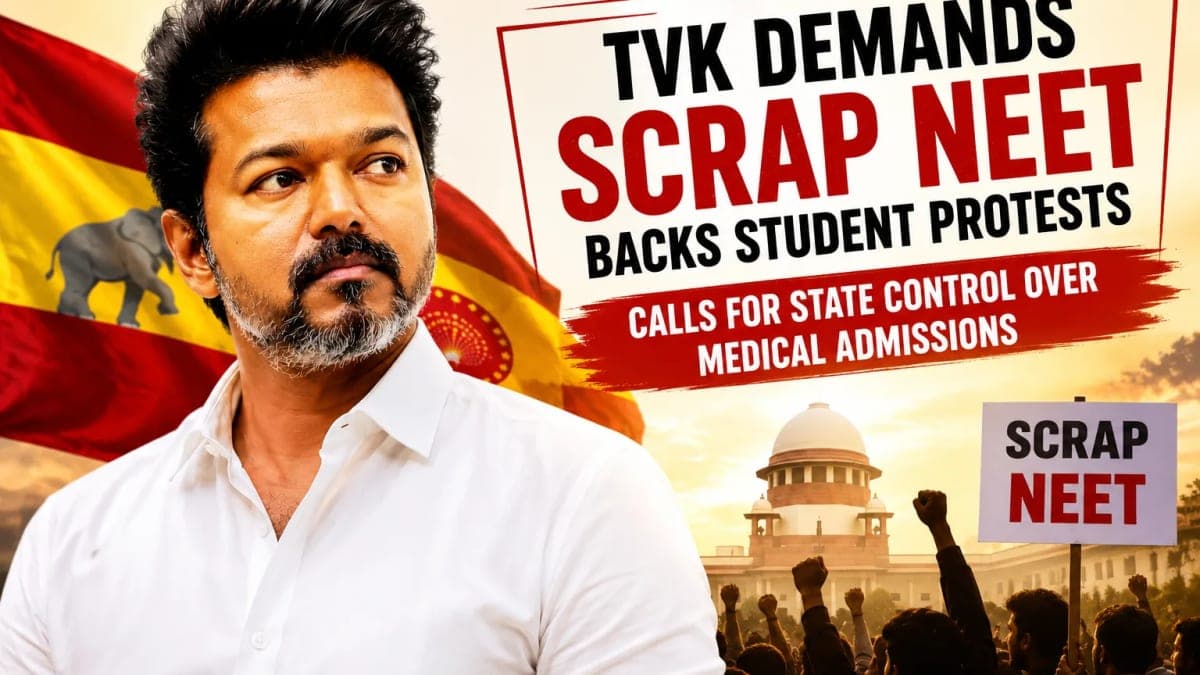
TVK Renews Opposition to NEET Amid Nationwide Student Protests
Tamilaga Vettri Kazhagam (TVK) has once again taken a firm stand against the National Eligibility cum Entrance Test (NEET), declaring that its position goes beyond criticism of alleged irregularities and extends to seeking the examination's complete abolition.
The party expressed support for ongoing student protests over the entrance examination while describing its opposition to NEET as an "uncompromising" position. According to TVK, the issue is rooted in the structure of the examination system itself rather than isolated controversies.
Demand for Greater State Control Over Education
Alongside its demand to abolish NEET, TVK has urged the Centre to give states greater authority over education policy, particularly medical admissions. The party argued that shifting education-related powers from the Concurrent List to the State List would allow individual states to design admission systems better suited to their educational needs and social realities.
TVK maintains that decentralizing decision-making would provide a long-term solution to recurring disputes surrounding medical entrance examinations.
Background: Tamil Nadu's Long-Standing Opposition to NEET
Opposition to NEET has remained a significant political issue in Tamil Nadu since the examination became the single national entrance test for undergraduate medical admissions.
Several political parties in the state have argued that the centralized examination disadvantages students from rural areas, government schools, regional-language backgrounds, and economically weaker sections. Supporters of NEET, however, argue that a common national examination creates uniform admission standards and promotes merit-based selection across India.
This debate has continued for years and has frequently resurfaced whenever concerns about the examination process emerge.
Student Protests Bring Fresh Attention to the Debate
TVK's latest statement comes as protests related to NEET have intensified in parts of the country. The party linked its long-standing position with the current demonstrations, arguing that recent developments have reinforced its demand for structural changes rather than temporary reforms.
The renewed political attention has placed education policy and examination reforms back at the center of national discussion.
Why the Issue Matters
NEET serves as the gateway for admission to undergraduate medical courses across India, making it one of the country's most competitive examinations. Any proposal to abolish or substantially modify the system carries implications for millions of students, educational institutions, and state governments.
The ongoing debate reflects a broader question of balancing national uniformity with state autonomy in education. While some advocate a centralized examination to ensure consistent standards, others believe states should have greater flexibility in designing admission systems that reflect regional educational priorities.
Balanced Analysis
TVK's renewed demand highlights the continuing divide over medical admissions in India. Supporters of the party's position argue that greater state control could better address regional disparities and improve access for disadvantaged students. Critics, however, contend that a nationwide examination provides a transparent and standardized method of selecting medical candidates.
With student concerns, political debate, and discussions on examination reforms continuing, the future of NEET is likely to remain an important national policy issue.
Conclusion
By reiterating its support for student protests and calling for the complete abolition of NEET, TVK has reinforced its long-held position on medical admissions. The party's demand for greater state authority over education adds another dimension to the broader debate over how India should balance national standards with regional educational priorities.