Who Really Owns Tata? Why 66% of Tata Sons Belongs to Charitable Trusts, Not One Family Member
Ask who owns Tata and the obvious answers might be Ratan Tata’s family, Noel Tata, or the Mistry family.
None of those answers is quite right.
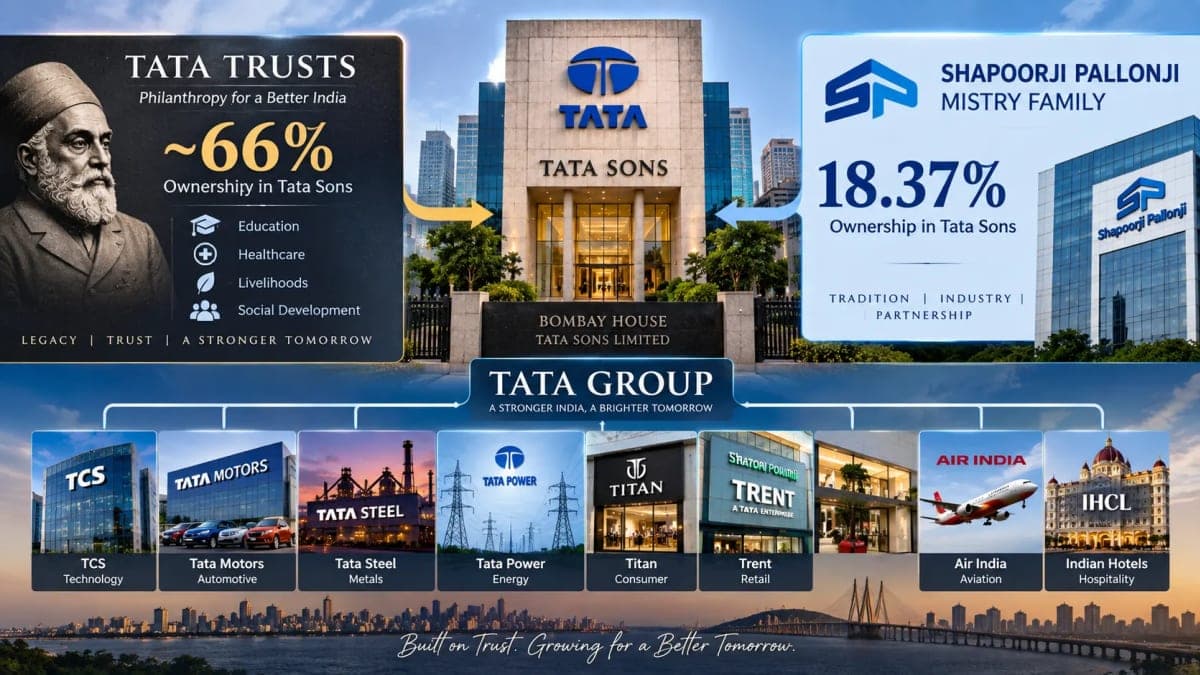
At the centre of the Tata Group sits Tata Sons Private Limited, the principal investment holding company and promoter of Tata companies. Around 66% of Tata Sons’ equity is held by philanthropic Tata Trusts, while the Mistry family’s Shapoorji Pallonji Group owns approximately 18.37%. The rest is spread among Tata group companies and individual shareholders.
That ownership structure is central to understanding how businesses as different as TCS, Tata Motors, Tata Steel, Air India, Titan, Trent and Tata Consumer Products fit into the same corporate ecosystem.
It has also become more relevant in September 2026 after the Reserve Bank of India rejected Tata Sons’ attempt to surrender its Core Investment Company registration, moving the company closer to a possible public listing.
Tata Sons is the company at the centre of the group
The Tata Group is not one legal company.
It is a collection of dozens of operating companies across technology, automobiles, steel, consumer goods, hotels, aviation, energy, retail and other sectors.
Tata Sons sits above that network as the group’s principal investment holding company and promoter. It owns significant stakes in many Tata companies and also controls important rights associated with the Tata brand.
Tata’s official group website says the group comprises 31 companies across multiple business verticals, operates in more than 100 countries and generated aggregate revenue of more than $180 billion in 2024-25. There were 26 publicly listed Tata companies with a combined market capitalisation above $328 billion as of March 31, 2025.
Each Tata operating company, however, has its own board and is run independently.
That means Tata Sons does not manage every business as if they were departments inside one corporation. Its role is closer to that of a strategic holding and promoter company sitting at the centre of a federation of businesses.
So who owns Tata Sons?
The largest shareholder group is Tata Trusts.
Tata itself states that 66% of the equity share capital of Tata Sons is held by philanthropic trusts involved in areas such as education, healthcare, livelihoods, culture and social development.
This is the feature that makes Tata’s ownership model unusual.
The shares are not simply personal wealth belonging to one Tata heir. They are owned by public charitable trusts established over generations.
The two largest are:
Sir Dorabji Tata Trust — 27.98%
Sir Ratan Tata Trust — 23.56%
Together, those two trusts own 51.54% of Tata Sons, giving them an absolute majority even before the other Tata charitable trusts are included. Tata Sons’ FY2024 annual return lists those holdings directly.
Other trusts holding Tata Sons shares include the JRD Tata Trust, Tata Education Trust, Tata Social Welfare Trust, R.D. Tata Trust and Sarvajanik Seva Trust.
Collectively, the philanthropic trusts take the total to roughly two-thirds of Tata Sons.
Does Noel Tata personally own 66% of Tata Sons?
No.
This is one of the most important distinctions in the structure.
Noel Tata chairs Tata Trusts, but that does not mean the 66% Tata Trusts shareholding is his personal property.
The shares belong to the respective charitable trusts. Decisions relating to those trusts are made through their governance structures and boards of trustees.
So statements suggesting that Noel Tata personally “owns 66% of Tata” are inaccurate.
He holds an influential governance position because he chairs Tata Trusts, but chairmanship and personal share ownership are not the same thing.
Where does the Mistry family fit in?
The Shapoorji Pallonji Group, controlled by the Mistry family, is Tata Sons’ largest minority shareholder.
Its stake is approximately 18.37%.
That holding is split principally through two investment companies historically associated with the family: Cyrus Investments Private Limited and Sterling Investment Corporation Private Limited.
Tata Sons’ FY2024 annual return showed each company holding about 9.19%, putting their combined stake at roughly 18.38% on the rounded figures in that filing. Market reporting generally refers to the SP Group’s current combined holding as 18.37%.
This makes the Mistry family far more than a small outside shareholder.
It owns one of the most valuable private corporate stakes in India.
The relationship became highly visible after Cyrus Mistry, who had served as chairman of Tata Sons, was removed in 2016, triggering years of legal and governance disputes between the Mistry camp and Tata Sons.
The Supreme Court ultimately ruled in Tata Sons’ favour in 2021 on the major corporate-governance dispute.
How did the Mistry family get such a large stake?
The connection between the Tata and Shapoorji Pallonji families dates back many decades.
Over time, the SP Group accumulated shares in Tata Sons, eventually becoming its biggest shareholder outside the Tata-controlled trust and group-company network.
Unlike Tata Trusts, however, the Mistry family does not control Tata Sons.
An 18.37% economic stake is enormous, but it is still well below the roughly 66% held collectively by the Tata Trusts.
That difference between ownership value and control is essential to understanding the long-running relationship between the two shareholder groups.
Tata companies also own part of Tata Sons
Another unusual layer is cross-shareholding.
Around 13% of Tata Sons is owned by Tata group companies themselves, rather than by the charitable trusts or the Mistry family. Tata historically described this portion at around 13%; current reporting puts the holding of nine Tata entities at approximately 12.83%.
Among those holders are listed Tata companies.
That matters because a future Tata Sons listing could potentially make the value of these long-held stakes easier for investors to assess.
Until now, Tata Sons has been privately held, meaning there is no continuously quoted public-market price for its shares.
What about the remaining shareholders?
After Tata Trusts, the SP Group and Tata group companies, a relatively small portion of Tata Sons is held by individual shareholders and other interests.
Tata historically described the broad structure as approximately:
66% Tata charitable trusts
18% Mistry family
13% Tata companies
3% individuals
More recent reporting uses the more precise SP Group figure of 18.37%, while the Tata group-company stake has been reported at about 12.8%-13%.
The exact percentages can vary slightly in descriptions because of rounding and the treatment of small holdings, but the overall structure has remained clear: Tata Trusts hold control, SP is the largest minority shareholder, and group companies hold a meaningful additional block.
Who actually controls Tata Sons?
Economically, shareholders own the company.
In practical governance terms, Tata Trusts hold the dominant position.
Their approximately 66% shareholding already gives them majority voting power. In addition, Tata Sons’ Articles of Association have historically provided the Sir Dorabji Tata Trust and Sir Ratan Tata Trust with important governance rights.
As long as Tata Trusts collectively hold at least 40% of Tata Sons’ ordinary share capital, the two principal trusts have the right to jointly nominate one-third of the Tata Sons board, according to Article 104B cited in litigation over the company’s governance.
The Articles also give the two major trusts an important role in the selection process for the Tata Sons chairman.
Under changes approved in 2022, the chairman selection committee includes three people jointly nominated by the Sir Dorabji Tata Trust and Sir Ratan Tata Trust, one Tata Sons board nominee and an outside independent person. The committee chair is selected by the two trusts from among their nominees.
That is why ownership of Tata Sons cannot be understood simply by looking at percentages.
The trust structure combines majority share ownership with significant governance rights.
Does Tata Sons own TCS, Tata Motors and Tata Steel completely?
No.
Most major Tata operating companies have their own outside shareholders, particularly those listed on stock exchanges.
Tata Sons and other Tata promoter entities typically own controlling or influential stakes rather than 100% of these businesses.
For example, Tata Sons is the principal promoter behind companies such as TCS, Tata Motors, Tata Steel, Tata Power and Indian Hotels, but public investors also own shares in those listed businesses.
This creates a layered structure:
Tata Trusts and other shareholders → Tata Sons → Tata operating companies → public shareholders in listed Tata companies
That is a more accurate picture than saying “Tata Sons owns the entire Tata Group.”
Why do Tata Trusts own so much of the business empire?
The structure is rooted in the Tata family’s long tradition of philanthropy.
The Sir Ratan Tata Trust and Sir Dorabji Tata Trust were established in the early 20th century and became major holders of Tata Sons shares.
Over time, dividends received through those holdings helped fund charitable activity in areas including healthcare, education, livelihoods, water, sanitation, research, culture and institution-building.
Tata’s own description says dividends flowing from the Trusts’ Tata Sons ownership support philanthropic programmes.
This is why a large part of the economic benefit generated at the holding-company level can ultimately flow towards charitable purposes rather than directly to a promoter family’s personal wealth.
Why is Tata Sons ownership suddenly important again in 2026?
Because Tata Sons may be moving closer to a stock-market listing.
The Reserve Bank of India classified Tata Sons as an Upper Layer NBFC in 2022. Such entities face stricter regulatory requirements, including listing obligations.
Tata Sons subsequently sought to surrender its Core Investment Company registration, a route that could have helped it avoid those requirements.
In September 2026, the RBI rejected that application, according to Reuters and other reports.
That decision has revived one of India’s biggest corporate questions: could Tata Sons eventually become a publicly traded company?
A listing would expose the holding company itself to public-market valuation for the first time.
Why does the SP Group want a Tata Sons listing?
The Mistry family’s SP Group has publicly supported listing Tata Sons.
In April 2026, Shapoorji Pallonji Mistry described a listing as a “necessary evolution” that could strengthen transparency, governance and accountability. The SP Group also stands to gain a liquid market for at least part of its 18.37% holding.
That liquidity is particularly important because an 18.37% stake in an unlisted company can be extraordinarily valuable while still being difficult to monetise.
Current reporting has linked the SP Group’s position to its broader financing needs and potential plans to monetise part of its Tata Sons shareholding.
A public listing could make that process substantially easier.
Would an IPO mean Tata Trusts lose control?
Not necessarily.
A public offering would depend heavily on its structure.
If existing shareholders sold only a limited portion of their holdings, or if Tata Sons issued new shares without materially diluting the Trusts, the Tata Trusts could continue to retain majority control.
That is why an IPO should not automatically be interpreted as the end of Tata Trusts’ dominance.
With about 66% today, there is a substantial cushion before the Trusts would fall below the 50% majority threshold.
However, the precise effect would depend on how many shares were issued or sold and which shareholders participated.
No final IPO structure has been publicly confirmed.
Could ordinary investors buy Tata Sons shares today?
No.
As of September 2026, Tata Sons remains a privately held company.
Investors can buy shares in listed Tata companies such as TCS, Tata Motors, Tata Steel, Tata Power, Titan, Trent and several others, but they cannot simply purchase Tata Sons stock on NSE or BSE.
That could change if the company eventually lists.
But until an IPO is formally announced, approved and completed, Tata Sons itself remains outside the public stock market.
Is buying TCS or Tata Motors the same as owning Tata Sons?
No.
Buying TCS shares makes an investor a shareholder of Tata Consultancy Services, not Tata Sons.
The same applies to Tata Motors, Tata Steel, Titan or any other listed Tata company.
Tata Sons may be the promoter and a major shareholder in those companies, but each listed company has its own share capital, investors, board, financial statements and valuation.
This distinction is particularly important when people talk about a possible Tata Sons IPO.
A Tata Sons listing would create a separate publicly traded security representing ownership in the group’s central holding company, rather than simply another way to hold TCS or Tata Motors.
Tata Trusts vs Tata Sons: they are not the same thing
The names are similar, but their roles are completely different.
Tata Trusts are charitable institutions.
Tata Sons is a commercial holding and investment company.
Tata Trusts own the majority of Tata Sons; Tata Sons, in turn, owns stakes in commercial Tata businesses.
This creates a chain:
Tata charitable trusts → Tata Sons → Tata group operating companies
That is the simplest way to understand the structure.
The charitable trusts do not directly operate Tata Motors factories or manage TCS client contracts. Those businesses operate through their respective companies and boards.
Who owns the Tata brand?
Tata Sons is also central because it is the custodian of the Tata brand.
Operating companies using the Tata name participate in Tata Sons’ Brand Equity and Business Promotion framework, which connects use of the brand with group standards such as the Tata Code of Conduct and Tata Business Excellence Model.
That makes Tata Sons strategically important even beyond the value of the shares it owns.
Its role combines capital ownership, promoter influence and stewardship of one of India’s most recognisable corporate brands.
What the ownership percentages really mean
A 66% Tata Trusts holding does not mean a single charity controls every decision directly.
The ownership is divided among multiple trusts, although the Sir Dorabji Tata Trust and Sir Ratan Tata Trust are by far the most important and jointly hold 51.54%.
Similarly, the Mistry family’s 18.37% does not translate into proportional control over Tata Sons’ board or management.
It gives the family substantial economic exposure and shareholder rights, but not control comparable with that of Tata Trusts.
And the stakes held by Tata group companies create another layer of circular economic ownership within the broader Tata ecosystem.
Those distinctions matter far more than simply ranking the shareholders by percentage.
Why this structure matters beyond Tata
Tata’s ownership model raises a broader question about what it means for a business group to be “family owned.”
The Tata name comes from the founding family, but the largest block of shares in the apex company has been transferred into charitable institutions rather than passed down as ordinary personal family wealth.
That gives the organisation a different ownership logic from many conglomerates where the founder’s descendants remain the direct controlling shareholders.
It also explains why debates over Tata Sons governance can involve not only company law and shareholder interests, but also charity law, trusteeship, group governance and the interests of minority shareholders.
Bottom line: Who owns Tata Sons?
The clearest answer is:
Tata Trusts collectively own roughly 66% and control Tata Sons.
The Mistry family’s Shapoorji Pallonji Group owns about 18.37%, making it the largest minority shareholder.
Tata group companies own roughly 13%, while the remaining shares are held by individuals and smaller shareholders.
So Tata is neither simply “owned by Noel Tata” nor “owned by the Tata family” in the ordinary billionaire-promoter sense.
Its commercial centre is majority-owned by charitable trusts.
That unusual structure has existed for decades. What is new in 2026 is that a potential Tata Sons listing could expose that ownership structure — and the enormous value behind it — directly to the public markets.