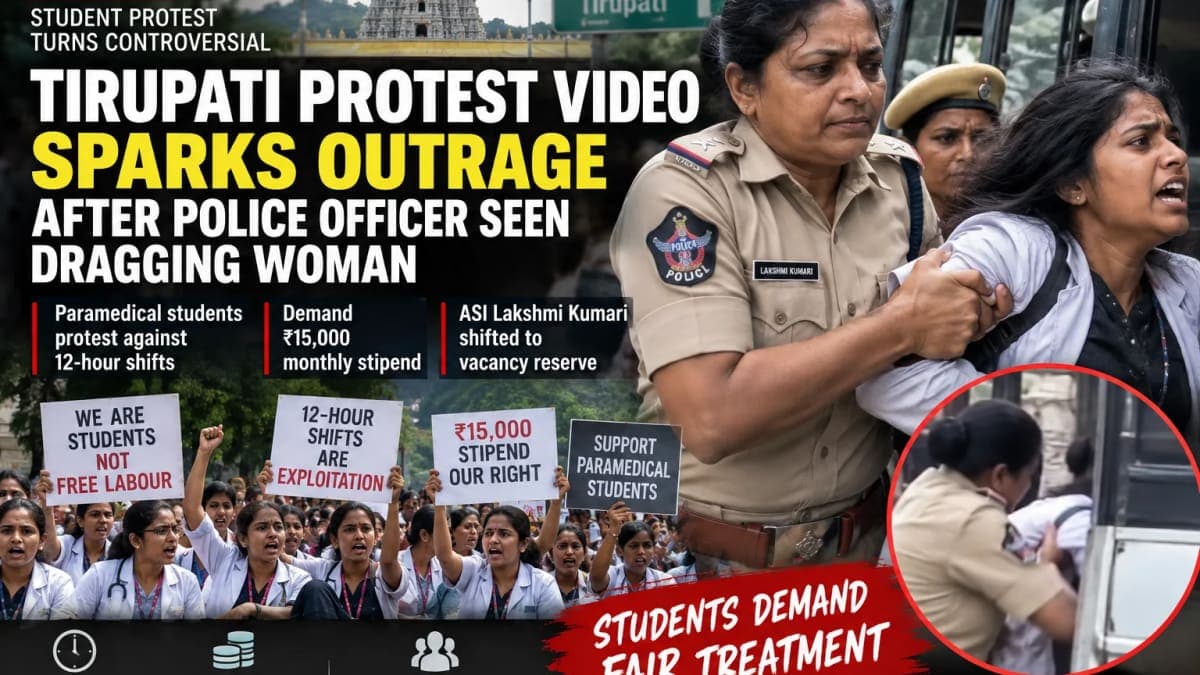
A demonstration over the working conditions of paramedical interns in Tirupati has become the subject of wider scrutiny after video of a confrontation between police and protesters circulated online.
Students had gathered at Garuda Circle in Alipiri to oppose mandatory 12-hour hospital shifts and press for a monthly stipend of ₹15,000. The protest included interns from BSc Medical Laboratory Technology and other allied health sciences courses, along with representatives of student organisations.
As police moved to disperse or detain demonstrators, the situation became tense. One piece of footage showed Assistant Sub-Inspector Lakshmi Kumari pulling a female protester towards a police vehicle.
The video quickly became the dominant image from the demonstration. But one of the most serious claims attached to it — that the officer deliberately dragged the woman by her hair — has subsequently been disputed by both Tirupati police and the protester herself.
Protest Began Over Working Hours and Stipend
Before the police confrontation became the focus, the students were raising a specific set of workplace concerns.
Paramedical and allied health sciences interns objected to a requirement for 12-hour hospital shifts, which protesters described as “free labour”. They also demanded a monthly stipend of ₹15,000 to help meet expenses such as food, accommodation and transportation.
Members of the Students’ Federation of India joined the demonstration in support of the students.
The protest brought a sizeable police presence to Garuda Circle. Tensions rose when officers attempted to move demonstrators from the area, leading to arguments, physical resistance and detentions.
It was during this phase that the video involving Lakshmi Kumari was recorded.
What the Viral Footage Shows — and What Remains Disputed
The distinction between what can be seen in the footage and what was subsequently claimed online is important.
The video shows the officer physically pulling a female protester as police deal with the demonstration. As the clip circulated, social-media posts alleged that the woman had been grabbed and dragged by her hair.
That specific interpretation has been challenged.
Tirupati Additional Superintendent of Police Ravi Manoharachary said the officer had pulled the protester by her hand rather than her hair. According to the police explanation, the woman's hair fell across her arm during the confrontation, creating a misleading impression in the footage.
The woman involved later gave an account that broadly supported that explanation.
Protester Says Policewoman Pulled Her Hand
The protester identified herself as a district committee member of the Students’ Federation of India and said the organisation had joined the paramedical students in support of their demands.
Describing the confrontation, she said:
“When a heated altercation broke out between police and the agitators, a policewoman tried to drag me away by pulling my hand.”
She separately addressed the allegation about her hair:
“My hair accidentally fell on my arm during the melee.”
Her statement does not erase the question of whether the level of physical force used against protesters was appropriate. It does, however, materially change how the more specific hair-pulling allegation should be reported.
The footage confirms physical contact and an attempt to pull the protester away. Based on the available accounts, deliberately dragging her by the hair should not be presented as an established fact.
ASI Lakshmi Kumari Shifted to Vacancy Reserve
As the footage attracted attention and criticism of the police response grew, authorities moved Lakshmi Kumari to vacancy reserve (VR).
The administrative step followed the controversy surrounding the video.
Her transfer to VR should be distinguished from a completed disciplinary finding. The action does not, on its own, establish that all allegations made about the officer's conduct have been proven.
That distinction matters in a case where the images themselves are not in dispute but one prominent interpretation of them is.
A Viral Clip Changes the Story
For the students, the confrontation created an unintended consequence: their original demands were pushed into the background.
The demonstration began over working hours and financial support for paramedical interns. Once the police video began circulating, public attention shifted towards the conduct of the officer and the allegation that the woman had been dragged by her hair.
Short videos frequently strip an event down to its most visually striking moment. That can expose conduct deserving scrutiny, but it can also encourage conclusions before accounts from those directly involved are available.
In Tirupati, the later statement from the protester provides unusually important context because she is the person shown being pulled in the footage.
Her account challenges the hair-pulling claim without changing the broader fact that police used physical force while attempting to move protesters.
The Students’ Demands Have Not Disappeared
The controversy over the video is therefore only part of the story.
Paramedical students had gone to Garuda Circle seeking changes to the conditions under which they work in hospitals. Their objections centred on 12-hour shifts and the absence of the ₹15,000 monthly stipend they are demanding.
Those concerns existed before the confrontation and remain separate from the debate over police conduct.
For administrators, the two issues require different responses. Questions surrounding the actions of police during the protest concern crowd management and the treatment of demonstrators. The dispute over shifts and stipends concerns the conditions facing paramedical interns.
The viral footage brought national-style social-media attention to a local student demonstration. It should not, however, reduce the episode to a few seconds of video.
The fuller account is more complicated: students were protesting over working conditions, police intervened, a woman was physically pulled during the confrontation, and an allegation about precisely how she was pulled was later challenged by the woman herself.
That distinction is essential to reporting the episode accurately.