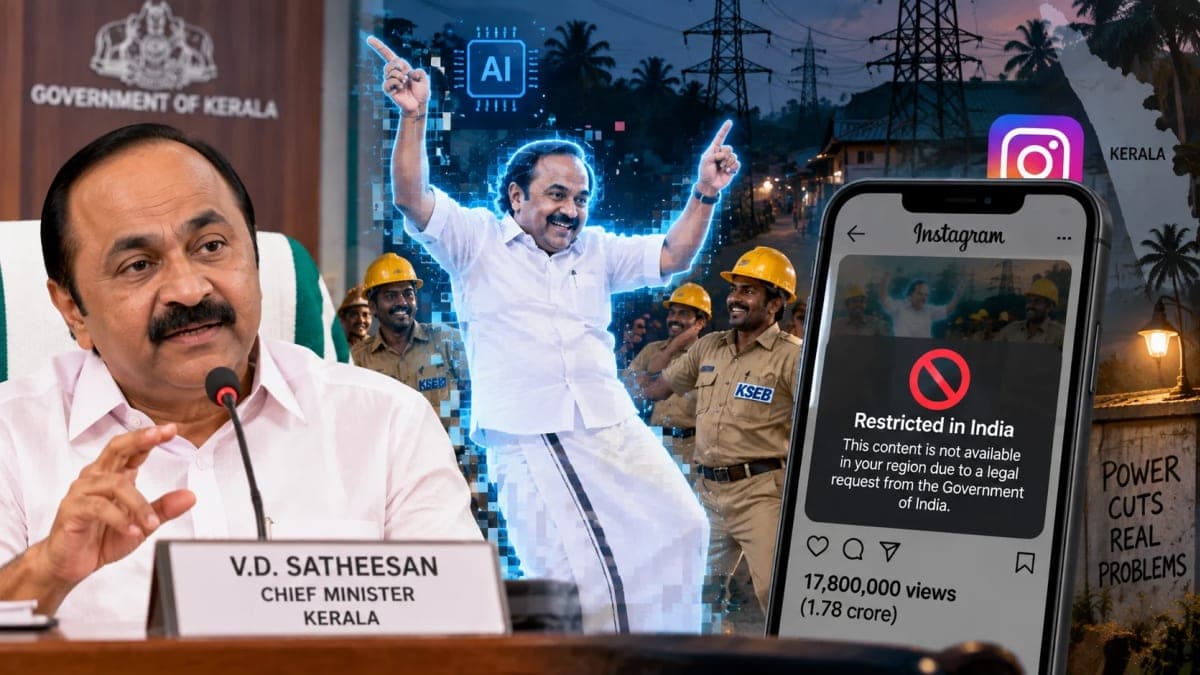
An AI Video of Kerala CM Satheesan Hit 1.78 Crore Views. Then Meta Restricted It in India
A satirical AI video that turned Kerala’s electricity crisis into a viral dance sequence has moved from online comedy into a debate about platform restrictions, political parody and government takedown requests.
The Instagram video, created by the account ai.kavala, depicts Kerala Chief Minister V.D. Satheesan dancing with Kerala State Electricity Board employees while the state faces criticism over power cuts and electricity shortages.
By Sunday, the post had accumulated about 1.78 crore views, according to multiple reports.
Meta subsequently restricted access to the original video in India. The platform’s notice said it had acted after receiving a legal request from the Government of India.
What has not been publicly established is just as important: available reporting does not identify the government agency behind the request, the specific law invoked or the detailed reasoning for seeking the restriction.
What does the viral video show?
The AI-generated clip portrays Satheesan leading a dance alongside people represented as KSEB employees.
It uses “Ala Bolelo”, a song composed by Anirudh for Jailer 2, according to reports. The creator’s page had identified the material as AI-generated and said the parody was intended for entertainment rather than to insult or defame anyone.
Its timing made the joke politically resonant.
Kerala has been dealing with electricity shortages and power restrictions, prompting criticism of the government and KSEB. Social media users had already begun turning the disruptions into memes, parody announcements and political jokes before the Satheesan clip exploded in popularity.
An Indian Express Malayalam report published on September 11 said the video had already crossed 50 lakh views within hours. By the weekend, the reported count had climbed to roughly 1.78 crore.
That rate of spread helps explain why the clip moved beyond a local meme and became a broader political-media story.
Satheesan himself had joked about the video
What makes the subsequent restriction particularly notable is that Satheesan had publicly responded to the clip with humour rather than outrage.
Speaking at a seminar on music, cinema, law and digital technology, the Kerala Chief Minister said he was “shocked and stunned” by how realistically AI had portrayed him.
He then joked:
“I was dancing better than Mohanlal and my friend, Tamil Nadu Chief Minister Vijay.”
Satheesan also pointed to the clip while discussing the wider implications of artificial intelligence and the need for legal frameworks to keep pace with technological change.
His remarks do not establish his office’s position on Meta’s later restriction. They do, however, show that he had publicly acknowledged the parody before access to the original post was limited.
Reports citing the creators said they did not believe the Chief Minister’s Office had sought the restriction, partly because Satheesan had reacted positively to the video. That is the creators’ assessment, not independently established fact.
What exactly did Meta do?
Meta did not merely attach an AI label or reduce the post’s reach.
Reports say the company restricted access to the original video in India after receiving a legal request from the Government of India.
That distinction matters.
A platform can moderate content because it believes the material violates its own community standards. It can also restrict material in a specific jurisdiction after receiving a legally valid government demand.
In this case, the reporting reviewed for this article attributes the restriction to a government legal request, rather than an independently identified violation of Meta’s general content rules.
The public information, however, does not provide enough detail to determine whether the request concerned impersonation, misinformation, copyright, public order, another legal category or some combination of issues.
Any claim about the specific legal rationale would therefore be speculation.
The original post is restricted, but copies may still circulate
Restricting one original Instagram post does not necessarily erase a viral video from the internet.
Once a clip has been downloaded, reposted or reproduced across different accounts and platforms, copies can continue circulating independently of the source post.
That appears relevant here. Users had already shared and discussed the Satheesan video extensively before the restriction.
The difference is important for readers: reports about Meta restricting the video refer to the original creator’s post/access in India, not evidence that every copy of the clip has disappeared from all social platforms.
This is one reason platform moderation becomes more complicated once synthetic content reaches millions of viewers.
Why did the video become so popular?
The technology alone does not explain 1.78 crore views.
The video arrived at a moment when Kerala’s electricity situation was already producing widespread public frustration and political argument.
India Today reported that unannounced outages and night-time power cuts had triggered complaints from households and generated a wave of memes and parody content. Some political campaigns used expressions such as “Indira cut” and “Satheesan cut” to attack the government.
The Satheesan dance clip compressed that complicated policy dispute into a few seconds of immediately understandable satire: the Chief Minister, electricity-board employees and a power crisis, rendered as an exaggerated dance routine.
That combination made it easy to share even for users who had little interest in the technical causes of Kerala’s electricity shortage.
Kerala’s power crisis is the context behind the meme
The satire should not be confused with evidence about the actual causes of the electricity shortage.
Kerala’s power problems have been linked to a gap between demand and available supply, including higher electricity consumption and pressure on generation and procurement.
Earlier reporting quoted Electricity Minister Sunny Joseph as saying the crisis had no instant solution and pointing, among other factors, to a sharp increase in night-time consumption.
Satheesan has also criticised sections of KSEB over what he described as resistance to renewable-energy projects and has said the government intends to give greater prominence to renewable power, particularly solar energy, in a new electricity policy.
Those policy disputes explain why a video depicting the Chief Minister dancing alongside KSEB staff carried an obvious political punch.
AI political parody is entering a difficult grey area
Synthetic videos of politicians are becoming easier to produce, but not all AI-generated political content serves the same purpose.
A deceptive deepfake designed to convince viewers that a politician genuinely said or did something can create misinformation risks.
An obvious parody can serve a very different purpose: satire, humour or political criticism.
The Satheesan video was presented as AI-generated entertainment, and the Chief Minister himself publicly treated it as an artificial creation.
That reduces one type of misinformation risk: viewers were not being told the dance was a genuine recording.
But AI-generated likenesses of public figures can still create questions around consent, defamation, copyright, personality rights, manipulated media rules and political communication.
The legal framework can become particularly complicated when one synthetic clip combines a politician’s likeness, an existing song and political commentary.
Why Meta’s legal-request notice matters
The central issue now is transparency.
If a platform says content was restricted because of a government legal request, readers need to distinguish that from a platform independently deciding that the content broke its own rules.
The distinction matters for accountability.
If the action came through a legal process, the key questions become:
Which authority made the request?
Under what legal provision?
What specific harm or violation was alleged?
Was the request limited to India?
Can the creator challenge or appeal the restriction?
Those details were not clearly available in the reporting reviewed for this article.
That leaves a gap between knowing that Meta restricted the post and understanding why the law required or justified the restriction.
This is not Satheesan’s first recent dispute involving Meta
The episode comes shortly after a separate social-media controversy involving the Kerala Chief Minister’s official Facebook presence.
Earlier in September, Meta removed two posts from the Kerala Chief Minister’s Office Facebook page: one concerning an Onam festival allowance for ASHA workers and another carrying Nabi Day greetings.
After the CMO contacted Meta and the Union Ministry of Electronics and Information Technology, the posts were restored. The Chief Minister’s Office sought an explanation and raised concerns over the removal of verified government communication.
Meta reportedly attributed those removals to a technical issue connected to automated safety checks.
That earlier episode was different from the current AI-video restriction. The CMO posts were official government communications removed and later restored; the new controversy concerns a third-party AI parody restricted following a legal request.
Still, taken together, the two cases show how dependent political communication and political commentary have become on the decisions of private platforms.
What does 1.78 crore views actually tell us?
The number is significant, but it requires context.
1.78 crore equals about 17.8 million views.
It indicates that the video travelled far beyond a small Kerala political audience.
But a view count does not mean 17.8 million unique people watched the video. Social platforms may count repeated plays, and public reporting reviewed here does not provide audited unique-viewer data.
Nor does a large view count indicate approval.
Users could have watched because they found the clip funny, opposed the government, supported Satheesan, were interested in AI or simply encountered it through Instagram’s recommendation system.
The number measures distribution, not political sentiment.
Could the restriction make the video even more visible?
Possibly, but that cannot yet be established with data.
Attempts to suppress or restrict already-viral material can sometimes attract additional curiosity, a phenomenon often described as the “Streisand effect.”
But it would be speculative to claim that Meta’s action has increased the total audience for this particular video without comparable before-and-after reach data.
What can be said is that the restriction itself has created a second news cycle around material that had already gone viral.
The story has shifted from “AI video mocks Kerala power cuts” to a broader argument about who decides what political parody remains visible online.
What users should remember when viewing AI political videos
The Satheesan clip was relatively easy to contextualise because it was widely identified as AI-generated satire.
Future synthetic videos may be less obvious.
Before sharing political AI content, users should look for:
the original uploader
a clear AI or parody disclosure
reporting from credible news organisations
inconsistencies in voice, movement or visuals
whether the supposed event is independently documented
whether the clip is being presented as satire or as genuine footage
The most convincing AI videos are increasingly difficult to assess by appearance alone. Verification from independent sources is more reliable than trying to detect every visual flaw manually.
The larger story is bigger than one meme
The viral Satheesan video sits at the intersection of three issues already reshaping political communication: AI-generated media, social-platform power and government content-removal requests.
The clip began as satire about electricity cuts.
It then became an example used by the Chief Minister himself to discuss how quickly AI technology has advanced.
Now, after 1.78 crore reported views and a Meta restriction in India, it has become a test case for a different question: how transparent should restrictions on synthetic political satire be when the content is already clearly labelled as artificial?
Until the specific legal grounds for the government request are publicly identified, that is the part of the story that remains unresolved.