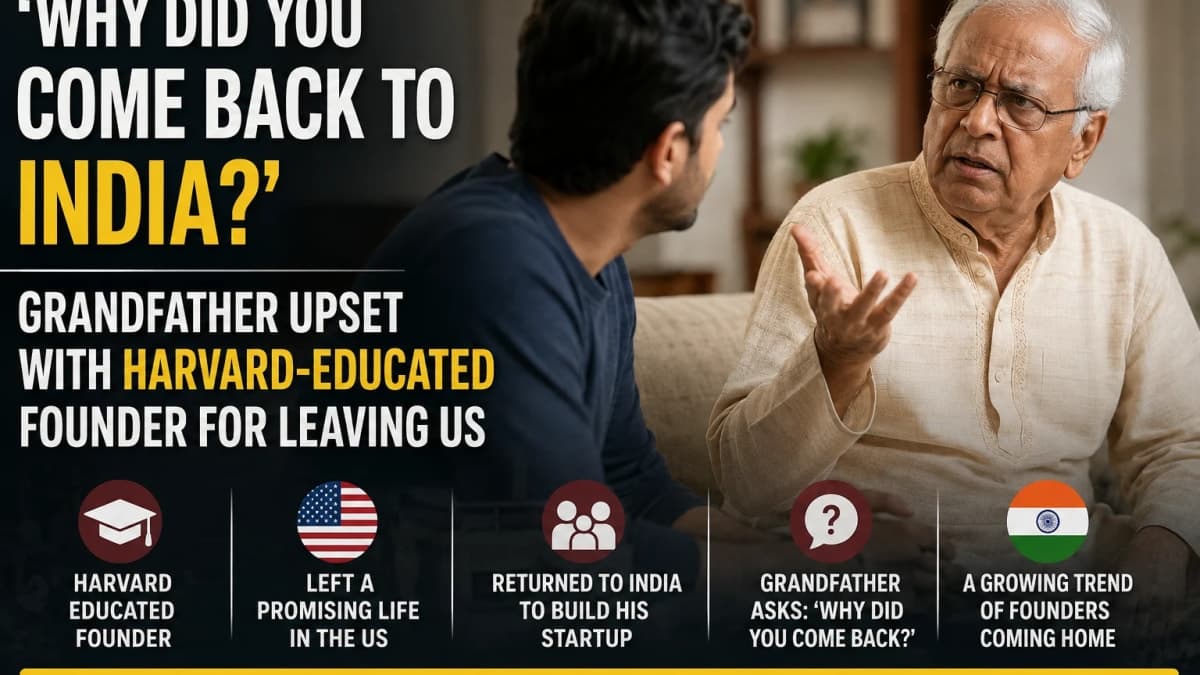
A Homecoming That Did Not Receive the Expected Reaction
Returning home after studying at one of the world’s most prestigious universities might ordinarily be expected to bring celebration. For one Harvard-educated founder, however, the decision produced a very different response within his family.
After leaving the United States and returning to India, the entrepreneur was confronted with a straightforward question from his grandfather: Why did you come back to India?
The grandfather was reportedly unhappy with the decision, reflecting a view familiar to many Indian families in which studying and eventually establishing a career in countries such as the United States has traditionally been regarded as a major professional achievement.
The exchange has attracted attention because it highlights the contrast between two generations and their perceptions of opportunity.
Why the Grandfather’s Reaction Matters
For decades, overseas education—particularly at prestigious American universities—has often been associated in India with access to better salaries, international exposure and long-term professional opportunities.
Against that background, voluntarily returning to India after securing a highly valued international education can appear counterintuitive to an older generation that witnessed talented professionals moving abroad in search of opportunities that were once comparatively scarce at home.
The grandfather’s reaction can therefore be viewed as more than disappointment over one individual decision. It represents a broader generational understanding of what professional success has historically looked like.
For the younger generation of founders, however, the calculation can be different.
From ‘Brain Drain’ to Building in India
India has long debated the phenomenon commonly described as “brain drain”—highly educated professionals leaving the country to pursue careers overseas.
But India's economic and entrepreneurial environment has changed substantially over the years.
The expansion of startups, digital infrastructure, venture capital, technology businesses and a large domestic consumer market has created opportunities for entrepreneurs who see India not merely as a place to return to, but as a market in which globally ambitious companies can be created.
For founders in particular, the decision about where to live is not necessarily determined only by salary.
Access to customers, understanding of the local market, proximity to business networks and the opportunity to solve India-specific problems can all influence the choice.
Why Would a Harvard Graduate Leave the US?
An elite international degree can create opportunities in several countries rather than requiring its holder to remain in the country where they studied.
For an entrepreneur, India offers one particularly important advantage: scale.
A large population, rapidly expanding digital adoption and demand across sectors ranging from financial technology and commerce to healthcare, education and consumer services can provide founders with significant room to experiment and grow.
At the same time, returning to India involves trade-offs. The US continues to offer an exceptionally mature technology and venture-capital ecosystem, high salaries in many professional fields and proximity to some of the world's largest technology companies and investors.
That makes the decision highly individual rather than an obvious choice between a “better” and “worse” destination.
A Generational Difference in the Meaning of Success
The grandfather’s question also captures how the meaning of professional success can evolve between generations.
For many Indians who grew up when opportunities abroad were relatively difficult to obtain, moving to the US represented economic security and upward mobility. Giving up such an opportunity could therefore appear unnecessary or even risky.
Younger entrepreneurs may assess success differently.
Instead of focusing primarily on where they are employed or how much they earn, some founders may place greater importance on ownership, entrepreneurship, impact and the possibility of building something themselves.
Neither perspective is inherently irrational. They are shaped by different economic environments and experiences.
India's Startup Opportunity Is Large—but So Are the Risks
The founder’s decision also fits into a wider discussion around India's growing startup ecosystem.
India has produced companies across fintech, software, e-commerce, logistics, consumer technology and other emerging industries. Greater smartphone penetration and digital payments have also made it possible for technology companies to reach customers at enormous scale.
However, the entrepreneurial route remains uncertain.
Startups face challenges including funding cycles, intense competition, profitability pressures, regulatory requirements and the difficulty of converting a promising idea into a sustainable business.
Returning to India to become an entrepreneur therefore should not automatically be romanticised as the superior choice.
Remaining in the United States can provide its own significant advantages, just as building a company in India can offer opportunities unavailable elsewhere.
More Than a Family Conversation
What makes the grandfather’s reaction relatable is that similar discussions take place in families across India.
Parents and grandparents who invested heavily in international education may naturally expect that qualification to lead to a stable career overseas. When a young professional instead decides to return home, join a startup or become an entrepreneur, the decision can conflict with those expectations.
The resulting disagreement is often less about patriotism versus migration and more about different attitudes toward risk.
One generation may prioritise stability and predictable career progression, while another may be more willing to exchange that security for entrepreneurial opportunity.
Balanced Analysis
The story should not be interpreted as evidence that returning to India is always preferable to staying in the United States—or vice versa.
Both countries offer distinctive opportunities.
The United States remains a global centre for technology, research, venture capital and high-value employment. India, meanwhile, offers entrepreneurs a rapidly evolving economy, a huge consumer base and numerous problems that can potentially become business opportunities.
The most important element of the founder’s story is therefore the freedom to make that calculation personally.
His grandfather’s disappointment reflects one generation’s understandable perception of an opportunity abroad. The founder’s return represents another generation’s willingness to redefine what constitutes opportunity.
Ultimately, an international education does not necessarily determine where someone must build their career. Increasingly, it can provide the skills and networks that allow graduates to choose among several possibilities—including returning home to build something of their own.
This article is based on reporting published by Hindustan Times.