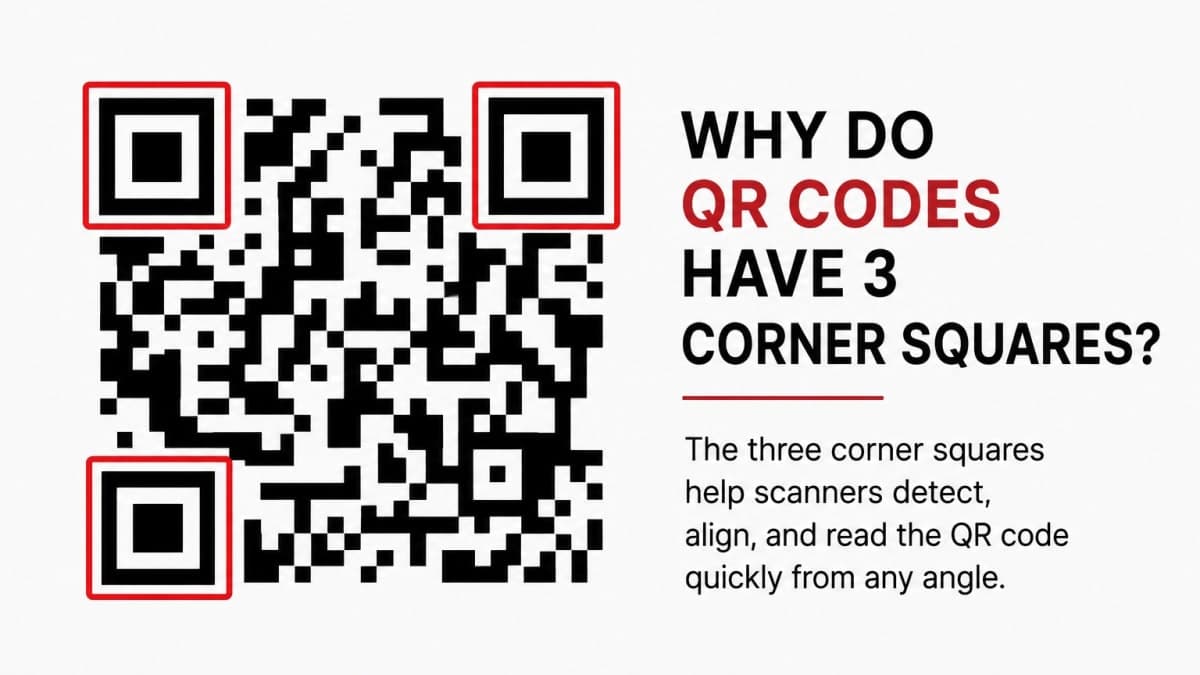
QR (Quick Response) codes are designed to store information in a compact, machine-readable format that can be scanned from different angles and distances. While the black-and-white pixel pattern often appears random, every element of a QR code has a specific purpose. Among the most recognizable features are the three large squares located in three of the four corners, known as finder patterns, which help scanners identify and decode the code within seconds.
The primary role of these three corner squares is to help scanning devices instantly recognize that the image is a QR code rather than an ordinary pattern. Once detected, the finder patterns allow the scanner to determine the code's exact position, orientation, and size. Whether the QR code is tilted, rotated, or viewed from an angle, these markers help software correctly align the image before decoding the stored information.
The three corner squares enable QR codes to be scanned even when they are rotated by 90, 180, or 270 degrees, ensuring fast and reliable recognition regardless of their orientation. This capability is one of the reasons QR codes are widely used in mobile payments, transportation, retail, healthcare, and logistics, where quick scanning is essential.
In addition to the finder patterns, QR codes include several other built-in design elements that improve accuracy. Smaller alignment patterns help scanners compensate for distortion when a code is printed on curved or uneven surfaces. Timing patterns—alternating black and white modules—assist in determining the precise spacing of the grid, while error correction technology allows a QR code to remain readable even if part of it is scratched, dirty, or partially covered.
Another reason QR codes remain dependable is their ability to recover missing data through advanced error correction algorithms. Depending on the chosen error correction level, a QR code can often be successfully scanned even when a significant portion of the code has been damaged or obscured. This makes QR codes highly practical for real-world environments where labels and printed materials may experience wear and tear.
Without the three corner finder patterns, scanners would struggle to quickly determine the QR code's orientation and boundaries, making fast and accurate scanning far less reliable. Their simple yet effective design is one of the key innovations that has helped QR technology become a global standard for sharing digital information.
Today, QR codes are used for digital payments, website links, Wi-Fi sharing, product authentication, event check-ins, marketing campaigns, inventory management, and many other applications. Their combination of efficient data storage, rapid scanning, and robust error correction has made them an essential part of modern digital communication.