Celebration Inside Train Goes Viral
A lively celebration inside a train has unexpectedly turned into a debate about where personal enjoyment ends and responsibility toward other passengers begins.
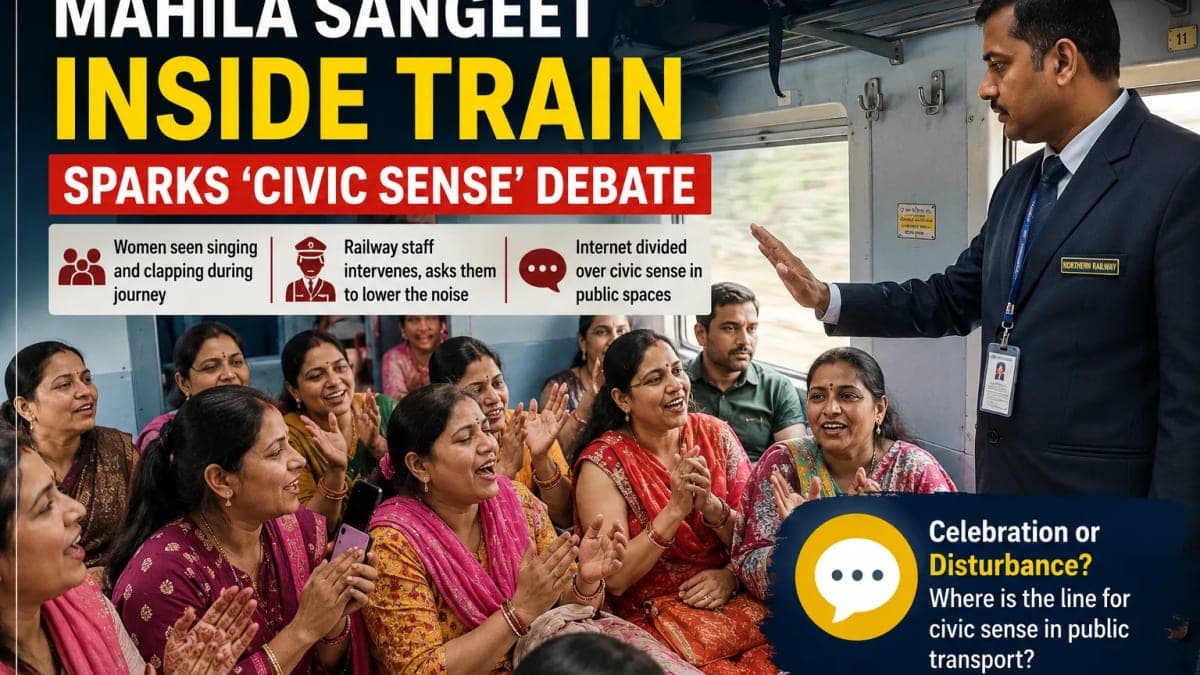
In the viral clip, a group of women can be seen sitting together, singing and clapping in a manner resembling a traditional Mahila Sangeet celebration. What may have started as entertainment during the journey soon attracted attention beyond the coach after footage of the gathering circulated on social media.
The video eventually shows a railway staff member approaching the group and asking them to stop or reduce the disturbance. Reports surrounding the viral clip indicate that the intervention followed concerns about other passengers being disturbed.
However, important details surrounding the incident remain unclear. Publicly available reports do not conclusively establish the train's identity, exact route, location or the full circumstances preceding the recorded interaction. The viral footage should therefore be understood primarily as a snapshot of an incident rather than a complete record of everything that happened inside the coach.
Social Media Divided Over the Celebration
The video quickly produced two very different interpretations.
Some viewers saw nothing seriously objectionable in the gathering. From their perspective, train journeys in India have long included conversations, shared food, singing and spontaneous interaction between groups of passengers. They viewed the women as simply enjoying their journey rather than deliberately attempting to inconvenience anyone.
Others strongly disagreed.
Critics argued that purchasing a train ticket provides the right to travel, but does not turn a shared coach into a private celebration venue. They said singing loudly, clapping or conducting an extended group activity can become disruptive when passengers around the group are trying to sleep, work, read or simply travel quietly.
Comments surrounding the viral video consequently shifted the discussion toward civic sense and respect for shared public spaces.
Why the Railway Staff Member’s Intervention Matters
The appearance of railway personnel changed the character of the viral clip.
Until that point, the gathering could be interpreted simply as passengers entertaining themselves. Once staff intervened, however, the incident became a question of balancing the preferences of one group with the comfort of everyone sharing the coach.
That distinction is important.
Public transport brings strangers with very different expectations into a confined space. One passenger may enjoy group singing, while another may be exhausted after a long day. Families may be travelling with children, elderly passengers may want rest, and others may need a relatively quiet environment.
A shared coach therefore requires a degree of compromise from everyone using it.
The Larger Question: What Does Civic Sense Mean in Public Transport?
The controversy is bigger than one Mahila Sangeet.
India's trains carry enormous numbers of passengers from different regions, generations and social backgrounds. Railway journeys are also traditionally more social than many other forms of transport, with conversations and interactions between passengers forming part of the experience.
But shared spaces work only when individual freedom is accompanied by consideration for others.
Civic sense in this context does not necessarily mean that passengers must remain completely silent. Talking, laughing and enjoying a journey are normal human activities.
The question is one of volume, duration, timing and impact.
A short song among friends may be received very differently from prolonged loud singing in a crowded coach. Similarly, an activity that seems harmless during the daytime could become significantly more disruptive when passengers are attempting to rest.
Celebration vs Public Convenience
The debate surrounding the video should not necessarily be reduced to a choice between celebrating Indian culture and demanding silence.
Mahila Sangeet is associated with wedding festivities and communal celebration. Singing together can be an important part of family and cultural occasions.
The disagreement arises because a railway coach is simultaneously being used by passengers who are not part of that celebration.
This creates a simple but important principle for public spaces: people should be able to enjoy themselves, provided their enjoyment does not unreasonably interfere with someone else's ability to use the same space comfortably.
That standard applies far beyond trains.
Similar debates regularly emerge around loud conversations, mobile-phone speakers, videos played without earphones and group celebrations in flights, buses, restaurants and other shared environments.
Viral Video Also Shows the Limits of Online Judgement
There is another dimension worth considering.
Short viral clips often encourage viewers to make immediate judgments about people without knowing everything that happened before or after the recording.
In this case, the footage has generated strong opinions about the passengers involved. Yet publicly reported information leaves several contextual details unresolved. At least one report explicitly notes that the precise train and coach details were not established from the available information.
That makes it reasonable to debate the behaviour visible in the clip while avoiding sweeping conclusions about the individuals involved.
The incident can raise a legitimate civic question without turning into personal ridicule.
Why This Viral Moment Matters
The popularity of the video suggests that the issue resonates because millions of Indians regularly negotiate the same boundaries in shared spaces.
Should passengers tolerate a certain amount of noise because public transport is inherently social?
Or should individuals and groups actively limit their behaviour because everyone has paid for the same journey?
There may not be a universal answer for every situation, but the underlying principle is relatively straightforward: public spaces require mutual adjustment.
The women in the viral video may have viewed their singing as harmless celebration. Passengers who were disturbed could reasonably have experienced exactly the same activity as unwanted noise.
Both perceptions can exist simultaneously.
The most practical solution is therefore neither banning ordinary enjoyment nor expecting other passengers to tolerate unlimited disturbance. It is recognising when a private celebration begins affecting a public environment.
Balanced Analysis
The controversy highlights how quickly everyday behaviour can become a national conversation once a smartphone camera and social media are involved.
Those defending the women have a valid point that public transport does not need to become an emotionless or completely silent environment. Indian railway journeys have historically included social interaction, conversations and shared experiences.
At the same time, critics raise an equally important principle: a shared space belongs equally to the passenger celebrating and the passenger seeking peace.
The railway staff member's intervention illustrates how that balance may sometimes require outside mediation.
Ultimately, the viral Mahila Sangeet clip is less about whether singing itself is acceptable and more about awareness of surroundings. Enjoyment and civic responsibility do not have to compete. In a shared space, the most considerate behaviour is often simply recognising when one's celebration has started becoming someone else's inconvenience.
This article is based on reporting published by Hindustan Times.