Arrowhead Eyes Series A as Voice-AI Ambitions Go Global
India's enterprise voice-AI market is attracting growing investor attention, and Bengaluru-based startup Arrowhead is preparing for its next phase of growth.
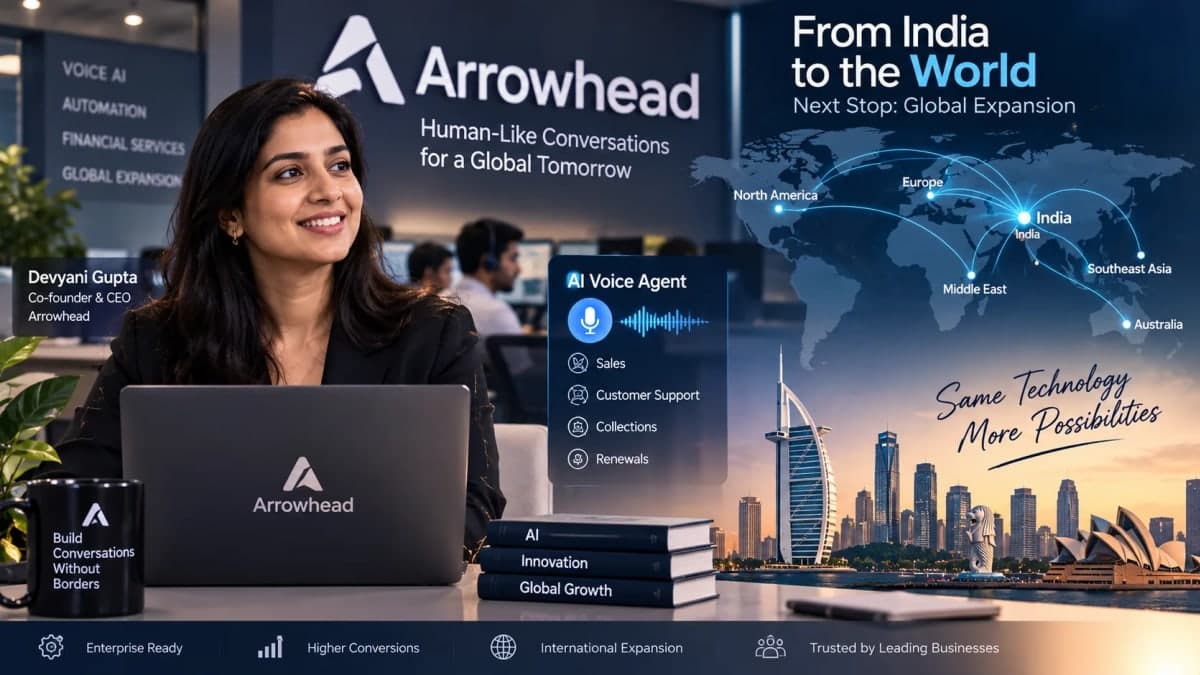
The company is looking to raise fresh capital through a Series A funding round, with the proceeds expected to support its international expansion, according to cofounder and CEO Devyani Gupta.
The development represents the next stage in Arrowhead's journey after its $3 million seed round earlier in 2026.
While the company has confirmed its fundraising plans, the target size of the proposed Series A, potential investors and expected closing timeline have not been publicly disclosed.
That distinction is important: Arrowhead is currently preparing to raise the round; it has not announced that a new Series A has been completed.
From Call Analytics to Full Voice AI
Arrowhead did not begin as the voice-AI business it is today.
According to Gupta, the startup initially focused on call analytics before evolving into a broader voice-AI solutions provider.
Its current technology is designed to allow enterprises to automate conversations that have traditionally required human calling agents.
Rather than relying entirely on third-party technology, Arrowhead says it has developed its technology stack in-house—an approach that could become increasingly important as it enters overseas markets and seeks greater control over latency, performance and customisation.
Financial Services Became Arrowhead's Key Market
Arrowhead has established a particularly strong focus on India's banking and financial-services ecosystem.
Founded by Devyani Gupta and Vengadanathan Srinivasan, the company develops AI voice agents that can be used by banks, non-banking financial companies and fintech businesses for high-volume customer interactions.
Use cases include sales, collections, renewals and other customer conversations.
The company's strategy has been to build specialised AI agents capable of reproducing the behaviour and conversational approach of strong human sales agents rather than offering only a generic voice bot.
This vertical focus on financial services differentiates Arrowhead from companies developing general-purpose voice-AI infrastructure.
$3 Million Seed Round Came Earlier This Year
Arrowhead's latest fundraising plan follows a $3 million seed round announced in January 2026.
The round was led by Stellaris Venture Partners.
It also included participation from CRED founder Kunal Shah, M2P founder Madhusudanan R and other fintech executives.
At the time, Arrowhead said the capital would be used to strengthen its core AI models, expand technology and go-to-market teams and improve conversion outcomes for financial-services customers.
The planned Series A therefore appears to mark a shift from primarily building and strengthening the platform toward taking that technology to a larger international customer base.
Already Operating Beyond India
Arrowhead's international ambitions are not starting from zero.
At the time of its seed funding announcement, the startup said it was operating across India and Southeast Asia and serving more than 50 customers across BFSI use cases.
Reported customers included Bank of Baroda Cards, Aditya Birla Capital, Paytm, Kissht, Equentis, TurtleMint, InsuranceDekho and Mudra Fincorp.
The company's own website currently highlights additional enterprise relationships and markets its voice agents for both sales and customer-support operations.
That existing enterprise adoption could be significant as Arrowhead tries to demonstrate that its technology can scale outside its home market.
Arrowhead Claims Up to 45% Higher Conversion
One of Arrowhead's key pitches is not simply replacing human calling capacity but improving business outcomes.
During its previous funding announcement, Gupta said the company's bots had achieved up to 45% higher conversion rates than human agents in some deployments.
Arrowhead has also said every proof of concept it participated in had converted into a live deployment at that stage.
These performance figures are company-reported results, rather than independent industry-wide benchmarks, and should therefore be understood in that context.
Nevertheless, conversion performance is particularly important in BFSI because financial institutions often operate large sales and customer-service teams where relatively small improvements in conversion or productivity can materially affect economics.
Why Voice AI Is Attracting Investors
Arrowhead's fundraising plans come amid broader investor interest in India's voice-AI ecosystem.
Voice AI has advanced from basic automated phone menus toward systems capable of holding more natural, real-time conversations and performing actions during calls.
This is particularly relevant in India, where businesses need to communicate with customers across multiple languages while handling enormous volumes of sales, support, collections and renewal calls.
In January alone, several Indian voice-AI startups announced funding rounds, including Arrowhead.
The growing interest suggests investors increasingly see voice AI as an enterprise software category rather than simply an experimental application of generative AI.
Building Longer, More Natural AI Conversations
Arrowhead has been developing its platform for conversations substantially more complex than simple automated responses.
Earlier company disclosures said its voice agents could conduct conversations lasting up to 20 minutes.
The company has also outlined plans to build infrastructure capable of supporting tens of thousands of concurrent calls with sub-500 millisecond latency.
Its longer-term product roadmap has included emotion-aware voice agents and an omnichannel interaction platform spanning calls, chat and messaging.
Those capabilities could become important internationally, where Arrowhead will face competition not only from Indian voice-AI startups but also from global AI platforms and specialised conversational-AI providers.
International Expansion Is the Next Test
Raising capital is only one part of Arrowhead's next phase.
Expanding internationally brings additional challenges, including language localisation, regulatory compliance, data protection requirements, telecom infrastructure differences and competition from established global AI companies.
Financial services makes those challenges particularly important because customer conversations may involve sensitive information and regulated financial products.
Arrowhead's decision to build more of its technology stack internally could give the company greater control over how its system adapts to those requirements.
But its ability to reproduce its Indian enterprise traction in overseas markets will ultimately determine whether international expansion becomes a major growth engine.
What Happens Next?
The next milestone will be the Series A itself.
For now, Arrowhead has confirmed its intention to seek fresh capital for international expansion, but no final fundraising amount, valuation or investor lineup has been announced.
Those details will provide a clearer indication of how investors value the company's progress since its $3 million seed round.
The larger story, however, extends beyond one startup.
As AI agents become increasingly capable of conducting complex conversations, India's voice-AI companies are beginning to test whether technology developed for the country's large and multilingual enterprise market can compete globally.
Arrowhead's upcoming fundraising effort will be one such test.