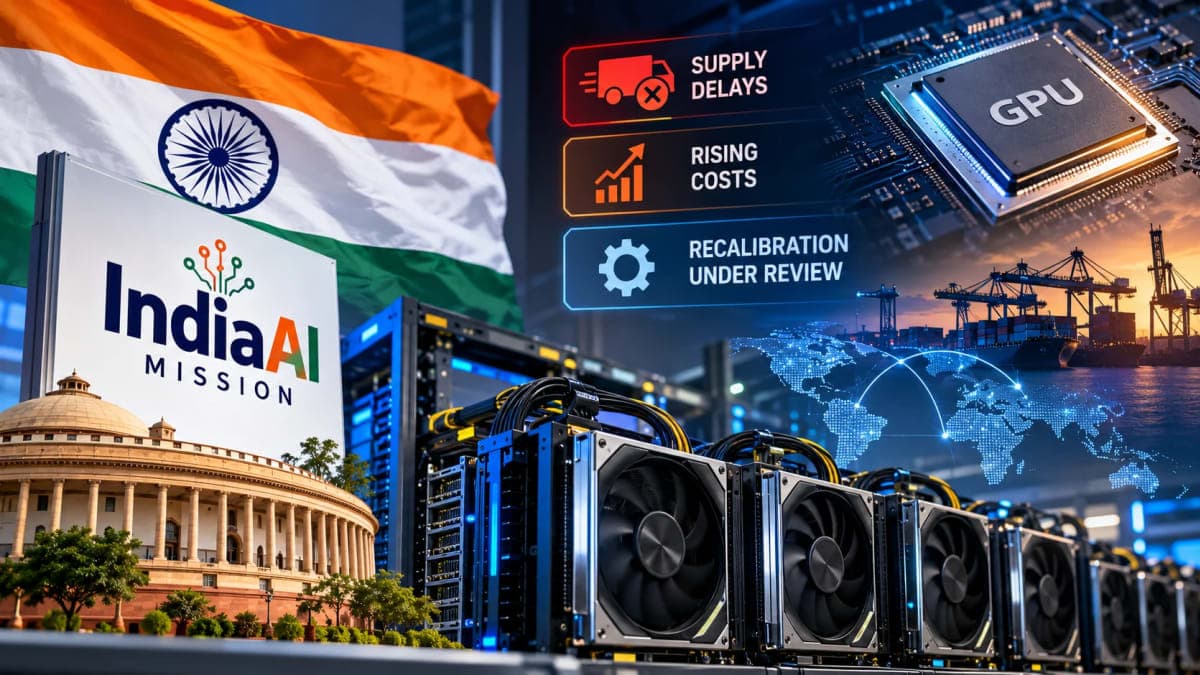
IndiaAI Compute Push Faces a Supply Challenge
India's ambitious effort to make advanced artificial intelligence computing accessible to startups, researchers and public institutions may be entering a new phase.
The government is planning to recalibrate parts of the IndiaAI Mission as the deployment of graphics processing units, or GPUs, encounters supply delays and higher costs, according to a report by The Economic Times. The report says the mission currently has access to around 30,000 GPUs, compared with commitments of roughly 45,000, with some participating companies facing difficulties delivering the capacity they had pledged.
The reported response could include fresh bids for additional capacity while the government also pushes existing providers to fulfil their commitments. However, the recalibration has been reported as a plan under consideration rather than a completed restructuring of the mission.
Why GPU Costs Have Become an Issue
The challenge is not simply about the number of processors.
According to the ET report, memory and GPU prices have risen sharply since the IndiaAI Mission was launched in 2024, with prices in many cases more than doubling over the past year. That has put additional pressure on companies that agreed to provide computing capacity under earlier commercial conditions.
GPUs are central to modern artificial intelligence because they can perform the large-scale parallel calculations required to train and run AI models.
India remains dependent on global supply chains for these processors. The government itself acknowledged in August that the country's AI compute ecosystem relies on globally sourced GPUs supplied through empanelled compute service providers.
That dependence means international hardware availability, pricing and supply-chain conditions can directly affect the speed and cost of India's domestic AI infrastructure expansion.
Official Figures Show Why GPU Numbers Need Context
The latest reporting needs to be read alongside the government's previously published capacity figures.
A government factsheet released in August said the IndiaAI Mission had expanded shared compute capacity to more than 45,000 GPUs as of June 2026. It also said that by August, 237 projects had accessed subsidised AI compute covering 93.18 lakh GPU hours.
Earlier, in March, the government said more than 38,000 GPUs had been onboarded through the IndiaAI Compute Portal.
The fresh report's figure of around 30,000 GPUs refers to capacity described as currently accessible against approximately 45,000 committed GPUs. The figures therefore appear to describe different stages or definitions of capacity—such as committed, onboarded/shared and presently accessible resources—rather than necessarily representing a direct contradiction.
What Is the IndiaAI Mission?
The IndiaAI Mission was approved by the government in March 2024 with an outlay of approximately ₹10,371.92 crore over five years.
Its scope extends well beyond computing infrastructure. The programme is intended to strengthen India's broader AI ecosystem through compute access, indigenous foundation models, datasets, application development, skills, startup support and responsible AI initiatives.
Affordable compute is nevertheless one of its most important components.
Instead of requiring every startup, university or research institution to purchase expensive AI hardware independently, the common-compute model is designed to make computing resources available through shared infrastructure.
That matters particularly for smaller organisations because acquiring and operating high-end GPU clusters can require substantial capital, power, cooling and specialised technical infrastructure.
India Has Already Expanded the Programme Beyond Its Initial Scale
The mission's compute programme has grown considerably since its launch.
By March 2026, the government said more than 38,000 GPUs had been onboarded, while the August government factsheet put shared capacity above 45,000 GPUs as of June.
The government also said in August that 15 compute service providers had been empanelled across four rounds, while 237 projects had been approved for subsidised compute support involving 93.18 lakh GPU hours.
These numbers show that the programme has moved well beyond its early infrastructure phase. They also make reliable delivery increasingly important: as more AI projects depend on shared compute, the difference between capacity promised on paper and capacity actually available to users becomes more consequential.
Why a Recalibration Could Matter
Any redesign of the compute programme could influence three important areas.
First is availability. Indigenous AI developers need predictable access to high-performance processors to train and test increasingly complex models.
Second is affordability. If hardware and memory prices continue rising, service providers may find earlier commercial commitments harder to maintain, potentially forcing changes in future procurement terms.
Third is strategic resilience. India's dependence on imported advanced processors means its AI ambitions remain exposed to changes in international supply, pricing and technology availability.
The government has already recognised this vulnerability. In August, it said limited domestic capabilities in semiconductors and computing infrastructure were among the risks India was seeking to address, while also pursuing a high-performance AI compute system at the NIC Data Centre in Delhi.
India's Broader Push for Technology Self-Reliance
The GPU issue also connects the IndiaAI Mission with India's semiconductor strategy.
The government has been expanding domestic semiconductor manufacturing, packaging and chip-design capabilities. In August, it said 12 semiconductor manufacturing projects had been approved with committed investment of ₹1.64 lakh crore, while three had begun commercial production.
These programmes do not immediately eliminate India's dependence on imported cutting-edge AI GPUs. Building domestic capacity across the semiconductor value chain is a longer-term process.
But the current GPU difficulties demonstrate why policymakers increasingly view AI infrastructure and semiconductor supply chains as interconnected strategic issues.
Balanced Analysis: A Supply Problem, but Also an Execution Test
The reported GPU shortfall does not by itself mean the IndiaAI Mission has failed to expand India's AI infrastructure. Official figures show substantial growth in shared compute capacity and hundreds of projects receiving subsidised compute support.
At the same time, the difference between committed capacity and GPUs that are actually accessible matters.
For AI developers, a processor that has been promised but cannot be used does not provide the same value as live computing capacity. Rising hardware prices can also make long-duration commitments difficult for private providers if market conditions change significantly after contracts or bids are submitted.
A recalibration could therefore become an attempt to make procurement and delivery arrangements more responsive to a volatile global AI hardware market rather than a retreat from India's broader AI ambitions.
The more important measure will be whether any revised framework can consistently translate announced or committed GPU capacity into affordable computing resources that startups, researchers and institutions can actually use.
What Happens Next?
Attention will now turn to whether the government formally announces fresh bidding or changes the commercial and procurement structure used under the IndiaAI Mission.
Until such measures are officially announced, reports of a recalibration should be treated as a developing policy response rather than a final change to the mission.
The broader objective remains unchanged: giving Indian developers access to the computing power required to build domestic AI technologies without requiring every organisation to finance its own expensive infrastructure.
The current supply difficulties show that achieving that objective will depend not only on how many GPUs India can secure on paper, but also on how reliably and affordably that computing power reaches the organisations building AI systems.