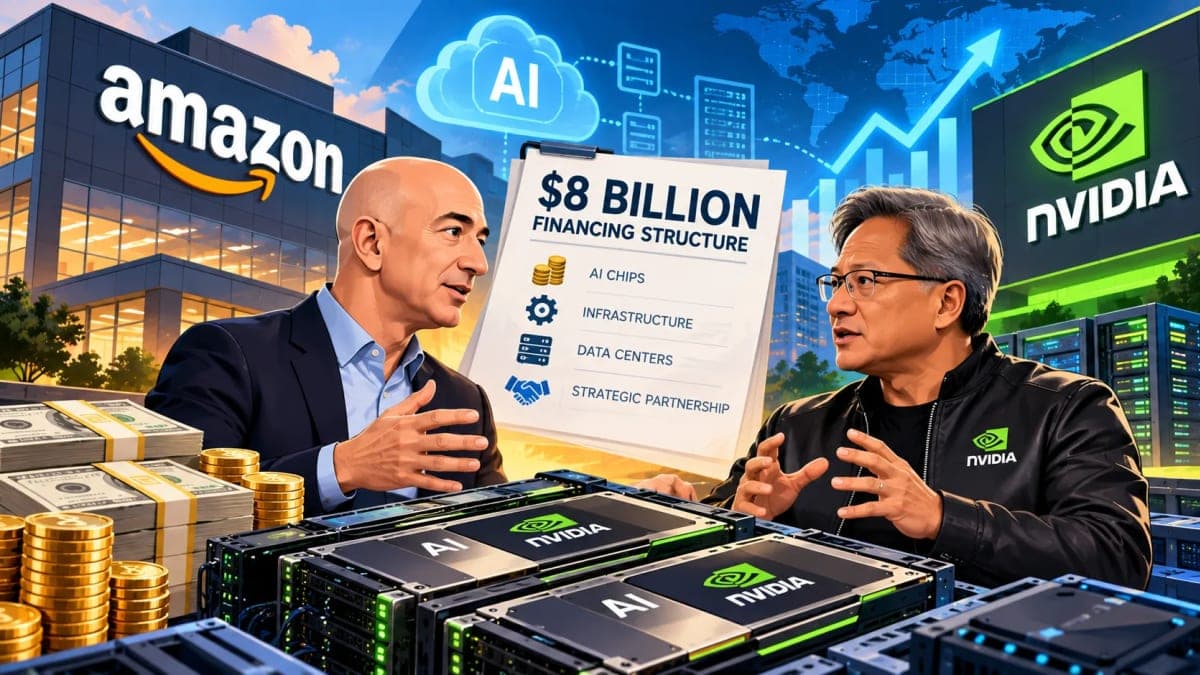
Amazon Looks at New Way to Finance Its AI Expansion
Amazon is exploring a financing structure that could shift approximately $8 billion worth of advanced Nvidia artificial-intelligence chips to outside investors as technology companies search for new ways to fund increasingly expensive AI infrastructure.
The proposal would involve placing thousands of Nvidia Grace Blackwell chips used in Amazon's US data centres into a special-purpose vehicle, or SPV, according to a Financial Times report citing people familiar with the discussions.
Amazon would then lease the computing hardware back from the vehicle rather than keeping all of the associated assets directly on its balance sheet.
The discussions are still at an exploratory stage. Amazon has reportedly been speaking with potential investors to determine their interest, and there is no indication yet that the proposed transaction has been completed.
How the $8 Billion Structure Could Work
Under the reported arrangement, a separate financial vehicle would hold the Nvidia processors.
The SPV would seek capital from outside investors, primarily through debt issuance. Amazon would continue accessing the chips by leasing them from the vehicle.
The company could also offer investors an equity interest of as much as 10% in the SPV, according to the Financial Times report.
The approach could allow Amazon to continue using valuable AI computing equipment while reducing the amount of expensive hardware it directly carries on its balance sheet.
In simple terms, the arrangement resembles a sale-and-leaseback model: investors finance or own the assets while Amazon pays to use their computing capacity.
Thousands of Grace Blackwell Chips Involved
The proposed transaction involves Nvidia's Grace Blackwell processors, among the advanced computing systems being deployed for demanding artificial-intelligence workloads.
According to the report, the chips involved were either purchased or leased by Amazon and are being installed across more than a dozen data centres in five US states.
Those locations reportedly include facilities in Nevada and Virginia.
The scale of the proposed transaction illustrates how AI infrastructure has transformed high-end processors from conventional technology purchases into assets requiring financing structures worth billions of dollars.
Why Amazon Is Considering the Structure
Amazon is spending heavily to expand the computing infrastructure behind Amazon Web Services as demand for generative AI and other computationally intensive applications grows.
The company plans approximately $220 billion in capital expenditure during 2026, with much of that spending directed toward AWS infrastructure, including chips and data-centre expansion.
That enormous investment requirement creates a financial challenge even for companies with Amazon's scale.
AI data centres require not only expensive processors but also buildings, networking equipment, cooling systems, electricity infrastructure and other specialised hardware.
Moving some processors into separately financed vehicles could give Amazon another source of capital while allowing it to continue expanding computing capacity.
AI Infrastructure Is Creating New Financing Markets
Amazon's reported proposal is part of a much broader change in the economics of artificial intelligence.
Technology companies and AI developers are pouring hundreds of billions of dollars into processors, data centres and power infrastructure.
As the required investment has increased, companies have increasingly turned to debt, private capital, leases and other financing arrangements rather than funding every project entirely from their own balance sheets.
Nvidia itself has been working with major financial institutions to expand financing for AI infrastructure.
In August, Nvidia partnered with six financial institutions on compute-financing platforms intended to help mobilise more than $500 billion for AI infrastructure.
Can AI Chips Become a New Financial Asset Class?
The development also raises a bigger question: can high-end AI processors be financed in a manner similar to other revenue-generating infrastructure assets?
Nvidia has argued that its computing systems are productive assets capable of supporting long-term financing.
But some banks and credit investors remain cautious.
One major concern is depreciation. AI processors can be extremely valuable when released, but rapid advances in semiconductor technology create uncertainty about how much economic value today's hardware will retain several years from now.
Reuters reported that some lenders are using shorter depreciation assumptions than Nvidia's estimates and want stronger guarantees or dependable customer contracts before treating GPU-backed loans similarly to established infrastructure financing.
Amazon Could Make the Financing More Attractive
Amazon's involvement could potentially address part of that concern.
Rather than investors relying solely on the resale value of Nvidia processors, a structure backed by lease payments from a large investment-grade technology company could provide a more predictable source of cash flow.
That distinction matters to lenders.
Reuters reported that some financiers considering chip-backed lending are more comfortable when repayment is supported by contracts with financially strong customers rather than relying primarily on the future resale value of GPUs.
If Amazon proceeds with the proposed SPV, its lease obligations could therefore become an important part of how investors assess the transaction.
Potential Benefits — and Risks
For Amazon, the structure could provide greater flexibility as it undertakes exceptionally large AI infrastructure investments.
It could free capital for additional data centres and computing capacity while allowing AWS to retain access to Nvidia hardware.
Investors, meanwhile, could gain exposure to infrastructure supported by demand for AI computing.
But the structure is not risk-free.
The future value of AI processors is difficult to predict. New chip generations could reduce the economic attractiveness of older hardware, while changes in AI demand could affect utilisation.
Complex financing structures can also transfer risk rather than eliminate it.
Investors therefore need to evaluate not only the underlying Nvidia hardware but also lease terms, Amazon's contractual obligations, depreciation assumptions and the residual value of the equipment.
Amazon Is Also Developing Its Own AI Chips
Another important part of the story is that Amazon is not exclusively dependent on Nvidia.
Through AWS, the company has developed its own custom AI processors, including Trainium chips designed for machine-learning workloads.
Amazon has promoted custom silicon as a way to improve the economics of AI computing and provide customers with alternatives to third-party processors.
At the same time, demand for Nvidia GPUs remains substantial across the cloud industry, meaning Amazon continues investing in Nvidia-based infrastructure alongside its own chips.
This creates a diversified strategy: Amazon can offer customers access to Nvidia hardware while continuing to develop proprietary processors intended to lower costs and increase control over its AI infrastructure.
Why the Proposed Deal Matters
The significance of the reported $8 billion structure extends beyond Amazon.
If large-scale chip-backed financing becomes common, the way the technology industry pays for AI infrastructure could fundamentally change.
Instead of cloud providers purchasing every processor outright and carrying it directly on their balance sheets, institutional investors could increasingly own portions of the physical computing infrastructure and lease capacity back to technology companies.
That would potentially open AI infrastructure to new pools of institutional capital.
However, whether such structures become widespread will depend heavily on how investors value rapidly depreciating technology assets and how much financial protection technology companies and chipmakers are prepared to provide.
No Final $8 Billion Deal Yet
For now, the most important distinction is that Amazon has not announced a completed $8 billion financing deal.
The Financial Times reported that the company has held discussions with investors to gauge interest in the proposed structure.
Reuters subsequently reported the FT's findings and said Amazon and Nvidia had not immediately responded to requests for comment outside regular business hours.
The eventual terms could therefore change substantially, or the transaction may not proceed in its currently reported form.
What is already clear, however, is that the extraordinary cost of building AI infrastructure is encouraging even the world's largest technology companies to experiment with new ways of financing computing capacity.