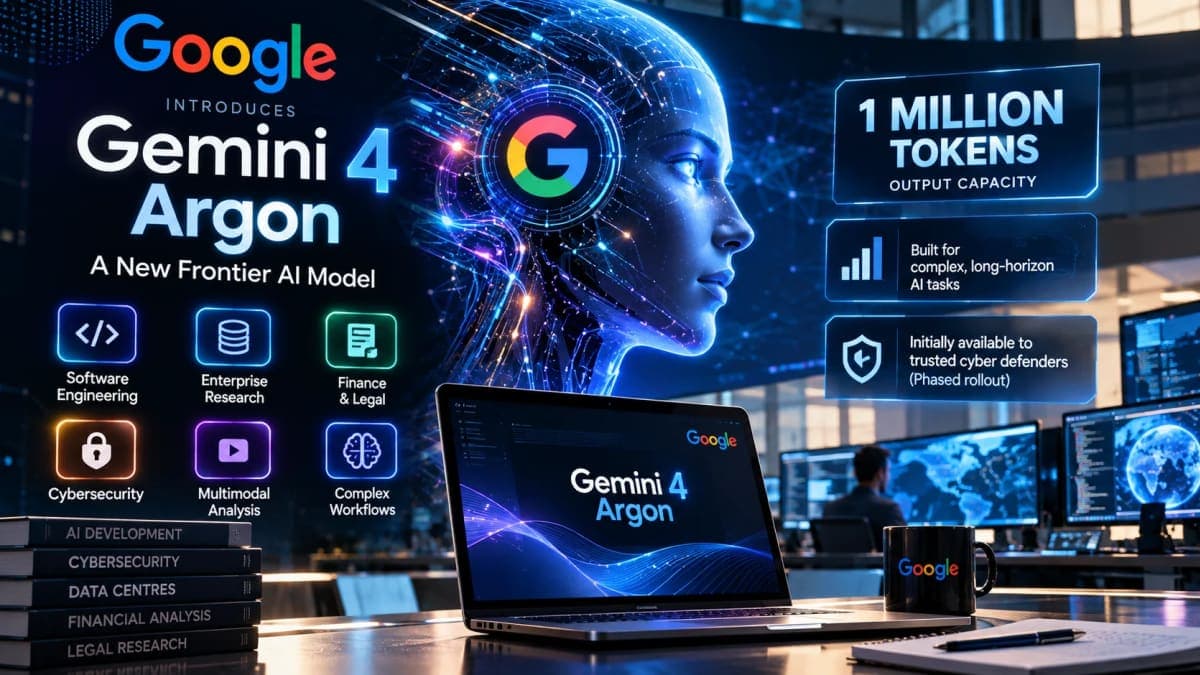
September 30, 2026: Google has unveiled Gemini 4 Argon, the latest frontier model from Google DeepMind, marking a significant new stage in the company's push to build AI systems capable of handling lengthy, multi-step professional tasks.
Google says Argon has been designed to maintain reasoning across complex workflows rather than simply answer individual prompts. Its targeted applications include software engineering, enterprise research, legal and financial work, multimodal analysis and defensive cybersecurity.
However, calling Argon a conventional public “release” requires an important qualification: most consumers and developers cannot use the model yet.
Gemini 4 Argon Is Not Yet Widely Available
Google is initially providing Argon to a selected group of cybersecurity defenders through its Fairwind Program.
The company says it is deliberately expanding access in stages because of the capabilities and potential risks associated with advanced frontier models, particularly in cybersecurity. Google is also participating in the US government's voluntary process for pre-release access to advanced AI models.
Google plans to gather feedback from early testers and continue refining safeguards before expanding Argon to developers, enterprises and consumers.
The company says broader availability will begin with paid API customers and Google AI Ultra subscribers, although it has not announced a specific date for that expansion.
A Major Increase in Output Capacity
One of Argon's most notable technical changes is its dramatically expanded output limit.
Google says Gemini 4 Argon supports an output limit of 1 million tokens, compared with 64,000 tokens for its previous models.
The significance is not simply the ability to produce unusually long answers. A larger output budget can give an AI agent more room to work through extended reasoning and tool-use trajectories required for complex projects.
Potential applications could include large software migrations, multi-stage financial research, extensive document analysis and other tasks that cannot easily be completed through a short interaction.
Google Targets Software Engineering
Software development is one of the main areas where Google is positioning Argon.
The company reports that Argon achieved 77.9% on DeepSWE v1.1, an evaluation designed around long-horizon software-engineering tasks. Benchmark results, however, should be interpreted as controlled evaluations rather than guarantees of equivalent performance in every real-world situation.
Google says its own engineers are already using Argon for debugging, algorithm design and large codebase migrations.
One particularly ambitious internal project involves agents helping migrate C and C++ codebases to Rust, including work involving more than 800,000 lines associated with the Fuchsia OS Zircon kernel. Google stresses that such critical changes remain subject to extensive automated and human review before production deployment.
Argon Is Already Being Used Inside Google
Google has also disclosed examples of Argon's use beyond conventional coding.
According to the company, Argon helped quantum-computing researchers optimize resources required for certain algorithms, beating a published baseline by 40% in one example.
Another internal project involved Argon agents analysing profiling telemetry from Google's data centres. Google says resulting optimizations have already freed more than 300 TiB of memory, with estimated potential savings of 500 TiB to 1 PiB.
These are Google-reported internal results, so they should be understood as the company's own evidence of the model's capabilities rather than independent evaluations.
Cybersecurity Takes Centre Stage
Cybersecurity is perhaps the most consequential part of the Argon announcement.
Google says the model has been specifically trained for defensive security work and is capable of autonomously finding, validating and patching critical software vulnerabilities.
Cloud-security company Wiz is already using Argon through its Scan for Good initiative. According to Google, Argon identified a critical vulnerability affecting healthcare software that earlier frontier models had missed. Google did not publicly identify the affected system in its announcement.
The same capabilities that can help defenders identify vulnerabilities also explain Google's cautious rollout. Advanced cyber capabilities can create risks if misused, making access controls and safeguards an important part of the deployment strategy.
How Does Gemini 4 Argon Perform?
Google has published a range of benchmark results showing strong performance across software engineering, business automation, finance, legal work, long-video understanding and cybersecurity.
For example, Google reports that Argon scored 51.3% on AutomationBench and 91.7% on LVBench, an evaluation focused on long-video understanding. It also reports leading results on several professional-work benchmarks.
Reuters reports that Google's internal benchmark comparisons show Argon outperforming competing frontier models in certain areas, including cybersecurity, while it does not lead every coding evaluation.
That distinction matters. No single benchmark provides a complete measurement of an AI system, and real-world performance can vary substantially according to prompts, tools, workloads and evaluation methodology.
Independent testing will become more informative once broader researchers and developers gain access.
Gemini 4 Argon Pricing
Google has already announced introductory API pricing even though general API access has not begun.
Argon is expected to launch at:
$2 per million input tokens and $10 per million output tokens.
Cached input tokens will initially receive a 95% discount. After the introductory period, Google says pricing will rise to $4 per million input tokens and $20 per million output tokens.
The aggressive introductory pricing suggests that cost will be an important part of Google's strategy when Argon becomes more widely available.
Why Gemini 4 Argon Matters
Argon arrives during intense competition among Google, OpenAI and Anthropic to develop increasingly capable frontier AI systems.
Reuters reports that Gemini 4 follows delays in Google's model roadmap and the decision not to proceed with the previously planned Gemini 3.5 Pro release.
The broader significance of Argon may therefore extend beyond benchmark scores.
Google is positioning the model around long-horizon AI work—systems capable of carrying out complicated sequences of reasoning, coding, research and tool use with less continuous human direction.
If these capabilities translate reliably from controlled evaluations and Google's internal deployments into external environments, they could make frontier models substantially more useful for professional workflows.
But the limited initial rollout means many of Google's performance claims cannot yet be tested broadly. The strongest conclusions about Argon's practical advantages will have to wait for wider independent evaluation.
What Happens Next?
Google says it will gradually expand access while collecting feedback from cybersecurity partners and strengthening the model's safeguards.
Developers, enterprises and consumers are expected to receive access later, starting with paid API users and Google AI Ultra subscribers. Google has not announced a firm date for general availability.
For now, Gemini 4 Argon is best described as Google's newly announced frontier model in a limited early rollout—not a model already available to everyone.