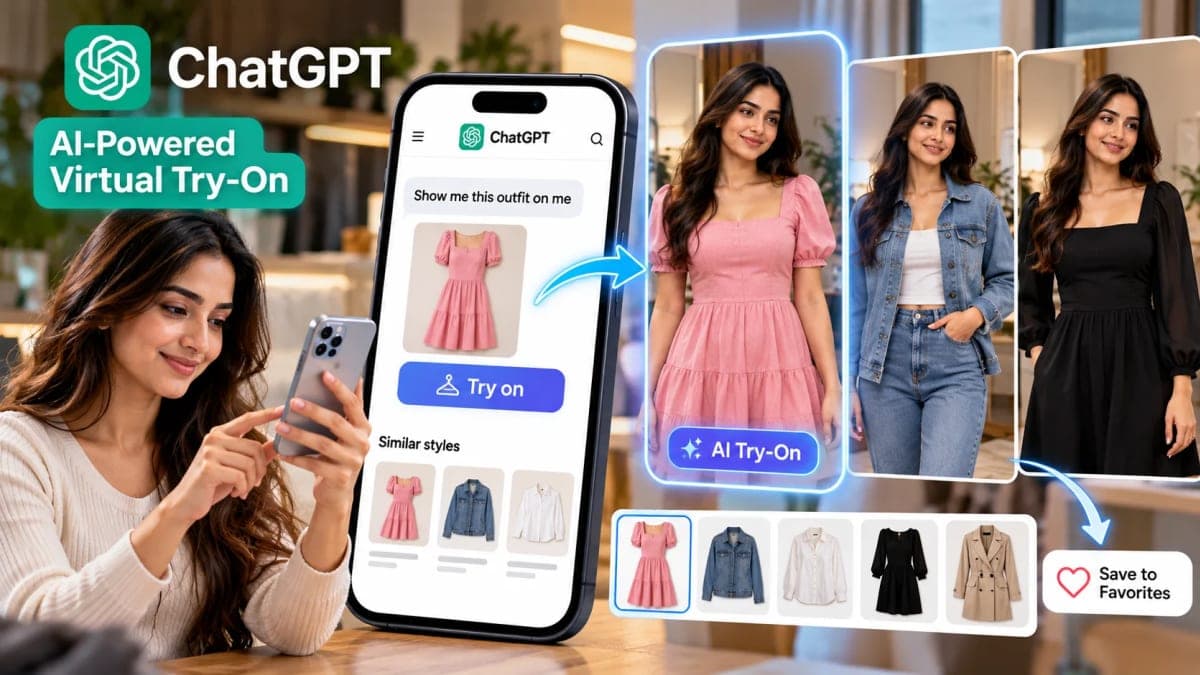
ChatGPT Gets a Virtual Fitting Room
OpenAI is bringing generative AI deeper into online shopping with a new virtual try-on feature for ChatGPT, allowing users to preview how clothing and accessories could look on them before making a purchase.
The feature began rolling out on October 1 and is available through ChatGPT on mobile and the web, according to OpenAI’s release notes.
When ChatGPT displays an eligible clothing or accessory product, users can select a new “Try on” option. They can then take or upload a selfie, which ChatGPT uses as a reference to generate an image showing the selected product on them.
Users Can Upload Their Own Clothing Images
The capability is not limited to products discovered directly through ChatGPT.
A user can upload an image of clothing or an accessory into a conversation and ask ChatGPT to show how the item could look on them. That means screenshots or other product images can become the starting point for a virtual outfit preview.
This broadens the feature from a conventional shopping catalogue tool into a more flexible visual assistant.
For example, someone who encounters an outfit elsewhere online could bring an image into ChatGPT and use it as inspiration for a virtual try-on or shopping conversation.
ChatGPT Images Powers the Experience
The virtual fitting-room experience is generated using ChatGPT Images.
OpenAI says users select an eligible product and provide a reference photo, after which its image-generation technology creates the virtual preview.
Rather than physically simulating fabric using exact body measurements, the system creates a generative visualisation of how the item might appear.
That distinction is important because the feature is intended primarily as a visual shopping aid, not as a precise clothing-sizing system.
Virtual Try-On Does Not Guarantee Fit or Size
OpenAI explicitly cautions users that generated try-on images may not perfectly reproduce either the shopper's appearance or the actual product.
More importantly, the virtual image does not guarantee that a particular size will fit. OpenAI advises shoppers to check merchants' measurements, product information and return policies before purchasing.
A generated picture might therefore help someone decide whether they like the general appearance of a jacket, dress or accessory, but it should not be treated as a substitute for sizing information.
This limitation is especially relevant because differences in fabric, cut, body measurements and manufacturing can determine how clothing actually fits.
Reference Photos Can Be Reused
OpenAI has also designed the system so shoppers do not necessarily have to upload the same photograph every time they want to try something virtually.
Reference photos are saved for future try-ons and can be reused across shopping sessions. Users can manage these images through Settings → Personalization → Reference photos, where they can replace or remove them.
Because the feature involves personal photographs, users may want to review these controls when deciding which images they want to retain.
Favorites Adds Another Shopping Feature
Virtual try-on is arriving alongside another addition: Favorites.
ChatGPT users can save products they discover and return to them later through their ChatGPT Library. Products can also be organised into folders.
Together, the two additions create a more continuous shopping workflow.
A shopper can discover an item, generate a visual preview, save promising products and revisit them later rather than treating every product search as an isolated conversation.
OpenAI Pushes ChatGPT Further Into Online Shopping
The update represents another step in OpenAI's effort to make ChatGPT useful for product discovery rather than limiting it to answering questions about products.
ChatGPT can already surface product options with images, details and merchant links when a conversation indicates shopping intent. OpenAI says these product results are selected independently and are not advertisements or influenced by its partnerships.
The virtual try-on feature adds a visual layer to that process.
Instead of simply asking, “Which jacket should I buy?”, users can potentially move through several stages of the shopping process inside the same conversation—from describing the style they want to discovering products and visualising them on themselves.
ChatGPT Enters an Increasingly Competitive AI Shopping Market
OpenAI is not the first major technology company to experiment with AI-powered virtual clothing previews.
Google previously introduced virtual try-on capabilities that allow shoppers to use photographs of themselves to visualise clothing. TechCrunch noted that OpenAI's launch therefore places ChatGPT more directly into a shopping category where Google and other visual-discovery platforms already have established products.
The broader competition is increasingly about more than answering product questions.
AI companies are trying to determine whether conversational assistants can become a starting point for product discovery, comparison, visualisation and eventually purchasing.
Why the Feature Matters for Online Shopping
One of e-commerce's persistent limitations is the gap between seeing clothing on a product page and understanding how it might look on an individual shopper.
AI-generated try-ons attempt to narrow that gap.
For consumers, the immediate advantage is convenience: they can experiment visually with different styles without physically trying on each product.
For retailers and technology platforms, virtual try-on could potentially make product discovery more interactive.
However, whether generated previews materially improve purchase decisions will depend on their consistency and accuracy. A visually impressive image has limited practical value if it misrepresents the garment's proportions, colour, texture or actual fit.
Balanced Analysis: Useful for Style, Not a Replacement for a Fitting Room
ChatGPT's virtual try-on feature represents a meaningful expansion of generative AI from information retrieval into interactive shopping.
Its strongest use case may be style exploration. Users can quickly experiment with clothing, compare appearances and explore outfits without repeatedly switching between product pages and separate image tools.
But its limitations are equally important.
The generated result is an AI-created approximation, not a physical simulation based on precise garment and body measurements. OpenAI itself warns that results may differ from reality and cannot guarantee sizing.
There is also a privacy consideration because the experience requires personal photographs and reference images can be retained for reuse, although OpenAI provides controls for changing or deleting them.
The feature should therefore be viewed as a visual decision aid rather than a digital replacement for an actual fitting room.
Its longer-term significance will depend on whether shoppers find these previews accurate and useful enough to become part of their normal purchasing process.