Agnikul Cosmos Expands Infrastructure for Reusable Rockets Ahead of Mission-02
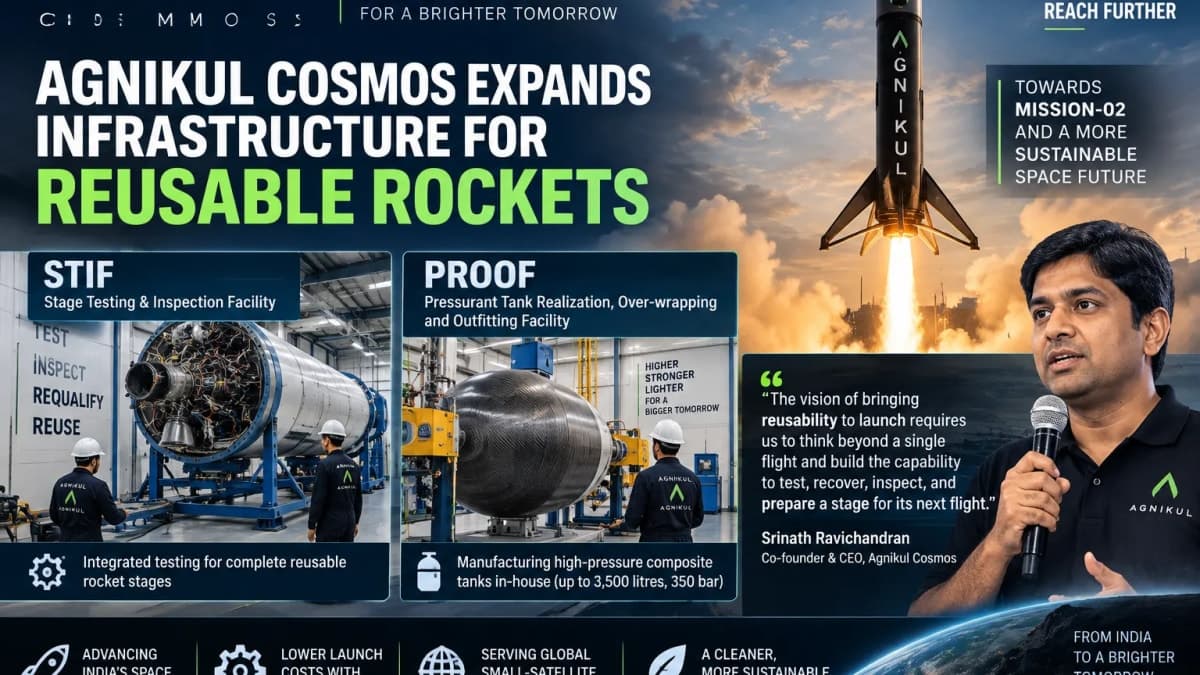
Indian space startup Agnikul Cosmos is expanding the physical infrastructure behind its reusable-rocket ambitions, opening two specialised facilities in Chennai that will allow the company to test complete rocket stages and manufacture critical components in-house.
The new Stage Testing & Inspection Facility (STIF) and Pressurant Tank Realization, Over-wrapping and Outfitting Facility (PROOF) were inaugurated at Agnikul's Assembly & Testing Facility in the presence of Group Captain Shubhanshu Shukla, a Gaganyaan astronaut.
The expansion is particularly important because Agnikul is preparing for Mission-02, an ambitious flight intended to move the company beyond demonstrating launch technology and towards recovering and ultimately reusing major elements of its rocket architecture.
STIF Designed to Test Complete Reusable Rocket Stages
The Stage Testing & Inspection Facility is intended to test reusable rocket stages under conditions representative of an actual flight.
Unlike testing an individual engine or subsystem in isolation, STIF can support integrated testing of a complete stage with propulsion and avionics, including clusters of semi-cryogenic engines.
Agnikul says it designed and fabricated the facility in-house.
The infrastructure is also intended to support what becomes one of the central engineering challenges after a reusable stage returns from a mission: determining whether it is safe and reliable enough to fly again.
Recovered stages can be inspected and requalified at STIF, giving Agnikul infrastructure for a repeated cycle of building, testing, flying, recovering, inspecting and preparing hardware for another mission.
Why Post-Flight Requalification Matters
Recovering a rocket is only one part of making launch vehicles genuinely reusable.
A returned stage has experienced intense vibration, thermal stress and aerodynamic forces during flight. Before it can launch again, engineers need to determine whether its propulsion, avionics, structures and other systems remain within acceptable limits.
Agnikul says the new facility gives it in-house post-flight requalification capability, which it describes as a first among Indian private space companies.
That claim is significant because the economics of reusability depend not simply on recovering expensive hardware, but on being able to inspect and return it to service efficiently.
“The vision of bringing reusability to launch requires us to think beyond a single flight and build the capability to test, recover, inspect, and prepare a stage for its next flight,” co-founder and CEO Srinath Ravichandran said.
He added that STIF would allow Agnikul to test complete stages for their mission duration as well as inspect and requalify recovered hardware as the company works towards its second mission.
PROOF Brings Critical Tank Manufacturing In-House
The second facility, PROOF, tackles a different part of the launch-vehicle manufacturing process.
It has been established for the production of high-pressure composite overwrapped pressure vessels used in launch vehicles.
According to reporting on the facility, PROOF is designed to manufacture more than 10 high-specification tanks per month, including vessels with capacities of up to 3,500 litres and pressures reaching 350 bar.
Bringing this capability in-house gives Agnikul greater control over manufacturing, quality and production schedules for components that have to operate under demanding conditions.
Together, STIF and PROOF therefore address two different requirements of scaling a reusable launch system: proving that flight hardware can safely operate again and improving control over the manufacturing of critical components.
Expansion Comes Ahead of Mission-02
The timing of the expansion is closely tied to Mission-02.
Agnikul announced in July that the mission would attempt the recovery of an orbital-class rocket booster. The company also plans to use its upper stage as an in-orbit platform rather than treating it simply as spent hardware after payload deployment.
If successfully demonstrated, those capabilities would represent a major step in Agnikul's strategy to make more of its launch architecture reusable or repurposable.
The mission, however, remains an upcoming technology demonstration. Recovery and operational reuse should not be treated as accomplished capabilities until they have been demonstrated in flight.
The new facilities are therefore best understood as infrastructure Agnikul believes it needs to make that transition possible.
Agnikul's Reusability Strategy Is About Launch Economics
The company's emphasis on reusable hardware is closely tied to its commercial strategy.
Ravichandran has previously argued that reusability is essential to lowering launch economics. In a July interview, he estimated that reuse could save 70% to 80% of the cost of a launch.
That is Agnikul's estimate rather than an independently established cost reduction for its future operational system, and the actual savings will depend on factors including recovery success, refurbishment requirements, flight frequency and the useful life of individual stages.
The underlying economic logic is straightforward: if expensive launch hardware can reliably fly several missions rather than being discarded after one, fewer new vehicles have to be manufactured for a given number of launches.
Agnikul has said it ultimately wants to reach roughly 100 launches annually by 2030. Ravichandran has argued that reusability could allow a facility capable of manufacturing around 20 rockets per year to support a much higher number of missions.
From 3D-Printed Engines to Reusable Launch Vehicles
Agnikul's reusable-rocket programme builds on several technologies the company has already developed.
The IIT Madras-incubated startup develops Agnibaan, a configurable launch vehicle aimed at the small-satellite market.
Its propulsion strategy centres on single-piece, 3D-printed semi-cryogenic rocket engines. The company also operates its own private launchpad at the Satish Dhawan Space Centre in Sriharikota.
In May 2024, Agnikul launched its Agnibaan SOrTeD technology demonstrator from that private launchpad, marking an important milestone for India's emerging private launch industry.
The company now faces a substantially harder engineering challenge: turning individual demonstrations and tests into a launch architecture that can repeatedly fly, recover and return hardware to service.
India's Private Space Race Moves Into Its Next Phase
Agnikul's infrastructure expansion also reflects a broader change in India's commercial space industry.
Private companies are increasingly moving beyond individual technology demonstrations towards manufacturing capacity, launch operations and commercially sustainable business models.
Reusable launch vehicles could become particularly important in that transition because launch frequency and cost will influence whether Indian companies can compete for international small-satellite customers.
Agnikul says its commercial focus includes customers in Europe, Australia, Japan and Singapore, alongside opportunities from Indian government programmes and domestic space startups.
For Agnikul, the immediate test is Mission-02.
The opening of STIF and PROOF does not prove that the company has solved reusable orbital launch. It does, however, give its engineers more of the infrastructure required to answer the questions that come after recovery: what survived, what needs repair, and whether the same hardware can safely fly again.