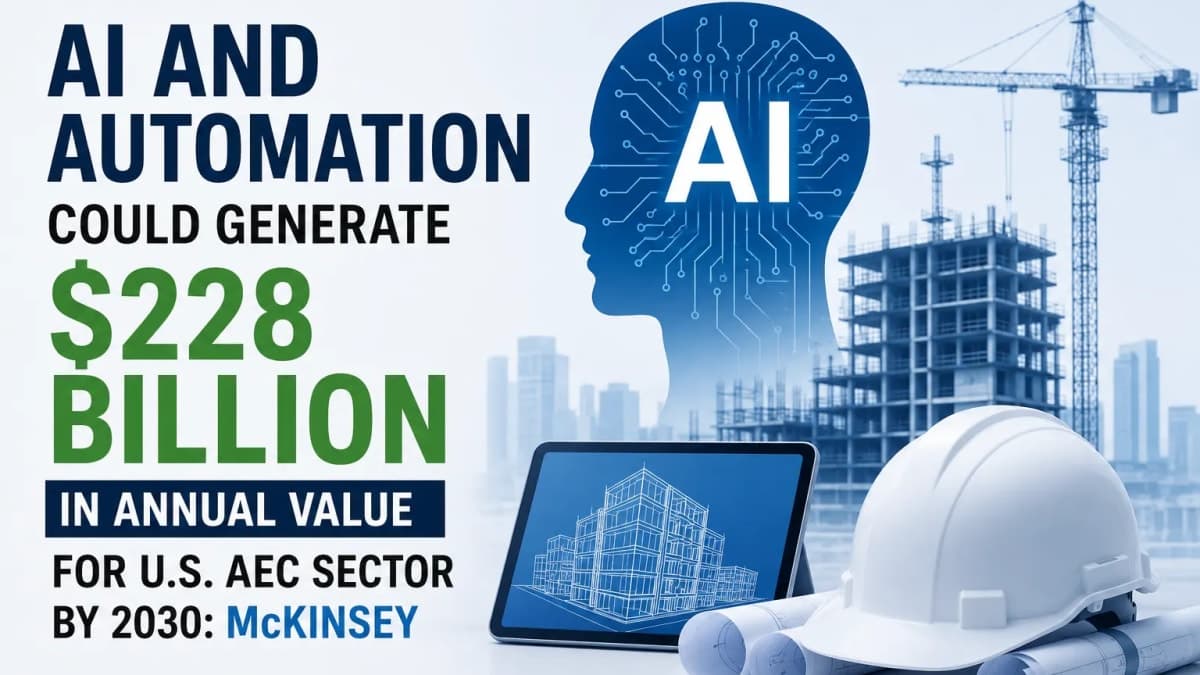
McKinsey Sees Major AI Opportunity Across U.S. Construction Industry
Artificial intelligence could significantly reshape how architecture, engineering and construction companies plan, design and deliver projects over the remainder of the decade.
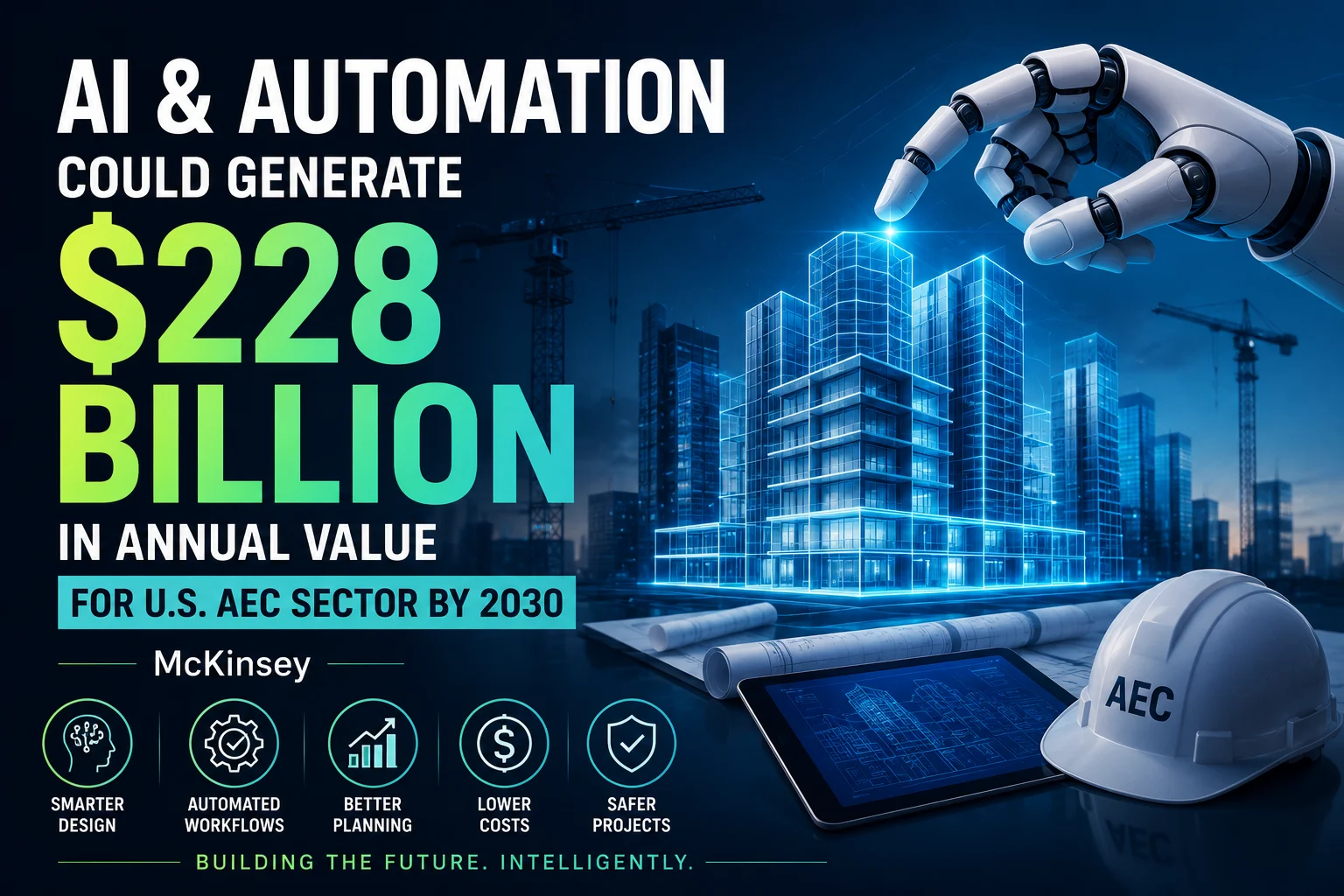
A new McKinsey analysis estimates that AI and other automation technologies could create approximately $228 billion in annual value for the U.S. AEC sector by 2030.
The estimate highlights the scale of the opportunity available to companies that successfully integrate AI into their operating systems. However, it should not be interpreted as value created by generative AI alone, as McKinsey’s projection covers AI alongside broader automation technologies.
What Is the AEC Sector?
AEC refers to the interconnected architecture, engineering and construction industries involved in designing, planning, building and maintaining physical infrastructure.
The sector includes architectural practices, engineering consultancies, contractors, specialist subcontractors, materials suppliers, equipment providers and project owners.
These businesses work together on projects ranging from housing and commercial buildings to transport networks, factories, energy facilities and public infrastructure.
Why AI Could Have a Large Economic Impact
Construction Continues to Face a Productivity Challenge
Construction is one of the world’s largest industries, yet its productivity growth has remained slower than that of many manufacturing sectors.
McKinsey said global construction output reached approximately $15 trillion in 2025 and could rise to $22 trillion by 2040. However, construction productivity improved by only about 10% between 2000 and 2022, equivalent to roughly 0.4% a year. Manufacturing productivity increased far more quickly over the same period.
This gap creates an opportunity for technologies that can reduce delays, automate repetitive work, improve coordination and help teams make faster decisions.
AI Could Automate a Significant Share of Nonphysical Work
McKinsey estimates that AI has the potential to automate around 50% of nonphysical work in architecture and engineering.
In construction, where a larger proportion of work takes place physically on job sites, AI could still automate approximately 39% of nonphysical activities.
These activities may include document review, invoice processing, data entry, estimating, scheduling, compliance checks, reporting and coordination between project teams.
Automation does not necessarily mean removing people entirely. In many cases, AI systems may prepare information, identify problems or propose solutions while human professionals retain final decision-making responsibility.
Where AI Could Deliver the Most Value
Winning and Pricing Projects
AI systems could assist companies with bid selection, proposal preparation, cost estimation, benchmarking and pricing scenarios.
By analysing previous projects and market data, AI tools may help businesses identify risks earlier and submit more competitive bids without relying entirely on manual reviews.
Design and Engineering
AI may help architects and engineers review specifications, interpret building standards, identify design conflicts and test whether projects can be constructed efficiently.
Such systems could detect potential problems before they reach the job site, reducing redesign, requests for information and expensive rework.
Planning and Procurement
AI agents could connect schedules with material availability, equipment requirements, procurement packages and contract obligations.
This could allow project managers to understand how a delayed delivery or design alteration affects costs, labour requirements and completion dates across the wider project.
Project Controls and Site Management
During construction, AI could support progress tracking, cost forecasting, change-order management, safety observations, quality inspections and claims documentation.
McKinsey argues that the greatest value may emerge when these systems communicate with one another rather than operating as separate tools.
Administrative and Back-Office Operations
Finance closing, invoice verification, compliance reporting, employee onboarding and document control are among the repeatable activities that could become increasingly automated.
These functions may offer an early opportunity because they often involve structured processes and large volumes of paperwork.
Agentic AI Could Connect Entire Project Workflows
A central theme of McKinsey’s analysis is the rise of agentic AI.
Unlike a conventional AI tool that completes one narrow task, an AI agent may retrieve information from multiple systems, examine project records, draft documents, identify exceptions and route decisions to the appropriate employees.
For example, if a late design change creates a problem with prefabricated materials, AI agents could compare photographs, engineering models, procurement records and project schedules. They could then assess possible solutions and estimate the impact on cost and delivery.
Human professionals would still approve the final response, particularly where safety, legal responsibility or engineering judgement is involved.
More Than 150 Workflows Could Be Affected
McKinsey identified more than 150 workflows across 25 AEC-related domains with varying levels of AI and automation potential.
The consultancy divided the opportunity into three broad time horizons:
Near Term: Up to 18 Months
Companies may initially focus on repeatable, information-heavy processes such as estimating, proposal development, design checking, scheduling and invoice validation.
Medium Term: 18 to 48 Months
The next phase may involve converting project records into reusable corporate knowledge.
Drawings, specifications, schedules, change orders and close-out documents could help train systems that improve with each completed project.
Long Term: Beyond Four Years
AI may become more closely connected with robotics, autonomous equipment, logistics systems and physical job-site operations.
Potential applications include automated equipment dispatch, material movement, site monitoring and designs optimised for manufacturing and installation.
Data Could Become a Competitive Advantage
AEC companies generate enormous quantities of project data, but much of it remains fragmented across spreadsheets, paper records and disconnected software platforms.
McKinsey argues that firms able to capture, structure and retain rights to their data may build a lasting competitive advantage.
A company that consistently connects estimates with actual costs, schedules with real progress and design choices with construction outcomes could develop a system that becomes more accurate over time.
However, companies may need to pay close attention to contracts with technology vendors, especially provisions governing data ownership, portability and the use of customer information to train external AI models.
AI Could Change How AEC Firms Charge Clients
Many engineering, architecture and consulting businesses currently bill customers according to the number of hours worked.
AI could reduce the time required for design, analysis and documentation, potentially weakening the traditional hourly billing model.
McKinsey suggests that firms may increasingly move toward fixed fees, milestone-based payments, shared savings or performance-linked contracts.
Under these models, clients would pay for outcomes such as more reliable schedules, lower project risk and reduced costs rather than simply paying for employee time.
Why This Development Matters
The potential economic value extends beyond higher company profits.
More efficient planning and delivery could contribute to lower infrastructure costs, faster housing construction, improved industrial development and more reliable energy projects.
AI could also help the industry respond to shortages of experienced engineers, project managers and skilled workers by making specialist knowledge available across a wider organisation.
For investors and technology providers, the $228 billion estimate signals a potentially large market for construction software, AI platforms, robotics, data services and digital project-management tools.
Challenges and Risks
Human Accountability Remains Essential
Construction decisions can affect public safety, legal liability and large financial commitments.
AI-generated recommendations therefore require review by qualified professionals, particularly in structural design, engineering approvals, safety management and regulatory compliance.
Poor Data Can Limit Results
AI tools may produce unreliable recommendations when project information is incomplete, outdated or inconsistent.
Companies must improve their data governance and maintain clear records showing what information was used and who approved important decisions.
Cybersecurity and Confidentiality Concerns
Construction records may contain sensitive information about buildings, infrastructure and commercial contracts.
Introducing AI systems can create additional cybersecurity and confidentiality risks unless access controls and data protections are carefully designed.
Training Junior Employees Could Become Harder
Routine tasks traditionally help junior architects, engineers and project managers develop experience.
When AI completes too much entry-level work, companies may need new training methods to ensure younger professionals still acquire judgement, technical understanding and risk awareness.
Balanced Analysis
McKinsey’s $228 billion projection demonstrates the substantial potential of AI and automation, but it is an estimate rather than a guaranteed economic outcome.
The final value will depend on adoption rates, implementation costs, workforce skills, data quality and the willingness of companies to redesign established processes.
AEC firms that use AI only to produce documents faster may achieve limited productivity improvements. Greater value is more likely when companies connect design, procurement, scheduling, finance and site operations through coordinated digital workflows.
At the same time, rapid deployment without appropriate oversight could introduce errors, data disputes and liability concerns. The sector’s safety-critical nature means human accountability will remain important even as automation expands.
Conclusion
AI and automation could become a major source of productivity and economic growth for the U.S. architecture, engineering and construction industry.
McKinsey’s estimate of $228 billion in potential annual value by 2030 reflects opportunities across design, bidding, procurement, project management and physical construction.
The companies most likely to benefit will be those that combine technology investment with strong data systems, redesigned workflows, employee training and clear governance.