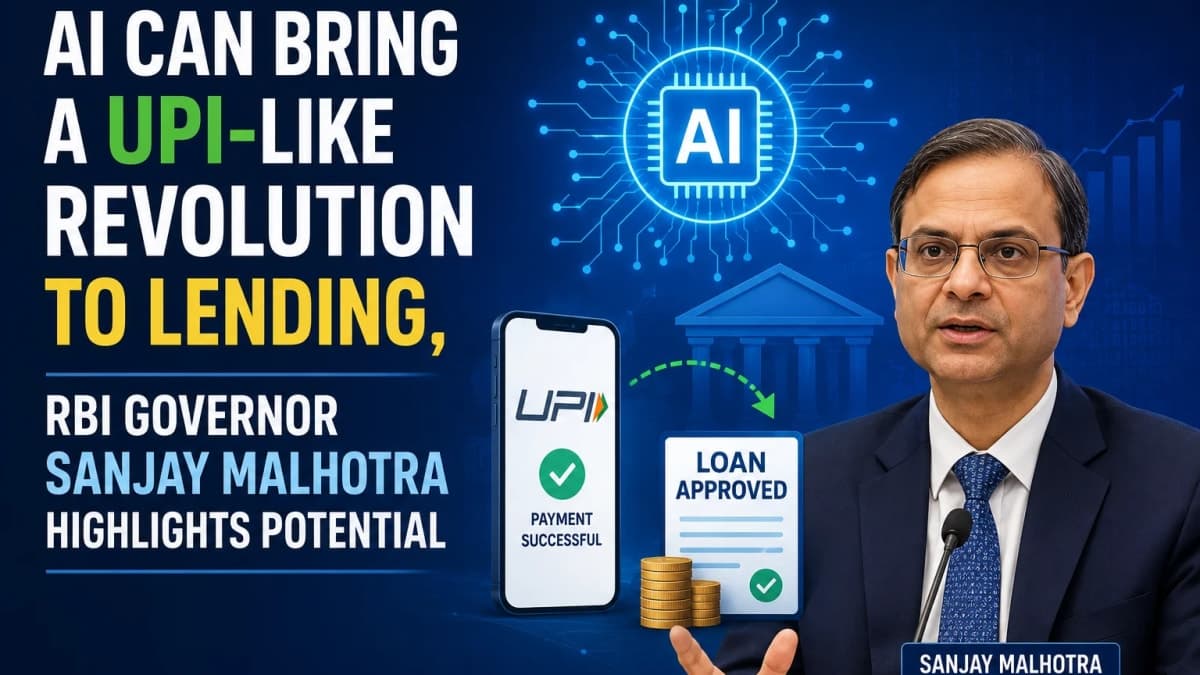
AI Could Transform India's Lending Landscape
Artificial intelligence could emerge as a major force reshaping India's financial sector, particularly the way loans are assessed and delivered.
RBI Governor Sanjay Malhotra has highlighted AI's potential in lending, drawing a comparison with the transformation brought about by UPI in India's digital payments ecosystem.
The comparison is significant because UPI dramatically simplified digital transactions and expanded their reach across consumers and businesses. AI could potentially trigger a similar technological shift in lending, although the nature and risks involved in credit decisions are considerably different from payments.
Why Is AI Being Compared With UPI?
UPI helped make bank-to-bank digital payments quick, convenient and widely accessible. Its growth changed how millions of consumers and merchants conduct everyday transactions.
AI could influence lending in a different way. Financial institutions can use advanced technology to analyse large amounts of relevant data, automate parts of loan processing and improve risk assessment.
This could potentially shorten the time required to evaluate applications and allow lenders to make more efficient credit decisions.
Could AI Improve Access to Credit?
One of the biggest potential benefits of AI-powered lending is its ability to improve how lenders assess borrowers.
Some small businesses and individuals may have limited traditional credit histories, making conventional credit assessment more challenging. Advanced analytical systems could potentially help lenders evaluate available and permitted information more effectively.
If implemented responsibly, such technology could support wider access to formal credit.
However, AI alone cannot guarantee loan availability. Lending decisions will continue to depend on factors including lenders' policies, regulatory requirements, data quality and overall risk management.
What AI Could Mean for Banks and Fintech Companies
AI could also help banks, non-banking financial companies and fintech platforms improve operational efficiency.
Automation may reduce the time and resources needed to process loan applications, while sophisticated analytical tools could help identify risk patterns more effectively.
AI can also potentially support areas such as fraud detection and customer-service personalisation, making it an increasingly important technology for the broader financial sector.
Data Privacy and Algorithmic Bias Remain Key Challenges
The potential benefits of AI-powered lending come with significant risks.
If an AI system is trained on incomplete, inaccurate or biased data, its decisions could potentially reproduce or amplify those problems. This makes fairness and appropriate oversight particularly important when algorithms influence decisions about access to credit.
Data privacy and cybersecurity are equally significant. Lending decisions can involve sensitive financial information, requiring strong safeguards governing how customer data is collected, processed and protected.
Transparency is another challenge. When an automated system contributes to the rejection of a loan application, borrowers and financial institutions may need a clear understanding of the factors behind that outcome.
Human oversight and accountability are therefore likely to remain essential even as automation expands.
Why Sanjay Malhotra's Statement Matters
The RBI Governor's comments are significant in the context of India's rapidly evolving digital financial infrastructure.
UPI has demonstrated how technology and financial infrastructure can fundamentally change consumer behaviour and expand access to digital services. Comparing AI's potential in lending with the UPI transformation underscores the scale of change that advanced technology could eventually bring to credit markets.
If AI systems are developed and deployed with appropriate safeguards, they could contribute to faster lending processes, better risk assessment and broader access to financial services.
Balanced Analysis
The comparison between AI-powered lending and UPI highlights the technology's potential, but there is an important distinction between the two.
Payments primarily involve transferring money, while lending requires lenders to assess the likelihood that an individual or business will repay borrowed funds in the future. Credit decisions therefore involve complex questions of risk, fairness and accountability.
AI could make these processes faster and more sophisticated, but technological efficiency cannot be the only objective. Consumer protection, explainability, data security, regulatory compliance and human oversight will be equally important.
The ultimate impact of AI on lending will depend not simply on how advanced the technology becomes, but on how responsibly India's financial ecosystem uses it.
This article is based on reporting published by Moneycontrol.