For decades, companies accumulated an enormous type of data they could barely search.
Video.
A two-hour customer interview might contain one critical complaint. A training recording could include the answer to an employee's question. Thousands of hours of broadcast footage might contain exactly the clip an editor needs.
The information existed.
Finding it often meant watching the footage.
Artificial intelligence is changing that equation.
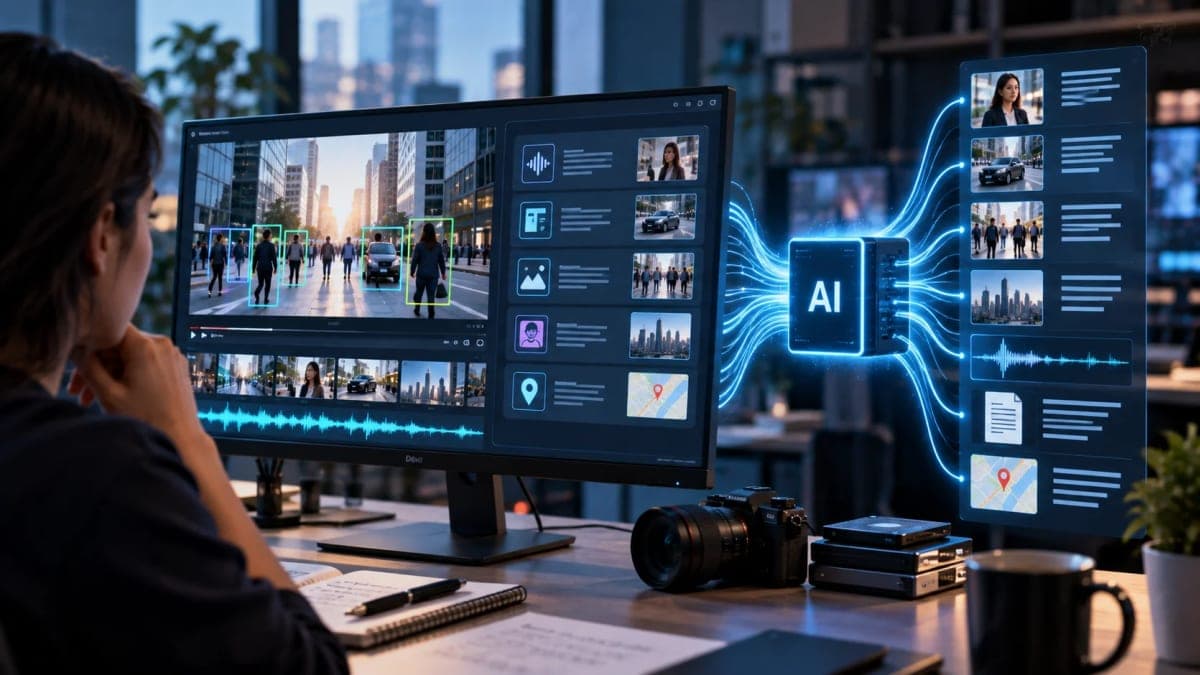
Modern video-analysis systems can extract spoken words, objects, people, visible text, scenes, timestamps and other information from audiovisual files. Newer multimodal models can go further, reasoning across those signals to summarize a video or answer questions about what happened inside it.
The result is a subtle but important shift:
Video is beginning to behave less like a file you watch and more like a database you query.
That may ultimately be more consequential than automated transcription itself.
What does AI actually see when it processes a video?
A human experiences a video as one continuous piece of media.
An AI processing pipeline can break it into multiple streams of information.
The audio contains speech and other sounds.
Frames contain objects, people and text.
Changes between frames reveal shots and scenes.
Timestamps connect those observations back to specific moments.
Language models can then operate on the resulting information to identify topics, generate summaries or answer questions.
This isn't theoretical.
Google's Video Intelligence API can annotate stored or streaming video at the video, segment, shot and frame levels. Its available functions include object tracking, people detection, text recognition, speech transcription, explicit-content detection and shot-change detection.
For label detection specifically, Google says its system can identify entities including objects, locations, activities, animal species and products, associating those observations with frames, shots or video segments.
Microsoft takes a similarly multi-layered approach.
Azure AI Video Indexer runs more than 30 AI models when indexing media and can generate structured JSON containing transcripts, OCR results, faces, topics and other time-linked insights.
The important output therefore isn't simply:
“Here is a summary of this video.”
It can instead become structured information such as:
who appeared → what was said → what appeared visually → when it happened → what topic it related to.
That structure is what makes large media libraries searchable.
Multimodal models are changing the pipeline again
Traditional video intelligence often worked as a collection of specialised models.
One system transcribed speech.
Another performed OCR.
Another detected objects.
Another separated scenes.
A later stage combined those outputs.
That architecture still exists and remains useful.
But multimodal foundation models are beginning to collapse parts of the pipeline.
Google's current Vertex AI documentation demonstrates Gemini accepting a video directly and answering a natural-language question about its contents.
Another official Google example asks Gemini to analyse a video including its audio, summarize its main points and produce chapters with timestamps.
That represents an important change.
Instead of developers always having to decide in advance which metadata they want extracted, they can increasingly ask higher-level questions.
For example:
“Where does the speaker discuss pricing?”
“Summarize the product complaints in these interviews.”
“Create chapters for this training session.”
“Find the section where the machine begins malfunctioning.”
The interface to video analysis is becoming natural language.
A searchable video archive is fundamentally different from a video archive
Imagine a broadcaster with 100,000 hours of footage.
The old archive might be searchable primarily through filenames, manually written descriptions and whatever metadata was entered when the content was stored.
An AI-indexed archive can potentially expose information contained inside the footage itself.
Microsoft says Video Indexer can search media using information such as people, projects, visual text, spoken words, entities and topics.
AWS offers another example of this structured approach.
Amazon Rekognition Video can identify labels, faces, people, celebrities, text and video segments in stored video. Its label-detection results associate detected items with the time in milliseconds when they appeared.
That timestamp is more important than it might appear.
Without time information, AI tells you:
“A car appears somewhere in this 90-minute recording.”
With temporal metadata, the system can tell software where to retrieve the relevant moment.
That transforms recognition into navigation.
The implications go far beyond media companies
The obvious beneficiaries are broadcasters, streaming platforms and video-production businesses.
But large quantities of audiovisual information exist throughout the economy.
A company may possess thousands of recorded customer interviews.
A university may have years of recorded lectures.
A retailer may have product videos.
A manufacturer may store inspection footage.
A company may archive training sessions, meetings and presentations.
A newsroom may have years of interviews and raw footage.
Once indexed, these recordings can potentially support search, summarisation, accessibility, analysis and content reuse.
Microsoft explicitly identifies use cases including media-archive search, accessibility, content moderation and editing.
The underlying opportunity is therefore not simply creating more video with AI.
It is extracting more utility from video that already exists.
One recording can produce several kinds of data
Consider a one-hour corporate earnings presentation.
An AI pipeline could potentially create:
a transcript of the presentation;
speaker-separated dialogue;
OCR of numbers or words appearing on slides;
timestamps for each topic;
a summary;
searchable company and product names;
translated subtitles;
and chapters pointing users to relevant sections.
Microsoft's documentation shows how several of these channels can be combined.
Its topic-inference system can use transcribed speech, OCR text and recognized people to infer subjects appearing in a video.
Its broader indexing configurations can combine transcription, translation, automatic language identification, keywords, named entities, OCR, scenes, people, speakers, topic extraction and content-moderation signals.
The original video hasn't changed.
Its information accessibility has.
Transcription is still one of the foundations
Despite rapid progress in multimodal reasoning, speech-to-text remains a fundamental component of many multimedia workflows.
Google's Video Intelligence API can transcribe spoken audio from video and associate the resulting text with portions of the recording.
OpenAI's current transcription API similarly accepts common media formats including FLAC, MP3, MP4, MPEG, M4A, OGG, WAV and WebM. Current model options include transcription models capable of speaker diarization, which identifies who spoke different parts of an audio recording.
Once speech becomes text, mature information-retrieval tools become available.
The transcript can be indexed.
It can be searched.
It can be summarized.
Entities can be extracted.
Different recordings can be compared.
The output can feed another AI system.
That is why speech recognition is increasingly less an end product than an input layer for additional AI processing.
But “AI understands video” needs qualification
The word understands can easily overstate what these systems do.
Video-analysis systems infer information from pixels, audio and learned statistical patterns.
Their output can be wrong.
A face can be misidentified.
Speech can be mistranscribed.
Text can be misread.
An object can be incorrectly labelled.
A summary can omit an important qualification.
A model can infer a relationship that the footage does not actually establish.
Microsoft's own transparency documentation notes that Video Indexer uses multiple AI technologies — including OCR, natural-language processing and other models — to generate inferred insights.
Those outputs should therefore be treated as machine-generated metadata, not automatically as ground truth.
The distinction becomes particularly important in journalism, legal evidence, security footage, healthcare or any situation where a mistaken identification can have serious consequences.
Input quality still matters
Better models do not eliminate poor source material.
Speech recognition becomes more difficult when speakers overlap, microphones are weak or background noise overwhelms dialogue.
Visual analysis can deteriorate when footage is blurry, badly exposed or too low-resolution to preserve useful detail.
The engineering implication is important.
The question is not simply:
Which AI model should we use?
A production system also has to consider capture quality, compression, supported formats, preprocessing, storage, permissions and validation.
Different platforms impose different technical requirements.
For example, Amazon Rekognition's stored-video APIs operate on video stored in Amazon S3 and support MP4, MOV and AVI inputs.
OpenAI's transcription endpoint accepts a different range of audio/media containers.
Google's video services likewise document supported formats and ingestion methods.
So file preparation can matter.
But it is important not to overstate the case.
No, every video does not need to be converted into WAV first
The sponsored article that prompted this story emphasizes converting MP4 video into WAV audio before AI processing.
That can be appropriate for particular workflows.
It is not a universal requirement.
OpenAI's transcription API accepts MP4 directly.
Google's Video Intelligence API can perform speech transcription on video.
Google's Gemini examples also demonstrate direct video input for multimodal analysis.
And Microsoft's Video Indexer is specifically designed to process both the audio and visual channels of media files.
Extracting audio separately may still be useful when only speech matters, when another service requires a particular input, or when developers want tighter control over cost and preprocessing.
But “convert video to WAV before using AI” is an implementation choice, not a general rule of multimedia AI.
That distinction is especially important because the original article promoting the idea is sponsored content.
Cost changes the architecture
Video AI also introduces a less glamorous problem: processing large media libraries costs money.
Video contains vastly more raw information than ordinary text.
That makes decisions about what to analyse economically significant at scale.
Google's Video Intelligence pricing, for example, charges for various stored-video annotation functions by processed minute once usage exceeds its free allowance. Label detection and explicit-content detection are currently listed at $0.10 per minute at the standard tier beyond the free volume, while shot detection is $0.05 per minute.
Those figures are service-specific and should not be generalized into a universal cost for video AI.
But they illustrate why companies with millions of minutes of footage may not simply run every possible model across every file.
A sensible architecture might first determine what information is actually needed.
If the task concerns only spoken customer feedback, processing every visual frame may add little value.
If the objective is to identify products appearing on screen, throwing away the video and analysing only audio would obviously destroy useful information.
The optimal pipeline depends on the question being asked.
Privacy becomes more complicated when AI makes video searchable
AI indexing also changes the privacy characteristics of a media archive.
A company might already possess thousands of videos containing employees, customers or visitors.
But if nobody can realistically search those recordings by person, spoken phrase or visual content, much of that information remains difficult to retrieve.
AI can change that.
Microsoft's system, for example, includes face detection and grouping, observed-person detection and named-entity extraction. Some capabilities are restricted because of privacy and regulatory requirements.
This creates an important governance principle:
Making existing data easier to search can increase its practical sensitivity even when no new recording has been created.
Organizations therefore need to think not only about whether they are permitted to store a video, but also what forms of automated indexing, identification and inference are appropriate.
AI-generated metadata can itself become valuable data
There is another consequence that receives less attention.
Once AI processes a media library, companies can end up with a second dataset derived from the first.
The original dataset consists of videos.
The derived dataset may contain:
transcripts;
people;
objects;
timestamps;
topics;
keywords;
locations;
scene boundaries;
captions;
summaries;
and embeddings or other searchable representations.
This derived layer can be dramatically easier for software to query than the underlying media.
That means the valuable asset may eventually be not just the archive itself, but the machine-readable index built on top of it.
It resembles what search engines did for the web.
The web's pages were useful individually.
The index made billions of pages navigable.
Multimedia AI is beginning to create a similar indexing layer for audiovisual information.
There is also a product shift: search is becoming conversational
Traditional video search starts with metadata.
Type a keyword and retrieve files whose titles, descriptions or tags match it.
Multimodal models make a different interaction possible.
A user could potentially ask:
“Find every customer interview where delivery delays were mentioned and summarize the three most common complaints.”
That request contains several operations:
searching across recordings;
understanding speech;
finding relevant moments;
grouping similar information;
and synthesizing the results.
The significance of multimodal AI is therefore not merely that it detects more things.
It can potentially connect retrieval and reasoning.
Google's current Gemini documentation already demonstrates direct natural-language summarisation and timestamped chapter generation from video.
That points toward media archives whose primary interface may eventually be a question rather than a search box.
JantaScope Analysis: Video is becoming a queryable corporate memory
The most interesting transformation is not AI-generated clips, automatic subtitles or even better transcription.
It is the conversion of unstructured time-based media into structured, retrievable knowledge.
Businesses have spent decades creating video faster than they could meaningfully catalogue it.
Meetings were recorded.
Interviews accumulated.
Training sessions were archived.
Customer calls were stored.
Broadcast footage piled up.
The information was technically available but economically expensive to revisit because humans consume video in real time.
AI changes that constraint.
A machine can potentially analyse many recordings, extract time-linked information and create an index that another system can query.
That makes video more similar to text databases — but not identical.
The visual and auditory source still matters.
A transcript cannot tell you everything that appeared on screen.
Object recognition cannot tell you everything that was said.
A summary cannot preserve every nuance of the original recording.
The strongest systems therefore won't necessarily be those that turn video entirely into text.
They will be those that maintain the connection between the original media, structured metadata and the exact moment from which an AI-derived claim came.
That final piece is critical.
If an AI says:
“Customers frequently complained about battery life,”
a trustworthy enterprise system should ideally allow the user to jump back to the actual recordings and inspect the evidence.
That is the difference between AI merely summarizing a video archive and AI turning it into a genuinely useful knowledge system.
The future of multimedia data may therefore be less about machines “watching video like humans.”
It may be about something humans have never been particularly good at:
remembering, indexing and querying millions of hours of video at once.