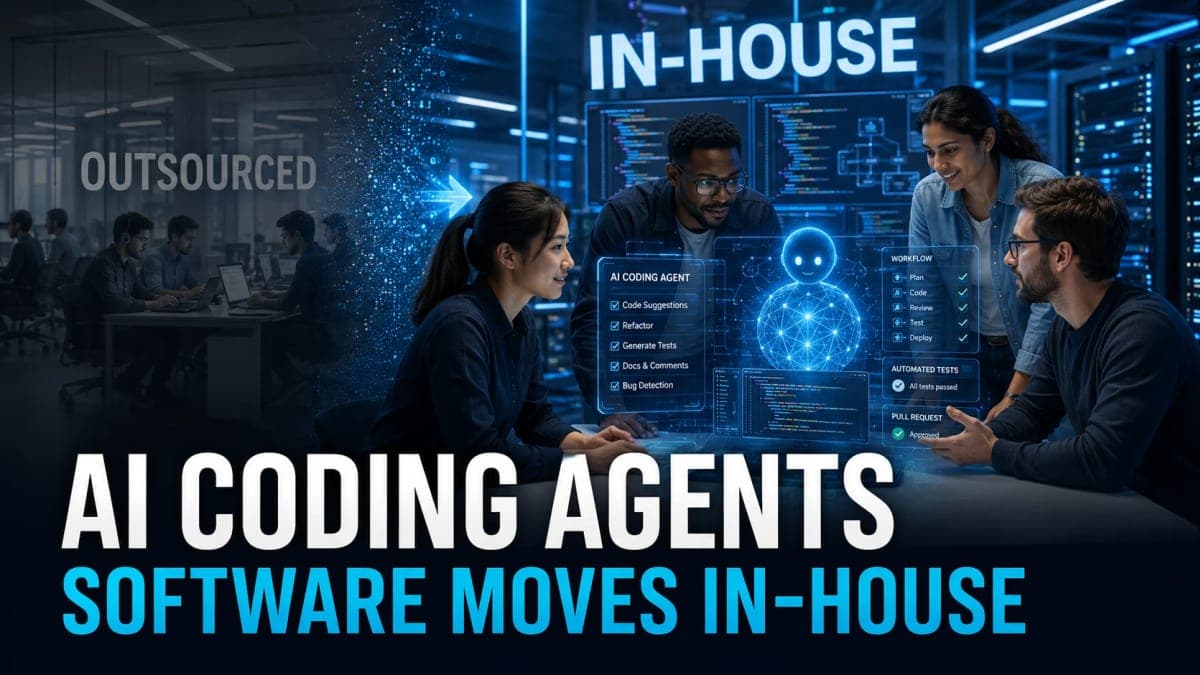
AI Coding Agents Push More Companies to Build Software In-House
Artificial intelligence is beginning to change not only how software is written, but also where that work is performed.
Companies that previously outsourced application development, software maintenance and routine coding are experimenting with AI agents that can complete some of these tasks inside their own organisations. The trend is creating new pressure on technology-services providers, particularly India’s large outsourcing industry.
Unlike basic code-completion tools, modern coding agents can analyse repositories, plan changes, generate and review code, run tests and prepare updates for human approval. This wider capability is making internal development practical for organisations that may not have previously maintained large engineering teams.
The transition remains at an early stage, and complex projects still require experienced developers, security specialists and external partners. However, AI is beginning to alter the economic calculation behind the traditional decision to build software internally or hire an IT services company.
Customers Are Taking Some Outsourced Work Back
Industry executives say clients are using AI to move certain technology assignments in-house. At the same time, customers are demanding lower prices and faster delivery from external providers because they expect AI to improve productivity.
This is contributing to shorter contracts and a move away from billing arrangements based primarily on the number of employees assigned to a project. Instead, clients increasingly want fees linked to specific business results, completed tasks or measurable performance.
The change directly challenges the traditional outsourcing model, under which large IT companies supplied extensive teams of engineers and charged clients according to time and staffing.
If an internal team supported by coding agents can perform a project with fewer people, the size of a vendor’s workforce becomes less important as a competitive advantage.
AI Changes the Build-Versus-Buy Calculation
Developing custom business software has historically required significant investment. Companies needed engineers, project managers, testers, infrastructure specialists and long-term maintenance capacity.
Purchasing packaged software or outsourcing development often provided a faster and more predictable alternative.
Coding agents could lower some of those barriers. They can help internal teams create prototypes, automate repetitive workflows, modernise older applications and produce integrations between existing systems.
This does not mean every company will attempt to recreate major enterprise platforms. Instead, many businesses may begin with smaller applications designed around their own operations—such as internal dashboards, approval tools, reporting systems or customer-service workflows.
The main attraction is control. Internally developed software can be more closely aligned with a company’s processes and may reduce dependence on outside vendors. It can also allow businesses to keep sensitive information within approved systems.
Indian IT Services Companies Face Pricing Pressure
India’s technology-services industry, valued at approximately $315 billion, has been built partly on the availability of large numbers of skilled engineers who develop and manage software for global clients.
That model is now being tested. Persistent Systems CEO Sandeep Kalra said customers were seeking price reductions of about 25% to 30% while simultaneously expecting quicker delivery and higher productivity.
Major providers including TCS, Infosys, Wipro, HCLTech and Cognizant are adjusting their commercial models. Some contracts are increasingly tied to outcomes rather than hours worked, while companies have also declined deals where the promised AI-related productivity gains made the work financially unattractive.
The impact is not entirely negative. AI is also generating demand for cloud migration, data preparation, cybersecurity, model integration and the redesign of business processes. The challenge for service providers is to create enough new work to compensate for falling revenue from tasks that AI makes cheaper or unnecessary.
Smaller IT Firms Could Gain Ground
AI may weaken the advantage traditionally enjoyed by the largest outsourcing companies.
In the past, multinational clients often selected major providers because they could quickly deploy thousands of workers across several locations. Coding agents could allow smaller teams to perform projects that once required much larger groups.
Mid-sized companies may therefore compete more effectively by providing experienced specialists, moving quickly and offering flexible contracts. Persistent Systems and Coforge have recently recorded stronger dollar-denominated revenue growth than several of India’s largest IT firms, although many factors beyond AI contribute to individual company performance.
Smaller providers may still struggle with global support coverage, regulatory compliance and investment capacity. Nevertheless, AI gives them an opportunity to compete on expertise and speed instead of workforce size alone.
Coding Agents Move Beyond Simple Autocomplete
Early AI programming tools largely suggested individual lines or short blocks of code. Agentic systems can now take on broader assignments across the software-development lifecycle.
They may break a project into tasks, work on several activities in parallel, inspect code, identify errors, execute tests and submit proposed changes. Developers increasingly act as supervisors who define requirements, review results and decide whether generated work should be accepted.
Gartner estimates that the enterprise AI coding-agent market reached an annualised value of approximately $9.8 billion to $11 billion by April 2026. Its research also found that 90% of surveyed engineering leaders reported productivity improvements, with a net average gain of 19.3%.
These figures indicate meaningful momentum, but productivity can vary considerably between organisations, teams and types of software.
What This Means for Technology Jobs
AI coding agents are most immediately affecting repetitive and entry-level programming work.
Former Infosys chief financial officer V. Balakrishnan argued that the traditional workforce pyramid—with large numbers of junior developers beneath a smaller group of senior employees—is losing relevance because agents can perform more basic coding.
That does not necessarily mean software engineers will disappear. Instead, demand may shift toward people who can define systems, validate AI output, secure applications and connect technical work with business requirements.
Skills likely to become more valuable include:
Software architecture and systems design
AI-agent supervision
Cybersecurity and code auditing
Data governance
Product management
Testing and quality assurance
Cloud and infrastructure engineering
Industry-specific knowledge
Entry-level opportunities could become more difficult if companies reduce routine coding positions. Employers may consequently need new training models that allow junior staff to develop expertise without relying exclusively on basic programming assignments.
Risks of Building Software With AI Agents
Lower development costs do not eliminate the risks associated with custom software.
AI-generated code can contain security vulnerabilities, hidden errors, unsuitable dependencies or technical decisions that become expensive to maintain. An application that works during a demonstration may not perform reliably when used by thousands of people or connected to sensitive corporate systems.
Companies must also control what information agents can access. Source code, customer records and internal business data could be exposed if tools are deployed without appropriate security and contractual protections.
Other concerns include:
Unclear ownership of generated code
Dependence on an AI model provider
Unpredictable usage-based costs
Regulatory and audit requirements
Inadequate documentation
Difficulty maintaining rapidly generated applications
Licensing risks involving training data or code dependencies
These factors favour organisations with mature engineering and governance practices. Businesses without those capabilities may still benefit more from established software products or professional service providers.
Established Software Vendors Are Not Disappearing
The ability to generate applications quickly has raised concerns that businesses may replace products from companies such as Salesforce, ServiceNow or Workday with custom alternatives.
In practice, replacing a major enterprise platform is far more complicated than generating an interface or automating a workflow. Large systems must handle permissions, security, data integrity, regulation, auditing and years of operational history.
Research cited by Reuters Breakingviews found that only 10% of surveyed corporate AI budgets were being used to build tools entirely in-house, while 78% involved paying third-party companies to assist with adoption.
This suggests that the more probable outcome is a hybrid market. Companies will continue purchasing major platforms while using coding agents to build specialised applications around them.
Why the Trend Matters
The shift matters because it could redistribute power across the software industry.
Businesses may gain greater leverage over outsourcing companies and software vendors. IT providers will have to demonstrate business outcomes rather than simply supplying large numbers of developers. Smaller specialists may compete for projects that were previously beyond their capacity.
At the same time, organisations will assume more responsibility for the reliability and security of internally generated software.
The central question is therefore not whether AI can write code. It is whether companies can turn that code into dependable systems that remain secure, compliant and maintainable over many years.
Balanced Analysis: Transformation, Not Immediate Replacement
Coding agents are likely to reduce the cost of some internal development and eliminate portions of routine outsourced work. Companies with strong technical teams may find it economical to build more specialised tools themselves.
However, claims that AI will make outsourcing companies or enterprise software vendors obsolete are premature. Large-scale systems require architecture, integration, governance and continuous support—areas where experienced providers retain significant value.
The IT services industry may shrink in some labour-intensive categories while expanding in AI integration, security and organisational transformation. Its future will depend on how quickly providers move away from selling employee hours and toward delivering measurable results.
Conclusion
AI coding agents are lowering the practical barriers to internal software development and giving companies a credible alternative to outsourcing selected technology projects.
For businesses, the opportunity is greater control and potentially faster development. For IT services firms, it is a warning that workforce size alone will no longer guarantee competitiveness.
The companies most likely to benefit will be those that combine AI-generated speed with human judgment, strong security and disciplined software engineering.
This article is based on reporting published by Indiagazette.