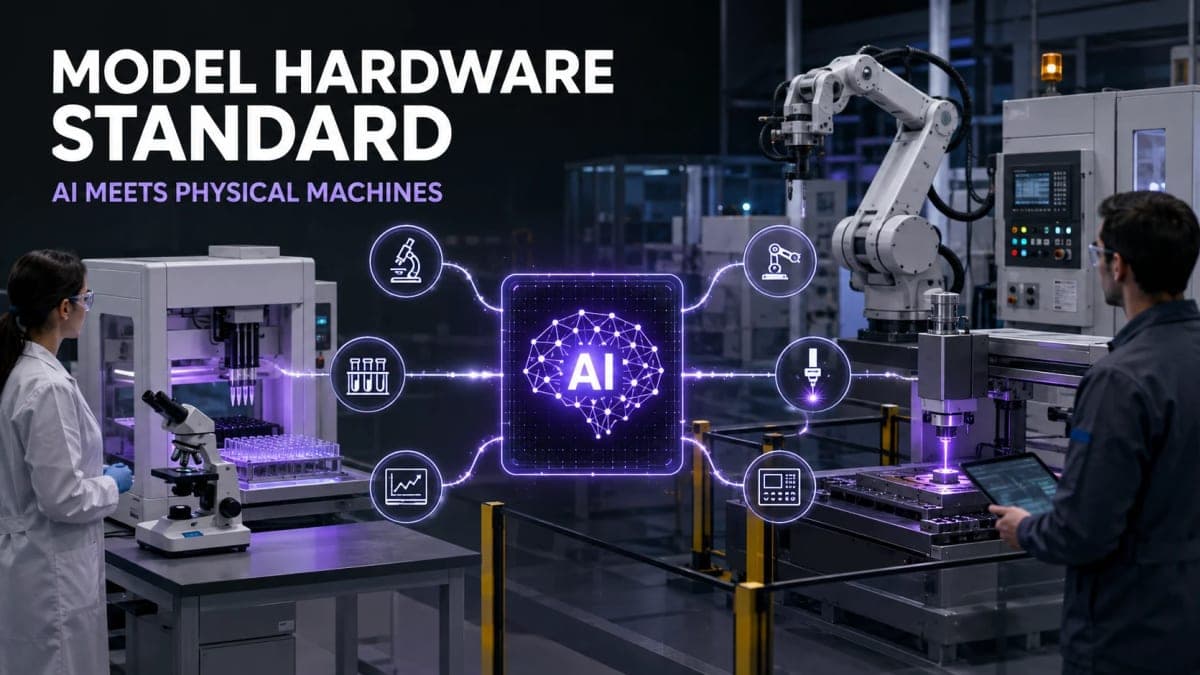
Anthropic Introduces Model Hardware Standard for AI Agents to Control Physical Machines
Anthropic has unveiled an early version of the Model Hardware Standard, or MHS, a specification designed to connect artificial-intelligence agents with physical equipment used in scientific laboratories and advanced manufacturing.
Announced on August 27, 2026, the standard is being released initially as a limited research preview. Anthropic is inviting selected research institutions and industrial partners to test the framework, develop safety evaluations and establish operating practices before it is made open source.
MHS could allow AI agents to coordinate instruments such as microscopes, liquid-handling systems, lasers and robotic arms. The framework is intended for programmable equipment rather than every mechanical device, and it remains an experimental standard rather than a widely deployed commercial system.
What Is the Model Hardware Standard?
The Model Hardware Standard is a common technical specification that describes how an AI agent can discover a machine, understand its capabilities, send instructions and receive information from it.
At present, scientific and industrial instruments frequently use different programming interfaces. Connecting multiple machines can require engineers to create custom software for each device and workflow—a process that may take weeks or months.
MHS introduces a standardised driver that translates between an AI system and the hardware. It uses basic operations such as “read” and “write.” A read command could request a temperature measurement, while a write command could change a temperature setting.
By presenting different machines through a consistent interface, the system could reduce the amount of bespoke integration work required whenever new equipment is added.
How an AI Agent Could Use MHS
A device connected through MHS can provide information about what it does, which commands it accepts and which physical characteristics an agent needs to consider.
This description could include details that are not obvious from software code alone. For example, knowing the weight or movement limits of a robotic arm could be important when planning how it should manipulate an object.
The standard also allows users to add machine information using natural-language tags. This could bring knowledge currently scattered across printed manuals, computer files and the experience of specialised technicians into a format an AI agent can access.
Once connected, agents could theoretically coordinate several machines simultaneously, adjust experimental parameters and respond to certain hardware errors. Anthropic says the approach could support longer-running workflows with less continuous human intervention.
Potential Uses in Science and Manufacturing
Anthropic has identified several possible applications for the technology:
Coordinating microscopes and liquid handlers during biological research
Performing routine stages of drug-discovery experiments
Calibrating lasers used in quantum-computing systems
Operating robotic arms in manufacturing environments
Connecting instruments that previously required separate control systems
Monitoring experiments and modifying parameters as results arrive
The project began as a collaboration between Anthropic and the Howard Hughes Medical Institute’s Janelia Research Campus. Organisations reportedly testing or participating in related work include Carnegie Mellon University, Genentech and quantum-computing company QuEra.
The research preview also extends Anthropic’s recent push into scientific AI, robotics and systems that operate beyond conventional chat interfaces.
MHS Is Model-Agnostic
An important feature of MHS is that it is not designed exclusively for Anthropic’s Claude models. According to the company, the specification is model-agnostic, meaning other AI models and agent frameworks could potentially use it.
Agent systems can access MHS through standard communication protocols, including Anthropic’s Model Context Protocol. MCP was created to give AI applications a consistent way to connect with software tools and data sources; MHS applies a related interoperability idea to physical machines.
This separation could make the standard more attractive to laboratories and manufacturers that do not want their equipment integrations tied permanently to one AI provider.
However, widespread adoption will depend on whether equipment manufacturers, software developers, researchers and safety specialists accept the specification and implement compatible drivers.
Why the Announcement Matters
AI agents have largely operated in digital environments, where they can search documents, write software, use online tools and manage computer-based workflows. Connecting them to physical equipment changes both their usefulness and their risk profile.
In scientific research, an agent capable of controlling instruments could help reduce the time spent on routine procedures. It could run repeated tests, monitor measurements and make permitted adjustments without waiting for a researcher to perform every step manually.
This could enable experiments to continue outside ordinary working hours and allow scientists to focus on designing studies and interpreting results. Standardised integrations could also make laboratory automation more accessible to organisations without large internal engineering teams.
In manufacturing, the technology could help coordinate machines from different vendors and modify production workflows more efficiently. The possible value is particularly significant in facilities where equipment integration remains expensive and technically demanding.
Physical Control Creates Higher Safety Stakes
The move from software to physical machinery introduces consequences that conventional AI agents do not face. An incorrect software action may damage a file or interrupt a digital workflow; an incorrect hardware command could destroy costly equipment, spoil biological material or injure someone.
Large language models can misinterpret instructions, produce incorrect conclusions and respond unpredictably to unusual inputs. They can also be exposed to malicious instructions or inaccurate device information.
A common communications standard does not, by itself, guarantee safe operation. Effective deployment would require several additional controls, potentially including:
Strict limits on the actions available to an agent
Hardware-level emergency stops
Independent validation of commands
Human approval for high-risk operations
Continuous monitoring and detailed activity logs
Network isolation and cybersecurity protections
Defined operating ranges that software cannot override
For critical machinery, deterministic control systems and physical safety mechanisms will remain necessary even if an AI agent manages the higher-level workflow.
Research Preview Comes Before Open-Source Release
Anthropic is limiting access during the initial phase so that research and industry partners can test MHS, build evaluations and identify potential failure modes.
The company plans to make the standard open source after this work, although it has not provided a confirmed date for general availability. The controlled preview indicates that important questions about safety, reliability and governance remain unresolved.
These evaluations will need to examine not only whether agents can operate machines successfully, but also whether they stop when conditions become unsafe, respect permissions and recover appropriately from incomplete or contradictory information.
Balanced Analysis: Significant Potential, Unproven Reliability
MHS addresses a genuine technical problem. Laboratories and factories often contain equipment that cannot easily communicate, and creating a shared interface could reduce integration costs even without full AI autonomy.
The standard’s model-independent design is another potential advantage. If adopted broadly, it could allow organisations to change AI providers without rebuilding every connection to their equipment.
Nevertheless, the announcement should not be interpreted as evidence that autonomous AI scientists or fully AI-operated factories are ready for unrestricted deployment. Performance in demonstrations or controlled research environments may not translate reliably to complex facilities where unexpected events occur.
There are also regulatory and accountability questions. If an AI-controlled experiment causes damage or produces unreliable results, responsibility could be divided among the model provider, equipment manufacturer, software integrator and operating institution.
The framework’s long-term importance will therefore depend on its safety architecture, independent testing, industry adoption and ability to work reliably across different machines.
AI Agents Move Closer to the Physical World
The Model Hardware Standard represents an attempt to extend agent-based AI from computer applications into laboratories and industrial environments.
Its immediate impact is likely to be limited because access remains restricted and the standard has not yet been open-sourced. But the project indicates the direction in which AI development is moving: from systems that only generate information towards agents that can initiate actions in the physical world.
That transition could accelerate research and automation, but it also demands stronger safeguards than ordinary chatbot applications. MHS will ultimately be judged not only by what it allows AI agents to do, but by how reliably it prevents them from doing the wrong thing.
This article is based on reporting published by Indian Express.