Nvidia Delivers Another Massive Earnings Quarter
Nvidia has provided one of the clearest signals yet that the global artificial intelligence infrastructure boom remains firmly underway.
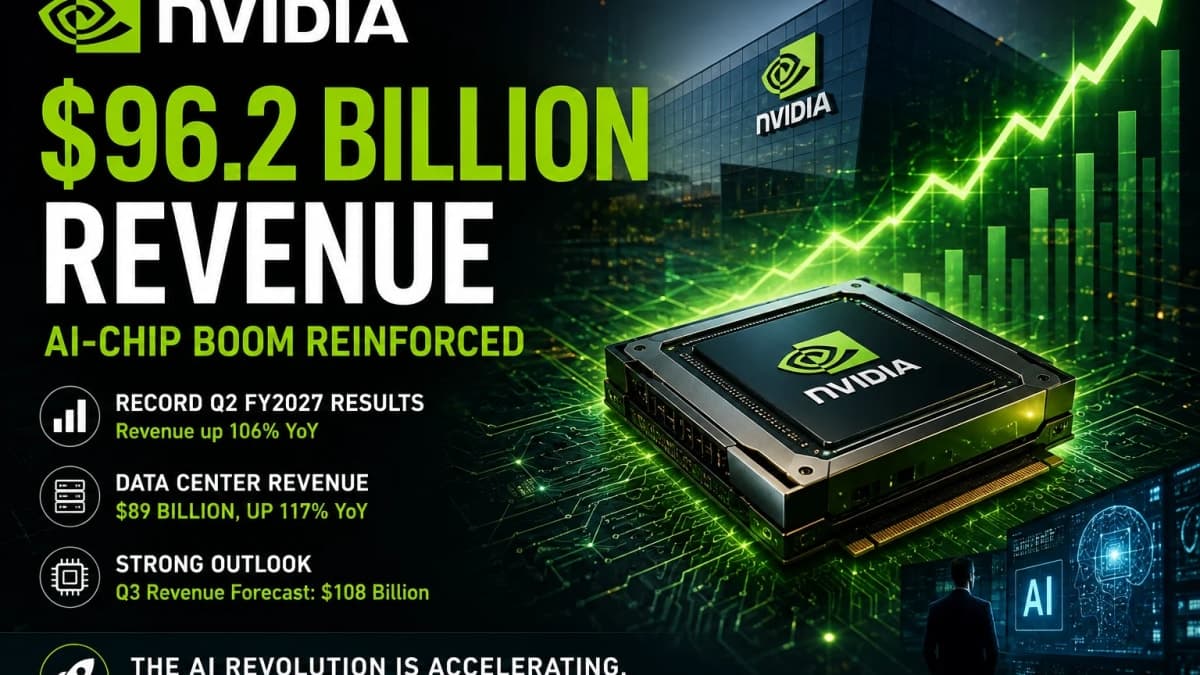
The chipmaker reported $96.2 billion in revenue for its fiscal second quarter of 2027, covering the three months ended July 26, 2026. Revenue increased 18% from the previous quarter and 106% from the same period a year earlier.
The scale of the increase is striking. Nvidia generated $46.74 billion in revenue during the comparable quarter a year ago, meaning its quarterly business has more than doubled within twelve months.
Profitability also remained exceptionally strong. Nvidia reported GAAP net income of $59.69 billion, compared with $26.42 billion a year earlier. GAAP diluted earnings reached $2.46 per share, while non-GAAP diluted earnings were $2.22.
Gross margin stood at 75%, highlighting the profitability Nvidia continues to generate from its position at the center of the AI computing market.
Data Center Revenue Hits $89 Billion
The biggest engine behind Nvidia’s expansion remains its Data Center business.
Revenue from the division reached an extraordinary $89 billion, rising 117% year over year and 18% from the previous quarter.
That means Data Center products accounted for more than 90% of Nvidia’s total quarterly revenue, demonstrating how dramatically the company has evolved from its historical identity as primarily a graphics-chip maker.
AI accelerators are now being deployed at enormous scale by cloud providers, AI laboratories, enterprises and governments building computing infrastructure capable of training and operating increasingly sophisticated artificial intelligence systems.
The continued expansion suggests that companies are not simply experimenting with AI anymore. Major technology groups are committing substantial amounts of capital to the computing infrastructure required to turn AI models into widely used commercial services.
Nvidia Forecasts Another $108 Billion Quarter
Perhaps the most important part of the earnings announcement was not the record quarter that Nvidia had already completed, but what management expects next.
Nvidia forecasts approximately $108 billion in revenue for the third quarter of fiscal 2027, with a range of plus or minus 2%.
The outlook is particularly significant because Nvidia said it assumes no Data Center compute revenue from China in the forecast.
Beyond the coming quarter, Nvidia has also projected approximately 70% revenue growth for its next fiscal year, a rare long-range projection that strengthened investor confidence that demand for AI computing could remain elevated well beyond the current spending cycle.
Why Nvidia’s Earnings Matter for the Entire AI Industry
Nvidia has become much more than an individual semiconductor company from the market’s perspective.
Its financial performance increasingly acts as a measure of how aggressively the world's largest companies are investing in artificial intelligence.
Building advanced AI systems requires enormous computing resources. Training frontier models, operating AI assistants, generating video and images, developing autonomous machines and running increasingly complex AI agents all require substantial processing capacity.
Nvidia supplies much of the high-performance computing infrastructure supporting those workloads.
As a result, rapidly rising Nvidia revenue provides indirect evidence that investment in AI infrastructure remains exceptionally strong.
The earnings report helped ease concerns that spending by major technology companies might begin slowing after several years of extraordinary investment.
Blackwell and Vera Rubin Drive Nvidia’s Next Growth Phase
Nvidia's growth strategy is also increasingly dependent on rapidly introducing new generations of AI infrastructure.
Blackwell remains a major contributor to the company's current business, while its next-generation Vera Rubin platform is moving into production.
The company says Rubin systems are already running with partners including major cloud infrastructure providers.
This rapid product cycle is strategically important.
AI companies are attempting to train larger models while simultaneously reducing the cost of generating each AI response. More powerful and efficient computing platforms can therefore give customers an economic incentive to continually upgrade their infrastructure.
That dynamic could help Nvidia maintain demand even after the initial wave of AI data-center construction matures.
AI Infrastructure Spending Is Expanding Beyond Big Tech
Another important development is the broadening of the AI infrastructure market.
The first phase of generative AI investment was dominated by a relatively small number of technology giants. The ecosystem is now expanding to include AI-native companies, governments, enterprises, research organizations and specialized cloud providers.
Nvidia is positioning its hardware, networking technologies and software ecosystem as infrastructure for all of these groups.
The company has also expanded major partnerships. Nvidia and Amazon Web Services announced plans to deploy 2 million additional Nvidia GPUs across AWS infrastructure, illustrating the extraordinary scale at which cloud providers are preparing for future AI workloads.
This expansion suggests that the AI computing race is evolving from individual chip purchases into construction of enormous interconnected computing systems sometimes described as “AI factories.”
Nvidia’s Results Lift the Wider Chip Sector
The earnings announcement also had consequences beyond Nvidia itself.
Nvidia shares surged following the results and long-term outlook, while enthusiasm spread to other semiconductor and technology companies exposed to AI infrastructure.
The reaction illustrates Nvidia's unusual influence over financial markets.
Investors increasingly treat its earnings as a quarterly health check for the broader AI investment cycle. Strong Nvidia demand can strengthen expectations for companies involved in memory chips, semiconductor manufacturing, networking equipment, data centers, power infrastructure and cooling technologies.
In other words, the economic impact of the AI-chip boom extends considerably further than Nvidia.
The Risks Behind the Extraordinary Growth
Despite the spectacular headline numbers, Nvidia's outlook is not without significant risks.
Supply constraints
Demand may be strong, but manufacturing enough advanced computing systems remains difficult. Nvidia has acknowledged supply limitations as it ramps new products.
Memory, advanced semiconductor packaging, networking equipment and other components all have to expand alongside GPU production.
These constraints could prevent Nvidia from converting all available demand into immediate revenue.
China and geopolitical restrictions
Export controls remain another major uncertainty.
Nvidia specifically excluded China Data Center compute revenue from its third-quarter outlook, demonstrating how geopolitical restrictions can directly influence its addressable market.
Further changes in U.S.-China technology policy could affect future sales.
Rising customer concentration
A relatively small number of companies are responsible for enormous amounts of AI infrastructure spending.
If major cloud companies eventually reduce capital expenditure, Nvidia could feel the effects quickly.
Growing competition
Nvidia also faces competition from traditional semiconductor rivals and from large technology companies developing custom AI accelerators.
These alternatives do not necessarily need to replace Nvidia entirely to matter. Even capturing specific workloads could gradually increase competitive pressure.
Could the AI Boom Become Too Expensive?
The biggest long-term question may not be whether artificial intelligence is useful, but whether the enormous infrastructure investment required to support it can generate sufficient economic returns.
Companies are spending hundreds of billions of dollars on data centers, chips, electricity, networking and related infrastructure.
For the current cycle to remain sustainable, AI services ultimately need to generate enough productivity gains, subscriptions, advertising revenue, enterprise savings or new business opportunities to justify that investment.
That creates an important distinction between AI adoption and AI economics.
Demand for AI could continue increasing while investors simultaneously become more cautious about how much companies are spending to capture that demand.
Balanced Analysis: Nvidia Remains Powerful, but Expectations Are Enormous
Nvidia’s latest quarter strengthens the argument that the AI infrastructure boom remains fundamentally strong.
Revenue doubling in a single year at a company already operating at enormous scale is unusual. Data Center revenue of $89 billion demonstrates that spending on accelerated computing has reached levels that would have appeared extraordinary only a few years ago.
Yet Nvidia's success has also raised expectations.
Markets increasingly expect the company to deliver exceptional growth quarter after quarter. That means merely producing strong results may eventually be insufficient if investors are anticipating something even stronger.
Supply limitations, export restrictions, competition, customer concentration and questions about returns on AI capital expenditure remain genuine risks.
For now, however, Nvidia's latest earnings suggest that the AI-chip cycle is still expanding rather than contracting.
What Happens Next?
Attention will now shift toward Nvidia's ability to execute its $108 billion third-quarter revenue target, ramp Vera Rubin systems and manage component shortages while customers continue expanding AI infrastructure.
Investors will also watch whether enterprises outside the largest technology companies begin contributing a greater share of AI spending.
If AI adoption continues spreading across industries while hyperscalers maintain their enormous infrastructure budgets, demand for accelerated computing could remain elevated for years.
Nvidia's latest earnings therefore represent more than another record quarter.
They provide evidence that the global race to build the computing infrastructure behind artificial intelligence remains one of the largest technology investment cycles underway today.