India’s Sovereign AI Mission Gets a Boost as Gnani AI Launches ‘Artha’
India’s efforts to develop indigenous artificial intelligence technology have taken another step forward with the introduction of a new sovereign AI platform. Bengaluru-based artificial intelligence company Gnani AI has launched its sovereign AI stack, ‘Gnani Artha’.
The platform was launched in New Delhi on August 28, 2026, by Vice President C. P. Radhakrishnan.
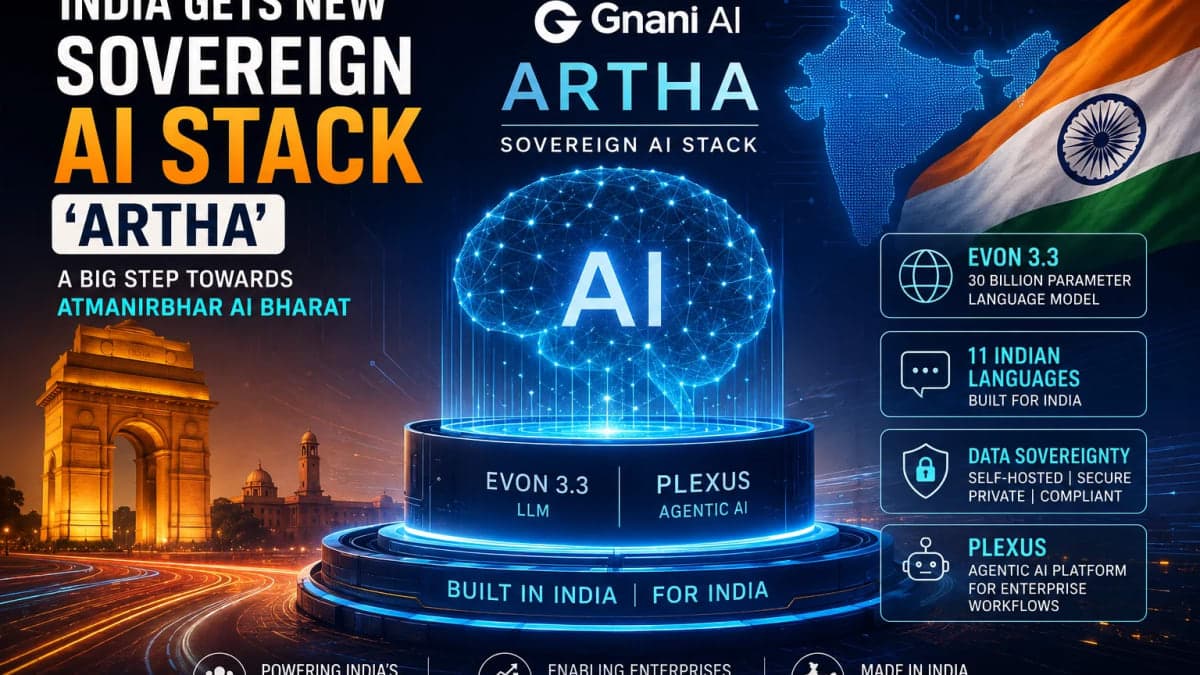
Artha primarily combines two major technology components—Evon 3.3 and Plexus. Evon 3.3 is a Large Language Model, while Plexus is an agentic AI platform designed to connect artificial intelligence with real-world enterprise workflows and institutional operations.
What Is Gnani Artha?
Artha has been developed not simply as another chatbot or standalone AI model, but as a broader sovereign AI stack.
Its objective is to provide Indian companies and public institutions with AI capabilities that can potentially operate within their own infrastructure.
This approach could be particularly important for sectors where sensitive information, regulatory compliance, data residency, and security are major priorities.
Banking, insurance, government services, and other regulated sectors could benefit from such an architecture because institutions may have the option to operate AI within their own data centres or private cloud environments.
Evon 3.3: A 30-Billion-Parameter AI Model
One of the central components of Artha is Evon 3.3, an open-weight language model with approximately 30 billion parameters and a focus on 11 Indian languages.
An important element of its architecture is that only around 3.5 billion parameters are active during a given task.
This Mixture-of-Experts approach can potentially improve computational efficiency by activating only the portions of the model required for a particular workload instead of using the entire model for every operation.
The model weights are being made available under the Apache 2.0 licence, giving organisations and developers greater flexibility to deploy, customise, and build upon the technology according to their requirements.
Special Focus on Indian Languages
India’s linguistic diversity remains one of the biggest challenges—and opportunities—for the country's AI ecosystem.
Many leading global AI models have historically been built around datasets and tokenisation systems with a strong English-language focus. India, however, requires AI systems capable of effectively handling multiple scripts, regional languages, and different linguistic contexts.
Gnani AI says it has optimised Evon 3.3’s tokenizer for Indian scripts.
According to the company, this can reduce the number of tokens required to process words in Indian languages, potentially improving both processing efficiency and response speed.
However, claims regarding performance, efficiency, and language capabilities will ultimately need to be evaluated through independent benchmarks and large-scale real-world deployments.
What Will Plexus Do?
The second major component of Artha is Plexus, an enterprise-focused agentic AI platform.
Conventional generative AI systems are often used to answer questions, analyse information, or generate content. Agentic AI aims to go further by handling multi-step tasks, connecting with different enterprise systems, and taking actions within predefined workflows.
Through Plexus, organisations could potentially connect multiple AI agents within a single workflow.
The platform can also incorporate controls involving human intervention, monitoring, audit logging, and governance.
Potential applications could include loan-document processing, transaction reconciliation, insurance underwriting, citizen grievance management, and other complex institutional workflows.
Why Is Sovereign AI Important for India?
Artificial intelligence is no longer limited to consumer-facing technology.
Its role is expanding rapidly across banking, healthcare, defence, education, governance, financial services, and several other strategically important sectors.
As AI becomes embedded in critical systems, a country's AI capability will not be determined simply by how many people use artificial intelligence applications.
Other questions are becoming equally important: Who controls the AI models? Where is the data processed? Can the technology be customised for local languages and requirements? And how much control do institutions have over their AI infrastructure?
These concerns are among the reasons why sovereign AI is receiving increasing attention in India.
Under the government’s IndiaAI Mission, efforts are underway to develop indigenous AI models, computing infrastructure, datasets, and India-specific applications.
The broader objective is to create an AI ecosystem that can better address India's languages, economic requirements, public services, and technological priorities.
Data Sovereignty Could Be a Major Strength for Artha
One of Artha’s potentially important features is its ability to support self-hosted deployment.
Banks, insurance companies, government departments, and other major institutions hold enormous quantities of sensitive information.
Sending customer or institutional data to external AI infrastructure can create concerns involving privacy, security, regulation, and compliance.
If an AI system can operate within an organisation’s own data centre or virtual private cloud, the institution may retain greater control over how its information is stored and processed.
For this reason, sovereign AI is not simply about building technology domestically. It is increasingly connected to data governance, regulatory compliance, cybersecurity, privacy, and operational control.
What Could Artha Change in India’s AI Competition?
Artha arrives at a time when India is seeking to position itself not merely as a consumer of foreign AI models but increasingly as a developer of artificial intelligence technology.
India’s massive population, linguistic diversity, rapidly expanding digital economy, and large-scale public digital infrastructure create a distinct opportunity for domestic AI companies.
If Indian AI models can effectively understand regional languages while maintaining competitive computing costs, they could potentially be deployed at scale across banking, government services, customer support, education, and other industries.
However, the challenge remains significant.
The success of a domestic AI model cannot be determined solely by its parameter count or initial benchmark results.
Reliability, security, reasoning capabilities, infrastructure costs, developer adoption, scalability, and successful enterprise deployments will ultimately determine whether it can compete effectively with global alternatives.
Balanced Analysis: A Promising Step, but the Real Test Comes Next
The launch of Gnani Artha represents an important development for India’s emerging sovereign AI ecosystem, but it would be premature to consider it a decisive breakthrough in the global AI race.
Evon 3.3’s focus on Indian languages and Artha’s self-hosted deployment model could make the platform attractive to Indian enterprises and institutions that require greater control over their data.
At the same time, major international AI ecosystems benefit from enormous computing resources, established developer communities, mature cloud infrastructure, and rapidly evolving frontier models.
Artha’s most meaningful test will therefore happen outside laboratory benchmarks—when banks, businesses, government departments, and public institutions begin deploying the technology for real-world workloads.
If the platform can deliver strong multilingual performance, competitive operating costs, robust security, reliable agentic workflows, and scalable enterprise deployments, Artha could become an important part of India’s journey toward greater technological independence in artificial intelligence.
This article is based on reporting published by The Economic Times.