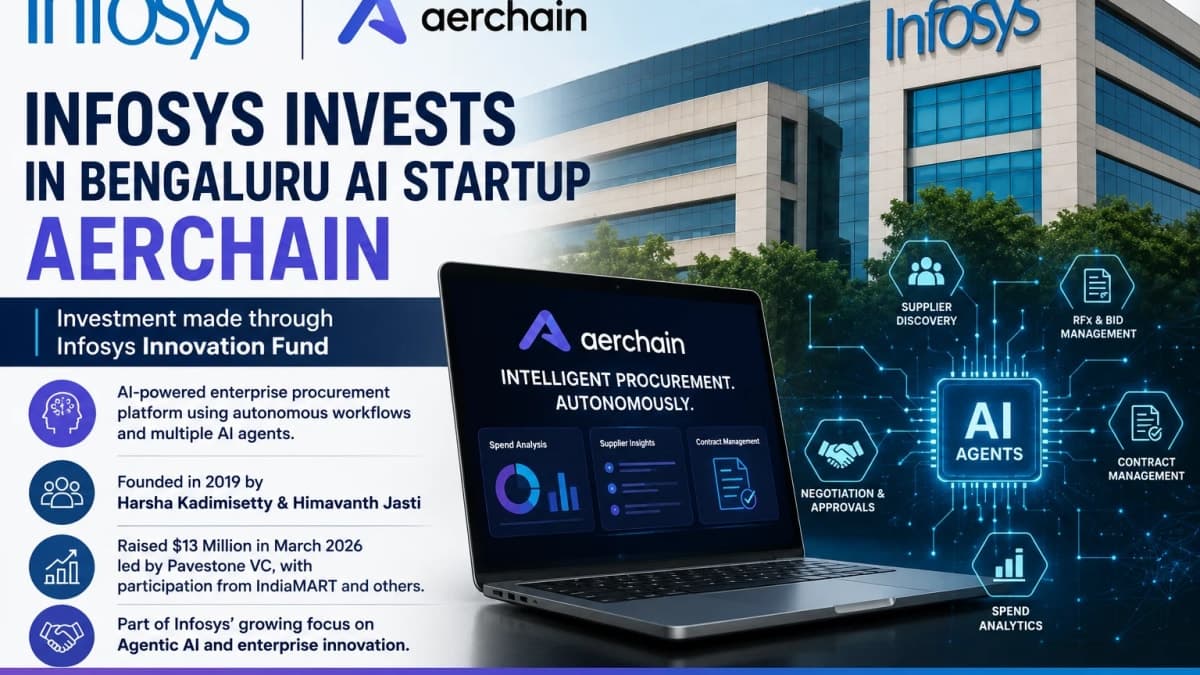
Infosys Backs Bengaluru AI Startup Aerchain
Indian IT services major Infosys has invested in Bengaluru-based artificial intelligence startup Aerchain, strengthening its exposure to the rapidly expanding market for AI-powered enterprise software.
The investment has been made through the Infosys Innovation Fund, the company's venture investment arm.
The financial value of the investment has not been publicly disclosed.
Aerchain operates in enterprise procurement, using artificial intelligence to help organisations automate and improve sourcing processes that traditionally require considerable manual work.
The investment comes as large technology companies increasingly explore how autonomous AI agents can move beyond generating information and begin performing specialised business tasks.
What Does Aerchain Do?
Aerchain describes itself as an AI-first enterprise procurement platform.
Its technology is designed to help businesses modernise sourcing through autonomous workflows and a multi-AI-agent framework.
In practical terms, procurement departments frequently deal with large volumes of suppliers, quotations, approvals, negotiations, contracts and spending information.
Automating parts of that process can potentially allow procurement teams to make decisions faster while reducing repetitive administrative work.
Aerchain's proposition is built around using AI to make these processes more automated and data-driven.
That puts the company at the intersection of two rapidly developing technology categories: enterprise software and agentic artificial intelligence.
Who Founded Aerchain?
Aerchain was founded in 2019 by Harsha Kadimisetty and Himavanth Jasti.
The startup is headquartered in Bengaluru, one of India's largest technology and startup hubs.
Rather than building a general-purpose consumer AI product, Aerchain has concentrated on a specialised business function.
That distinction is important.
A growing segment of the AI industry is shifting from broad conversational tools toward specialised systems designed to solve specific enterprise problems.
Procurement represents one such opportunity because large organisations can manage enormous supplier networks and substantial annual spending.
Even relatively small improvements in purchasing efficiency can potentially translate into meaningful financial savings for large businesses.
Aerchain Raised $13 Million Earlier in 2026
The Infosys investment follows another significant funding development for Aerchain.
In March 2026, the startup raised $13 million, approximately ₹118 crore, in a funding round led by Pavestone VC.
IndiaMART also participated alongside other investors.
The company had previously raised $3 million in a pre-Series A funding round in September 2021, co-led by IndiaMART and Season Two Ventures.
The latest backing from Infosys therefore adds a major Indian technology company to Aerchain's expanding investor ecosystem.
Why Infosys' Investment Matters
The significance of the transaction extends beyond the amount invested, which remains undisclosed.
Infosys works with large corporations around the world on technology modernisation, consulting and digital transformation.
Aerchain, meanwhile, is developing AI specifically for an enterprise operational function.
The strategic overlap is clear.
As corporations explore AI adoption, many are looking beyond standalone chatbots toward systems that can integrate with existing workflows and produce measurable operational improvements.
Procurement is particularly attractive because businesses can evaluate AI's effectiveness through outcomes such as process efficiency, sourcing speed and potential cost savings.
Backing a specialised company such as Aerchain gives Infosys exposure to innovation taking place outside its own internal development programmes.
Infosys Innovation Fund Behind the Investment
The investment was made through the Infosys Innovation Fund.
The fund was established in 2013 and its capital allocation was expanded to $500 million in 2015.
It has been used to invest in entrepreneurial ventures, startups and investment funds connected with technologies that could become strategically important to Infosys and its enterprise customers.
Its investment approach has generally included companies at relatively early stages, particularly around late Series A and Series B.
The fund's portfolio has included businesses operating across several emerging technology categories.
Backing Aerchain further demonstrates the growing importance of artificial intelligence within that strategy.
Infosys Has Been Increasing Its Exposure to Emerging AI Companies
Aerchain is not the only recent investment connected with Infosys' innovation strategy.
The Infosys Innovation Fund has recently backed other technology companies and investment platforms, including agentic AI startup NinjaTech AI.
This broader investment activity suggests Infosys is taking a portfolio approach to emerging technologies.
Instead of relying entirely on internally developed technology, strategic investments can give established companies access to specialised startups experimenting with new architectures and business models.
For startups, corporate investors can potentially offer more than capital.
Connections with large enterprise ecosystems can provide industry knowledge, market credibility and opportunities to understand the requirements of global corporations.
However, an investment by itself does not guarantee commercial partnerships or large-scale adoption.
Those outcomes depend on how the relationship develops.
Why Procurement Is Becoming an AI Opportunity
Enterprise procurement is often less visible to consumers than generative AI applications, but it represents a potentially significant commercial market.
Large organisations can purchase thousands of products and services from extensive supplier networks.
Procurement teams may need to compare bids, evaluate vendors, negotiate pricing, manage approvals, enforce internal policies and monitor spending.
Traditional enterprise software digitised many of these activities.
The next phase could involve AI systems taking a more active role.
Instead of merely displaying information, AI agents could potentially analyse requirements, identify suppliers, organise sourcing events and recommend decisions.
This transition from software as a passive tool toward software capable of executing tasks is one reason agentic AI has attracted significant enterprise interest.
India's Enterprise AI Ecosystem Is Expanding
The investment also reflects a broader shift within India's startup ecosystem.
The first wave of generative AI enthusiasm produced large numbers of consumer applications and conversational tools.
Attention is increasingly moving toward enterprise AI companies that can demonstrate clear business outcomes.
Startups building technology for finance, customer support, cybersecurity, software development, logistics, healthcare and procurement are competing to embed AI directly into business operations.
Bengaluru has become an important centre for many of these companies because of its combination of engineering talent, enterprise technology expertise and venture capital networks.
Aerchain's backing from Infosys adds another example of a large Indian technology company investing in specialised domestic AI innovation.
Balanced Analysis: Strategic Investment Does Not Remove Execution Risk
The Infosys investment provides Aerchain with strategic validation, but enterprise AI remains a highly competitive market.
Large software companies are rapidly integrating generative and agentic AI capabilities into their existing products.
Startups therefore need to demonstrate that their technology offers capabilities or efficiencies strong enough to compete with established enterprise platforms.
Procurement also involves sensitive corporate information.
AI systems operating in this environment must deal with issues including data security, reliability, regulatory compliance, system integration and human oversight.
Businesses are unlikely to hand important purchasing decisions entirely to autonomous software without strong safeguards.
Successful enterprise AI adoption will therefore depend not simply on how sophisticated the underlying models are, but on whether companies can integrate them safely into real-world business processes.
Human Plus AI Could Define the Next Stage of Procurement
One important theme surrounding Aerchain's technology is the combination of human expertise and artificial intelligence.
Procurement professionals make decisions involving more than numerical comparisons.
Supplier reliability, business relationships, geopolitical risk, quality standards and contractual requirements can all influence purchasing decisions.
AI can potentially process large quantities of information and automate repetitive tasks, while human professionals retain responsibility for strategic judgment.
The most successful procurement platforms may therefore be those that augment professionals rather than attempting to eliminate human involvement completely.
What the Infosys-Aerchain Investment Signals
The investment provides another indication of where enterprise AI development may be heading.
The industry's attention is gradually shifting from asking whether companies should use artificial intelligence toward identifying specific business processes where AI can create measurable value.
Procurement could become one of those areas.
For Aerchain, backing from Infosys adds a prominent strategic investor as the company seeks to expand its AI-powered procurement platform.
For Infosys, the investment creates another connection to the fast-developing ecosystem of specialised AI startups.
The ultimate significance of the deal will depend on whether Aerchain's technology can translate AI automation into sustained improvements for enterprise customers.
But the investment itself sends a clear signal: agentic AI is increasingly moving from experimental demonstrations toward specialised tools designed to participate directly in everyday business operations.
This article is based on reporting published by The Economic Times.